
War All The Time
Sun Tzu and Crisis Communications in an Age of Rapid Acceleration

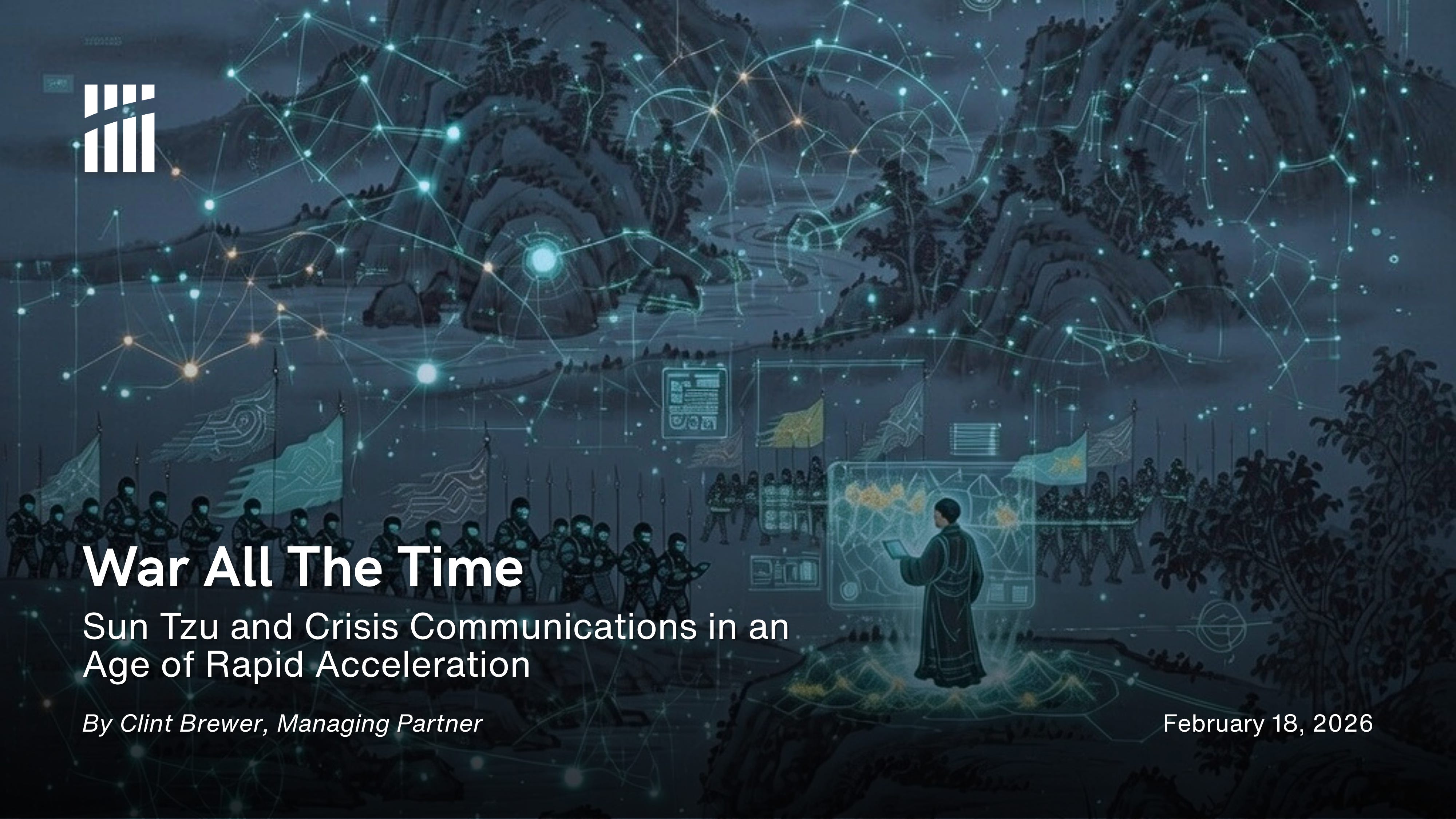
NOTE: While our regular Imperium Insights arrives on Fridays, we are breaking our usual cadence to release this special deep dive. The following essay, “War All The Time,” argues that in an era of rapid digital acceleration and narrative intelligence, leaders must stop viewing reputation management as a battle for headlines and start preparing for a permanent state of information warfare.
“Do not repeat the tactics which have gained you one victory but let your methods be regulated by the infinite variety of circumstances.” - The Art of War, Chapter V, “Energy”
Leaders across public and private sectors face the same challenges as the public when it comes to the rapid acceleration of information in our society. Determining fact from fiction online is a global, everyday problem. Doing so in the face of a perceived crisis then choosing how to react and whether to transition into an offensive, proactive posture is that much more difficult.
Sharpening the ability to discern what matters online, what is real, and whether to act or not will determine whether a crisis can be controlled and then if reputations can be preserved, protected, or salvaged.
Artificial intelligence is rightly presented as a seismic development in our evolution as a species. Given the reality gap in our newsfeeds, leaders might assume there is a complementary AI easy button for crisis communications, and by extension, crisis management. The truth is that AI presents both potential risk and reward for principals and organizations facing a crisis communication scenario.
The blinding pace of today’s accelerated communications environment and the deep, forever nature of information on the internet mandates leaders think about managing their overall communications efforts including crisis preparations and gaming for it more like war than a simple battle for headlines.
Practitioners are no longer just facing a cadre of reporters covering a given sector, but an army of social media accounts, conflict entrepreneurs, bots, and large language models (LLMs) that can end your crisis communication management effort before it begins. To fight an army, you must build your own or at least a meaningful counter insurgency.
Throughout history, advances in technology have seen pockets of humanity push back with retro techniques in business, war, and politics that short-circuit or circumvent the effectiveness of the latest technological advances. Scenarios that call for a crisis communications response from leaders require now more than ever a decidedly human driven decision-making tree. The trick is getting the mix of technology and human touch correct.
In Western business and culture, the ancient Chinese military strategist Sun Tzu has periodically been referenced and revered. His seminal text The Art of War has been referenced by coaches that have won Super Bowls and World Cups, titans of industry, and fictional characters as disparate as James Bond, Tony Soprano, and Gordon Gekko.
Tzu’s lessons are a roadmap for the modern communicator looking to master the breakneck, machine-driven speed of today’s communications landscape. Apply these four lessons from this 5th Century work to the multi-vector requirements of managing communications today.
Preparation, an Audience of One, and the Kobayashi Maru
“Victorious warriors win first and then go to war, while defeated warriors go to war first and then seek to win.” – Chapter 1, “Laying Plans”
Tzu stressed preparation almost above all else. Most battles are won, he argued, before they begin. That requires intense self-examination.
For leaders, communications professionals, and fixers, best practices for many years have called for rote preparation to message to media, partners, stakeholders, and the public including the use of crisis simulation. Canned talking points, holding statements, and tabletop exercises are not a substitute for having one’s house in order and holistic digital assets in place before the storm hits.
Few companies or causes have adjusted their digital strategy to address the reputational protection challenges and opportunities LLMs represent. Chatbots as the interpreter of fact and fiction online are now an Audience of One (AO1). People look to chatbots like ChatGPT, Gemini, and Claude to find facts and truth rather than sifting through web pages driven by Google search results.
Impacting what LLMs return for inquires requires companies to chase Generative Engine Optimization (GEO) rather than Search Engine Optimization (SEO). GEO is driven by domain authority and the portable nature of messaging rather than just being sharp or loud. Digital information must be adaptable to multiple styles of queries online. Under SEO, the message was fixed and the audience adapted. With GEO, the audience is fixed, and the message adapts.
Leaders should inventory their organization’s domain authority and the depth and nuance of the information they are publishing across all owned channels. Backloading websites with FAQs, fact sheets, and company manifestos is crucial to impacting the answers LLMs give users. Standing up a full GEO driven content strategy is now imperative so that in a crisis your reputation online is established, pushed forward in LLM responses to queries, and less malleable once a crisis begins.
The advantage of AO1 is that a digital wall can be built to protect from reputational damage in a crisis by investing in GEO and advanced content techniques. This is also an approach to be employed for the day-to-day act of building a brand. If your message is established, thorough, and searchable, then LLM inquiries can help defend reputation by making it less subject to attack.
Similarly, leaders need to make a ruthless assessment of their own organization’s owned channels to plumb for gaps. Many crisis simulations force communicators sitting around the table to play under the assumption that adequate assets are in place to make the right moves in the moment. That is rarely the case. Use crisis simulations to instead identify disconnects.
Is our database of stakeholders truly built out or are key players’ information still trapped in the C-Suite’s phones?
Have we invested in building audience through our social media channels so that we can quickly communicate to the public, or did that get cut in the budget?
Do we need a Substack page or subreddit to increase our own domain authority?
How many people can we immediately touch with our own message in a time of crisis without relying on the filter of legacy media?
Here is a very difficult proposition. Gamify your crisis simulations exercises so that failure is the only option.
We assist clients with a crisis simulation we call the Kobayashi Maru. It is a no-win crisis communication scenario involving media, legal, regulatory, and financial pressures named for the training test from the Star Trek movies. In the films, a ship’s captain was faced with a no-win scenario in battle where the only outcome was death.
We learn more from defeat than victory. How do leaders perform when they know they will in some respect lose? What becomes a priority when operational excellence fails, and a reputational hit is certain? Can you triage failure and find a path forward?
Pressure test your system and find the gaps. Understand the new internet and prepare.
Espionage and your Tech Stack
“If you know the enemy and know yourself, you need not fear the result of a hundred battles.” Chapter III, “Attack by Stratagem”
Next to preparation, Tzu believed in the use of spies and espionage and considered it crucial to success in warfare. He saw it as an enabling condition of victory.
Tzu couched his views on warfare through the lens of state economics. Generals must be mindful of the state’s resources to field an army and sustain it for a prolonged campaign – which he discouraged.
Espionage and resulting intelligence added value in two ways. First, spies and intelligence gathering are inexpensive compared to the cost of fielding an army. Second, intelligence allowed generals not to overcommit or take unnecessary actions. Intelligence makes room for restraint.
This touches on Tzu’s most famous line from the text.
“All warfare is based on deception.”
Today’s once unimaginable cascade of digital information presents the repeated risk of suffering from intentional and unintentional deception in the teeth of a communications crisis.
It is very easy for leaders to be deceived by what they see online in a crisis. Principals too often react to single posts from lone voices that touch a nerve but can miss whether the viewpoint is a prevailing sentiment or just low-level noise.
Again, it is about understanding what is real and what is not online, not only in terms of facts and information but also whether online content or commentary represents an actual threat in a crisis or just a nuisance. The standard today in most companies and PR shops is to measure harmful or inaccurate online sentiment in terms of volume or heat – is it being reposted and is it spreading? Those are still very valid factors to consider.
The new frontier in closing the information reality gap is narrative intelligence: tools that allow users to track conversations online. Narrative intelligence gives leaders a predictive tool allowing them to see what narratives exist, who is having the conversation and where, and how those narratives may spread and evolve.
Even more cutting edge are newer tools that allow users to see what queries are being asked of LLMs. They map what chatbots are being asked about a company, brand, cause, or issue and what answers the chatbots are giving. Similarly, they track the same information for competitors or opponents. The idea is to gather intelligence on how to improve your company or cause’s narrative via the answers LLMs give to queries – including during a crisis.
Better intelligence during any communications effort is crucial given the massive amount of messaging that can erupt with no notice. Having the right tools in your company’s tech stack to hear conversations, understand how they are spreading, and having the facts to make solid decisions about response is critical.
That of course comes down to budget. Dollars can be tight in any organizational setting. How much would an organization pay to keep a crisis from happening? How much is that spend versus fighting off a crisis for months or even years?
Since the 5th Century, Tzu’s posit that spies are cheaper than armies has never proven wrong.
Energy, Audience, & Kuzushi
“When the enemy rushes forward, take his strength away; when he retreats, pursue him.” - Chapter VII, “Maneuvering”
Even the best preparation and intelligence will not prepare leaders and organizations for every communications challenge. Threats and reputational risk can blow up like an unexpected storm. Companies and causes face fast-moving currents in media, legal, cultural, and regulatory landscapes constantly.
The rapid acceleration of information gives operators increasingly less time to respond. This is where judgement and human intuition take over, and shrewd comms teams will need to call the plays. It summons another famous line from Tzu’s text:
“On desperate ground, fight.”
Our current culture’s information flow rewards force and aggression given that online communication is not an arena where subtlety is often successful. Confrontation is met with confrontation. Leaders are eager to get “on the front foot,” pressing for forceful response in the face of attack. Our own national politics is a daily proving ground for this kind of approach.
Tzu devotes an entire chapter to the concept of energy, offering that there are two types of action, direct and indirect. Direct force creates commitment while indirect force exploits commitment. Tzu’s concept of energy in the context of modern communications should be viewed as a function of how to use audiences.
What is often overlooked in a crisis is how to use the opposition’s audience. This is where indirect energy is useful. Can the commitment of the opposition to an attack be used against them to cause imbalance? Can you co-opt their audience through message, voice and creativity to knock them off their center? The answer is almost always yes.
Imagine the doomsday scenario online where the politician, influencer, or celebrity that matters most to your situation suddenly becomes an adversary. A damaging Tweet or statement is launched and suddenly, your sales, regulatory status, or electability are all in flux. Holding statements suddenly are pulled out of proverbial desk drawers. Prior crisis simulations seem underwhelming. Board members are blowing up the C-Suite’s phones.
Use your opponent’s audience to amplify your response. They’ve given it to you.
Dive into your response not just on your own channels but on their channels as well. Speak directly to the source and challenge the claim if it is untrue, unfair, or wildly out of context. Remain tactful but firm, businesslike but real. Take the audience they are giving you and use their own megaphone to message back to the people they are communicating to and the media that are listening. Get your own side of the story out using the opponent’s momentum against them.
Sports provides examples of this tactic in abundance. Floyd Mayweather was arguably the greatest pound-for-pound boxer of all time, and he was primarily a defensive fighter. Real Madrid is perhaps the greatest dynasty in the history of sports, and the club’s incredible tenure at the top of the Champion’s League was built on counter attacking.
Some 2,400 years after Sun Tzu lived, Judo was created in Japan in 1882. A primary concept in Judo is Kuzushi, or the art of using an opponent’s weight and momentum against them. You let the opponent supply the force. Using their momentum, you then use that force against them. Though millennia apart, the Japanese were dialed in to Tzu’s concept of indirect force. And now, so is the internet.
Deliberate Inaction & The Art of Doing Nothing
“If it is not advantageous, do not move. If an objective cannot be attained, do not employ the army.” – Chapter VIII, “Variations in Tactics”
This lesson is perhaps the simplest to understand but the most incongruous to today’s culture. In a crisis or perceived crisis, sometimes the answer is to do nothing.
Tzu continuously stresses that action is conditional but not continuous. The idea is that movement must be motivated by obtaining or preserving advantage. Calm is a prerequisite for perception and control. Acting out of haste and without intent gives away the advantage.
One way to use these concepts in a world where speed, noise, and volume are rewarded in the moment by the online mob is to fold in the previous lesson about momentum. Just as a leader can use the momentum of the opposition against them, an organization’s momentum expelled needlessly can also be used to take away its advantage.
In the spirit of retro techniques, this goes back to the age-old concept of the one-day news story.
Your principal is attacked, and they get in their feelings about it. They are spoiling for a fight, and they want to respond. They need to respond. Is this tactical or emotional? Most often, it is emotional.
Whether it is a news story or an online post, an attack must be assessed for its net effect and long-term effectiveness, not the emotions it generates in the moment. Does it benefit your company or cause to respond? What do you get from it? What does the opposition get from it? Are you elevating a voice by getting down in the mud and rolling around with them?
We once were retained by a client due to a crisis communications scenario where his company was hit with a glancing blow in a news story during a political campaign. The client was incidental to the campaign but was called out directly. After looking at the players involved, the audience engaged by the coverage, and the messaging’s lack of viral spread we told them to do nothing. We got a very sharp response.
Client: “I’m paying you all this money to tell me to do nothing?”
Imperium: “Yes.”
There were actions behind the scenes including putting touches on key stakeholders and customers, having internal discussion with partners about the coverage, and tracking the online noise or lack thereof. But publicly, we responded to a perceived crisis by doing nothing. And the crisis went away quickly.
General inaction in the face of a crisis is not good, but deliberate inaction can save your side a lot of time and reputational risk. Deliberate inaction is a form of decision making the prioritizes reason and preserves advantage. The luxury of deliberate inaction is only created through preparation, gathered intelligence, and understanding momentum.
Suggested Reading:
The Art of War by Sun Tzu (deluxe hardcover edition) - Amazon
China Turns to AI in Information Warfare - New York Times
Cognitive Warfare: An Allied Blueprint and a Pentagon Opportunity – Small Wars Journal
‘We Can Bury Anyone’: Inside a Hollywood Smear Machine – New York Times
The RAV3N Report: 2026 State of Disinformation Narrative Intelligence – Blackbird.ai

Connect with Imperium
Imperium Public Strategies is a public affairs consultancy in Nashville, Tennessee with an office in DC, providing private and public sector clients with the strategies and services to advance agendas, shape public policy, and drive their narratives.
We specialize in a multi-disciplined approach spanning public relations, government relations, campaigns, and best-in-class digital tools. Imperium gives our clients the strategic counsel to thrive and succeed in a rapidly changing world. Our core capabilities include strategic counsel, campaigns, government affairs, and communications and digital media.
The dynamics of power never stop shifting. Stay ahead of the curve by subscribing to Imperium Insights for our weekly analysis, and follow us on X and LinkedIn for real-time updates on policy, technology, and leadership.