



The United States isn’t drifting into change. It’s being dragged into it.
Artificial intelligence is reshaping labor faster than policy can follow. Supply chains are being rewired under geopolitical pressure. Energy demand is spiking. Healthcare is brittle and expensive. Education systems, in too many places, are still calibrated for an economy that no longer exists.
The question facing state governments isn’t whether change is coming. It’s whether they’re built to survive it.
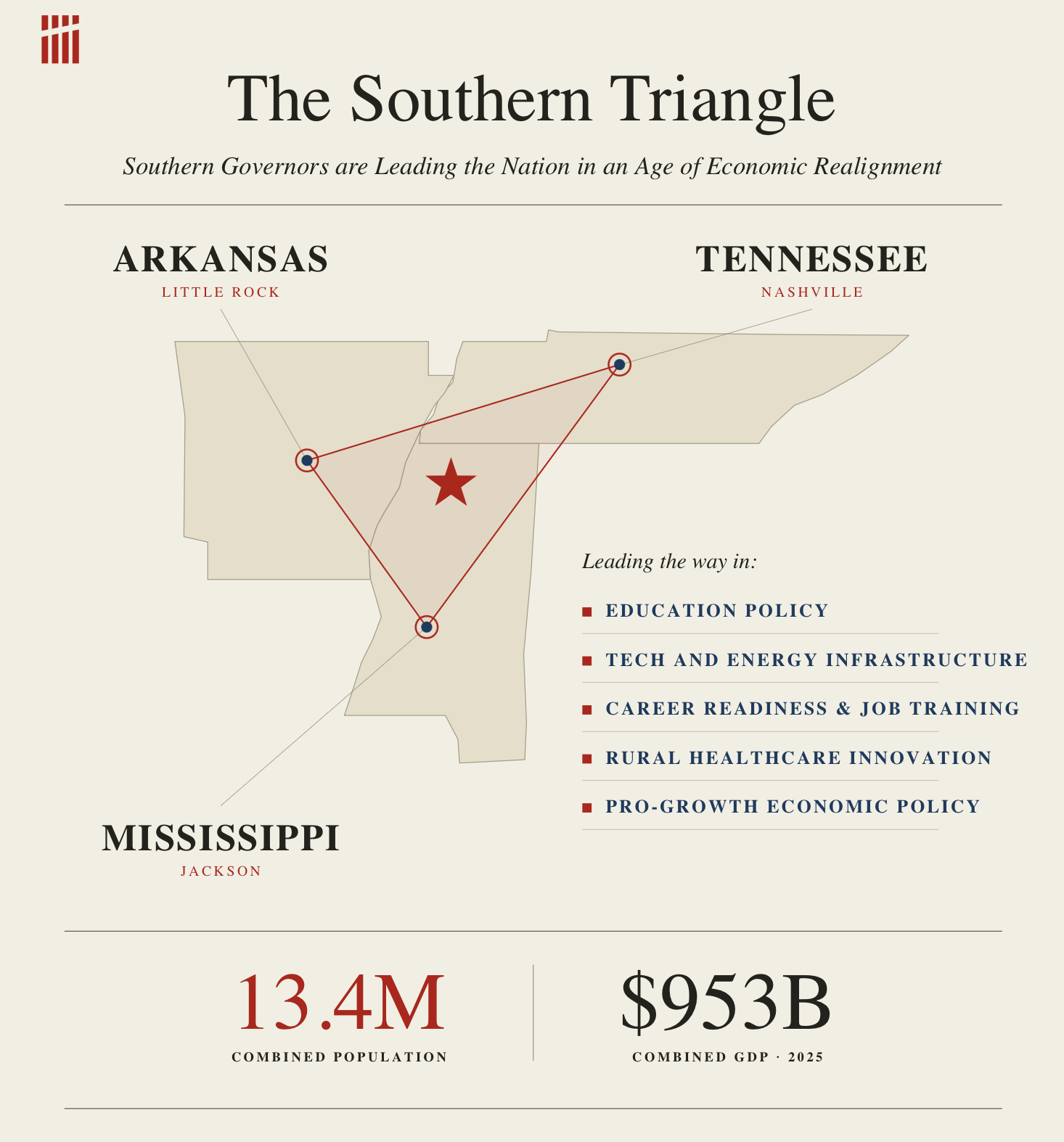
In a triangle that runs from Tennessee to Arkansas to Mississippi, the answer is increasingly yes. These states moved to the front of the line on five things that determine long-term competitiveness:
Education systems producing measurable gains in literacy and workforce readiness.
Integrating artificial intelligence rather than running from it.
Economic development programs that de-risk investment.
Healthcare solutions for rural residents that embrace innovation.
Building new energy capacity to embrace the new normal.
The governing challenge in each state was different, but the discipline required was the same. Governor Bill Lee inherited a Tennessee already in motion under Governor Haslam, along with a seasoned conservative legislature led by Speaker Cameron Sexton and Lieutenant Governor Randy McNally, and accelerated it. Governor Tate Reeves and Governor Sarah Huckabee-Sanders stepped into states long written off as structurally behind — bottom of the rankings on education, health, and workforce readiness — and forced a reversal few expected to see.
Across all three administrations, a similar governing instinct has taken hold. Legacy systems are being challenged rather than protected, and longstanding assumptions about education, workforce development, healthcare, and economic growth are being tested rather than accepted. The result is an emerging southern triangle that has become one of the country’s most consequential laboratories for state-level reform.
Education: Results or Irrelevance
Tax cuts and big economic development announcements matter. But for most parents in the triangle, the item at the top of their scorecard is simpler: are their kids being prepared for the future they’re walking into?
The clearest proof point sits in the place almost no one expected it: Mississippi.
The “Mississippi Miracle” as it has become known isn’t a miracle. It’s a method executed under pressure. The state’s Literacy-Based Promotion Act imposed phonics-based instruction, enforced a third-grade reading gate, and deployed literacy coaches with one objective: get students reading on time or intervene until they can.
Mississippi moved from the bottom of fourth-grade reading rankings in 2013 to the top tier by 2024 and now leads the nation. Even Rahm Emanuel, a Democrat and likely 2028 presidential contender, pointed to Mississippi’s literacy reforms in the Wall Street Journal as a model worth following nationally.
Tennessee and Arkansas applied the same premise in different ways. Tennessee’s Literacy Success Act doubled down on early reading and accountability, requiring science-of-reading instruction statewide and backing it with real consequences. It sits alongside Tennessee Promise and Tennessee Reconnect, free community and technical college programs that create a direct bridge from education to employment. Arkansas chose disruption through the LEARNS Act, raising teacher pay to a $50,000 minimum, expanding school choice statewide, and introducing competitive pressure into a system that had grown comfortable with uneven results.
These policies are forward-looking because they accept a reality most systems still won’t face head-on: the labor market doesn’t reward time spent in school, it rewards skills delivered on time.
Literacy targets aren’t feel‑good social aspirations; they’re an economic threshold. When school systems miss them, they produce workers who can’t compete. When they continually hit them, those gains stack year after year in earnings, productivity, and mobility.
Technology and AI: Where the Value Lands
Artificial intelligence is being treated as a philosophical problem in much of the country. In the southern triangle, it’s being treated as a logistical one, and that distinction determines who captures value.
Arkansas built an AI & Analytics Center of Excellence to embed AI into state operations and workforce training. Mississippi has been mapping AI use cases across agencies to move quickly from concept to deployment, using automation where it frees people to do higher-value work. Tennessee tied its technology posture directly to workforce and industrial strategy through GIVE and related initiatives, aligning training programs with the needs of advanced manufacturers, logistics firms, and data-heavy industries.
Data centers and AI infrastructure already account for a portion of U.S. electricity consumption, and that demand is expected to rise by 2030. That growth is tied to physical infrastructure — servers, cooling, grid capacity, land, and water — and it requires a workforce that can maintain it and a regulatory environment that can move at the speed of capital.
The triangle isn’t trying to lead the invention of AI models; it’s positioning itself to host the infrastructure that runs them. That’s where the capital lands, where the long-term jobs sit, and where enduring economic leverage is built. As coastal states run out of both power and patience for data centers, the South’s choosing to build more of each.
Economic Development and Jobs: Remove Friction, Capture Capital
The Southern economic model has evolved from a reliance on low-cost labor and welcoming regulatory environments into something more durable that aligns taxes, workforce, infrastructure, and permitting systems around growth.
Tennessee completed the repeal of its remaining tax on investment income and leaned fully into its no-income-tax advantage. Arkansas has repeatedly reduced individual and corporate income tax rates under Governor Sanders. Mississippi has passed a phased repeal of its income tax under Governor Reeves. These states are making a long-term bet that growth, investment, and population gains will generate more durable prosperity than higher tax rates on a stagnant base.
The strategy extends beyond tax policy. Economic development incentives are paired with workforce investments, infrastructure improvements, and site readiness efforts designed to shorten the distance between a company’s interest and a company’s decision. The objective is to de-risk site decisions, accelerate timelines, and make investment easier.
The results are in — since 2020, Southern states have captured nearly two‑thirds of all net new jobs added in the United States, with Tennessee, Arkansas, and Mississippi pulling above their historical weight in that trend. Multiple Southern states are posting GDP growth rates around or above 4%, which is roughly 35% higher than the national average.
At the same time, left-leaning national outlets are pushing Tennessee and Arkansas down the league tables on their lists of the “worst states to live in,” even as people and employers keep moving there. Outlets like CNBC build their quality‑of‑life scores around a progressive policy checklist — with “inclusiveness” and reproductive rights weighted alongside crime and healthcare — so states that don’t look like Massachusetts on social policy are going to get punished, no matter what their job growth, tax environment, or migration numbers say. The triangle is telling a different story: Tennessee has posted one of the largest population increases in the country, adding roughly 64,000 residents in the last year alone, while Arkansas has led the nation in inbound moves, with nearly seven out of ten relocations headed into the state rather than out. People and capital are voting with their feet, even if rankings built around a left‑leaning scorecard haven’t caught up yet.
Each state’s economic development model removes friction. Mississippi’s Advantage Mississippi program prepares industrial sites before companies arrive, so the clock starts on day one instead of year two. In Tennessee, conservative leadership overhauled the state’s incentive toolbox — linking infrastructure support, capital project funds, and workforce training into a more transparent, faster‑moving package that delivers real value to companies relocating or expanding to the state. Recent investments from companies like Oracle’s $4.5 billion Tennessee campus and Korea Zinc’s $6.6 billion advanced manufacturing commitment — supported by performance‑based incentive agreements tied to thousands of high‑wage jobs — are visible examples of that strategy in action.
Arkansas’s Arkansas Forward initiative compresses permitting timelines that, in other states, can stretch into a multi‑year attrition exercise. Governor Reeves blocked legislation that would’ve added procurement layers to healthcare spending and put more than a billion dollars in federal funding at risk. Lawmakers didn’t override the veto.
Delay is a cost. Bureaucracy is a cost. In a competitive market, those costs decide who wins the projects and who reads about them in the paper. The conservative leadership in this economic triangle has been focused on clearing obstacles so capital can be deployed to drive growth, and their residents are seeing the benefit.
Workforce and Healthcare: Closing the Gap
The American workforce system is built around separation. K–12 in one bucket. Higher education in another. Training is on a different track. Employers somewhere else entirely. That separation no longer works in a labor market defined by scarcity and speed.
The triangle is collapsing that distance. Tennessee's Colleges of Applied Technology operate as direct extensions of industry demand — programs are built with employers, not around them. That approach didn't begin with one administration. Governor Haslam launched Drive to 55, put entrepreneur Randy Boyd in charge of the execution, and built Tennessee Promise and Tennessee Reconnect into national models for tuition-free credentialing. Boyd now leads the University of Tennessee system, bringing that same workforce-first philosophy to the state's flagship higher education network. Governor Lee added the GIVE initiative — his first legislative priority — pushing more than $100 million into career and technical education, especially in rural and distressed counties, tying workforce pipelines directly to employer demand and to the advanced-industry projects the state is recruiting.
Mississippi has aligned community colleges with employers through initiatives like Mississippi Works and sector partnerships that design programs around specific industries — advanced manufacturing, logistics, healthcare. Arkansas’s 10:33 Initiative and related efforts recognize that transportation, childcare, and healthcare access often determine whether training turns into employment.
Healthcare’s under the same pressure, especially in rural areas where closures and workforce shortages are hardest to hide. Mississippi’s participation in the Rural Health Transformation Program is designed to test new delivery models that move beyond the assumption that every community must be anchored by a full-service hospital. Tennessee’s deploying significant federal and state resources through its Rural Health Care Task Force, expanding workforce pipelines and building out distributed care models that use clinics, telehealth, and community-based services. Arkansas is targeting structural weak points through reforms focused on maternal health, pharmacy access, and sustaining care in underserved areas.
Forward-looking policy in both workforce and healthcare starts from the same reality: the current models can’t simply be scaled. They must be adapted under real-world constraints by rethinking where services are delivered, who delivers them, and how they connect back to work. Education showed that targeted policy shifts can produce measurable gains over a decade. Workforce and healthcare are now on the clock.
Energy: Build or Fall Behind
Energy’s the constraint that will define the next decade of competitiveness. AI, data centers, and advanced manufacturing are driving electricity demand that can’t be met with existing infrastructure. States either build enough capacity to meet that demand or watch the investment go somewhere else.
Tennessee government is working with the Tennessee Valley Authority to explore next-generation nuclear, including small modular reactors. Mississippi is aligning energy policy directly with industrial recruitment, emphasizing reliability and cost stability in its pitch to manufacturers and data-intensive firms. Arkansas is treating energy availability and pricing as core components of its economic strategy, not siloing utilities policy.
The region has already shown it can deliver, as Georgia did with its nuclear capacity at Plant Vogtle. At the same time, estimates suggest data centers could consume close to 10 percent of total U.S. electricity by 2030. That’s a meaningful shift, not a blip, and it won’t be managed by asking people to turn off lights.
States that can meet demand will capture growth. States that can’t will talk about it while projects go elsewhere. The triangle’s choosing to build capacity in advance rather than scramble to catch up.
What Comes Next
The South still faces structural challenges. Median household income in states like Arkansas and Mississippi still trails the national average by a wide margin, and health outcomes remain uneven across regions. Growth isn’t evenly distributed, and the work isn’t finished.
What’s different now is the direction of momentum — and the willingness to commit to a new path. These states are reshaping education, workforce development, healthcare, energy, and economic policy around the demands of a changing economy at a pace that stands out nationally. The emphasis has been on execution, adaptation, and a willingness to challenge assumptions that no longer fit the moment.
For most families, the stakes aren’t abstract. The question is whether their kids can build a life where they grew up without having to leave for opportunity somewhere else. Education gains determine whether that’s possible. Workforce, healthcare, and energy decisions determine whether it lasts. As the same discipline that produced Mississippi’s literacy gains, Tennessee’s workforce pipelines, and Arkansas’s education reforms shows up in these other systems, the impact won’t just be visible in rankings. It will become even more visible in paychecks and population trends.
This economic triangle is building a place where parents can reasonably believe their children’s futures will be better than their own — and where that belief is backed by policy, not just optimism. The rest of the country will have to decide whether to match that pace or explain to their own voters why they chose not to.
