

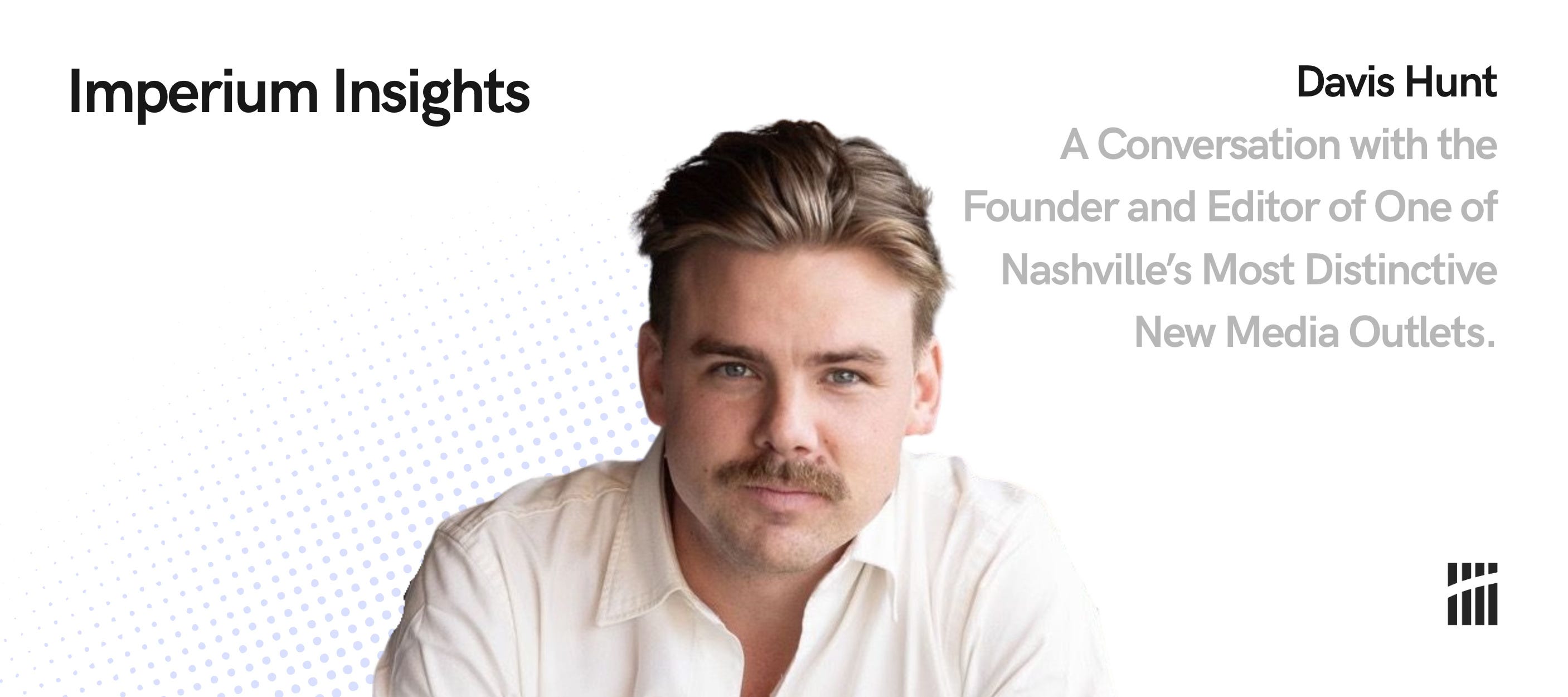
Davis Hunt didn’t come to journalism through a newsroom.
A Nashville native with a background in technology and entertainment, Hunt’s interest in local media began after college when he moved to Palo Alto, California, for work. Knowing almost no one, he started reading the local newspaper as a way to understand his new surroundings. He became fascinated by the small political disputes, civic controversies and neighborhood issues that made up the daily life of a place.
That interest followed him back to Nashville and eventually became The Pamphleteer, the alternative digital publication Hunt founded in 2021 and now serves as editor-in-chief and publisher.
The Pamphleteer occupies an unusual place in Nashville’s media ecosystem. It covers Metro government, politics, development and public policy, but mixes that reporting with culture, commentary, humor and an unapologetically distinct point of view. Hunt describes himself as a conservative and Republican, but he is less interested in attaching an ideological label to the publication than in offering a perspective he believes is largely absent from Nashville’s traditional media.
More importantly, Hunt wants The Pamphleteer to reach people who do not work in politics.
At a time when local journalism across the country is shrinking and national politics consumes an increasing share of Americans’ attention, Hunt sees an opportunity to make local government accessible — and interesting — to citizens who might otherwise ignore it. The publication has expanded beyond its daily newsletter into events, podcasts and Council Watch, a digital tool designed to make the sprawling 40-member Metro Council easier for citizens to understand.
Five years into the experiment, Hunt has also developed some contrarian views about the future of independent media. He believes trust in individual influencers may have already peaked, that institutions and mastheads could make a comeback, and that local journalism’s biggest problem is not necessarily a lack of information. It is that local news is competing against a vastly more entertaining national media environment.
Imperium sat down with Hunt to talk about building The Pamphleteer, the economics of independent journalism, the future of media and what it means to be a Southerner in a city transformed by growth.
This is a transcript of our conversation, lightly edited for length and clarity.
Clint Brewer: You’re a Nashville native, but you came out of technology rather than journalism. What made a daily newsletter the thing you wanted to build when you started The Pamphleteer in 2021?
Davis Hunt: I’ve had a long fascination with local media that started with my first job out of college, which was in Palo Alto, California. I was getting acclimated to the area. I didn’t know anyone, so I started reading the local newspaper.
Weirdly, it felt kind of exotic reading about the little quibbles of Palo Alto, California. I became fascinated with this idea that there was this whole world that most people completely ignore at this point. There’s a lot of activity happening at the local level that is basically invisible to most people.
That was in 2014. I became interested in local journalism, and I ended up back in Nashville in 2015 and started playing around with it. I had a music calendar that I ran called ShowGrid, and that evolved into another blog and newsletter called the Nashville Note. It was a combination event calendar plus blogging about local politics. This was around the time Megan Barry was mayor and the transit referendum was a big issue, so it was an interesting time.
I did that for probably a year or two, and then I got bored with it because it wasn’t profitable. I went off and got involved in the entertainment industry, which put me out in Los Angeles until 2020. When I moved back to Nashville in 2020 because COVID shut down all the entertainment stuff, I got introduced to some people who were interested in local media and playing around in it. It sparked this old interest that I had. I raised a little bit of money and went from there.
CB: For readers who aren’t familiar with your work, explain The Pamphleteer. What’s the elevator pitch or the value proposition to readers in the community?
DH: The Pamphleteer was influenced by the alt-weekly — the mix of culture and politics, a certain amount of irreverence and covering things from an angle that other publications, maybe more respectable publications, may not be willing to cover.
It was also about saying things that are patently obvious and not being afraid of violating some social decorum. As the publication has matured, we do less of that, and it’s more deliberate than it was in the past. But the origins of it were very much about looking at Nashville from a different perspective.
The motivation for doing The Pamphleteer and playing in local media is that I think it’s very important to have opposing viewpoints hashing it out in public. The Pamphleteer represents a distinct viewpoint that, in my view, is absent from the other media outlets in town. Introducing a certain amount of perspective and narrative diversity to public conversations around issues is good and healthy for a city. We should be hashing these things out publicly, and local journalism is a great avenue to do that.
CB: My next question was going to be about the gap in the market that made you want to launch it, but it sounds like part of that was a viewpoint you didn’t think was being represented. What was that viewpoint? How would you describe the gap you were trying to fill?
DH: The gap in the market, to be more specific about it, is that local media options also tend to be reflective of an insider’s view of local politics. If you work in and around city politics and Metro Nashville, probably part of your job is staying abreast of developments within city government. But there wasn’t a populist — or more populist — publication talking about city politics. I wanted to increase the net number of people who were interested in Nashville city politics.
I didn’t feel like any of the other publications in town were effective at doing that. In fact, it feels to some extent like a lot of them prefer to have their small, very concentrated readership rather than try to appeal more broadly to citizens who may not be as engaged in the political process.
CB: So, you’re writing about government more for the non-practitioner — the citizen — rather than the participant?
DH: Yes, very much so. In Nashville, about 20 percent of the city votes in city elections. You get around 40 percent in midterm elections and 60 percent in presidential elections. I think that’s a huge issue from a civic engagement perspective.
To say nothing of the fact that the city elections happen in odd years. The next one is just at this seemingly random time in August 2027. You just don’t have enough people engaged, and it’s intimidating to approach this stuff.
We wanted to be the front door — the top of the funnel — to engaging in civic politics. Part of the way we do that is through humor when appropriate, trying to be lighthearted about it and trying to dumb it down in a way that doesn’t paper over the complexity. That’s the challenge of it, basically.
CB: I’ve heard The Pamphleteer referred to as conservative media. Do you think that’s fair? Is that an accurate description of what you do?
DH: I mean, I’m a Republican, right? Megan and I are probably the only Republican journalists covering Nashville city politics. We’re absolutely conservative. That’s our worldview. It leaks into the publication. Because we’re focused on city politics, a lot of the issues don’t have the kind of political valence that state or national-level issues do. But yes, we’re absolutely conservatives. Conservatives tend to like us.
At the same time, I don’t like to label things. I wouldn’t want to label us overtly as a conservative publication. We’re inherently conservative because the people involved in the business are conservative, and that just expresses itself naturally. So, it’s a complicated answer to that question.
CB: When you started, Nashville was in the middle of this extraordinary period of growth. How much did the Nashville boom inform the direction of The Pamphleteer in the early days?
DH: Right when we started was basically as the ink was drying on the Oracle deal. That was one of the first things I wrote about. We were also in the middle of COVID. This was March or April of 2021.
Naturally, over these five years, a lot has changed. Even my own perspective on growth has changed. How do you reconcile the desire to attract people to the city who buy into it and get them to want to invest in it, while also admitting that growth is inevitable and largely outside of your control?
The growth thing is interesting. At the beginning, we were very - almost comically - resistant to it. I remember making fun of the Oracle development and the way John Cooper was selling it. I thought it was kind of ham-handed and corny.
But the more I think about it, the more I observe city politics and the more I think about what a city is and who it serves, the more positively I think about economic development and things like Oracle relocating here. I think it’s great. If you have a family and you want to stay in Nashville, it’s very important to have employers that will hire your kids long term. That’s a perspective that has become more mature in my head over the past year in particular.
But part of the reason, from the genesis of The Pamphleteer, that I thought this would be fun to work on was Nashville’s explosive growth. It’s still got a reputation nationally, and it’s a desirable place to visit and live. There’s no reason we can’t expect more from our government and from these things. It felt like a really worthy cause to spend my time on.
CB: Nationally, independent media has displaced a lot of legacy gatekeepers. Podcasts, newsletters and X are displacing a lot of traditional media voices at the national level. Does that same pattern hold at the local level, or is local media fundamentally different somehow?
DH: You see a lot of local influencers across Facebook and Instagram. Twitter is a little different, but on Facebook and Instagram there are a lot of independent influencers who might do content about new restaurants in town, summaries of news stories, development stories and things like that.
The independent journalism and independent things that have popped up locally tend to be less political and more newsy, as opposed to the national level, where independent media producers are extremely political without compunction. You don’t see a lot of independent media people locally who seem to be serious about their business getting very political.
CB: A lot of audiences increasingly seem to trust individuals over institutions. Do you think that shift is going to stick, or is it a phase that ends once independent personalities start behaving like the institutions they displaced?
DH: I think we’ve witnessed peak individual independent influencer trust factor, and we’re on the downslope from there. I think you’ll start to see institutions enter the picture again. I don’t know exactly how it’s going to look, but maybe it’s bundling up these influencers and putting them under a masthead, or some kind of certification that an influencer is associated with a reputable organization. I think that is increasingly going to become a way to filter people out.
Things have just gotten so crazy with independent influencers, and some of them are based here in Nashville. You look at a list of the most-listened-to podcasts and Theo Von is based here, Candace Owens is here, Shawn Ryan, Bussin’ With The Boys. There are a ton.
On the political side, there are kind of two sides of it. You’ve got people like Bussin’ With The Boys, which is entertainment or infotainment, because they veer into some political opining. Then you’ve got something like what Tucker Carlson does, which deliberately has a political bent to it. I think the latter will fall out of fashion. That’s my prediction.
CB: The attention economy pulls everybody toward national politics. The stakes seem bigger and the personalities are bigger. But local government is actually where an individual reader or voter has far more leverage. How do you fight that gravity as a local publication?
DH: I describe it as being an indie movie going up against a blockbuster. Fox News and national media are the high-production blockbuster. It’s The Odyssey in IMAX, right? The stakes are higher. You’re talking about these extremely engaging, dramatic storylines: Donald Trump takes on the deep state and wins.
You just can’t create the same narrative or the same stakes at the local level. If you think about yourself as an indie movie, you go about it a different way. A lot of this is trying to make the stuff entertaining, and that goes back to the attempt to make it accessible. I don’t believe what some newsrooms say, which is essentially that local news is a utility and the reason no one reads or knows about local stuff is because there aren’t enough local publications.
I think the information and entertainment environment is so different now that that’s just not the case. The reason is because it’s boring. If I’m looking at my phone and I’m inundated with content and various other media, the last thing I want to do is read about a council meeting.
The challenge for local media trying to get people to engage is figuring out a way to be entertaining with fewer resources than your national compatriots.
CB: You guys do more than the newsletter. You have a pretty robust event schedule every year, and some of the speakers are pretty edgy and tend to come from the right side of the political spectrum. How do you approach the events? How do you choose speakers, and what are you looking for? Are the events a revenue driver, an awareness tool for The Pamphleteer, a subscriber benefit? How do those pieces fit together?
DH: It drives a little bit of revenue. Events as a revenue model are interesting. I think you basically have to do one really big event. Bitcoin Magazine, which is also based here incidentally, makes its money off the Bitcoin conference. That model as a means to fund a publication has always been compelling to me.
But yes, our events provide some revenue. You have to be very creative about where you get your revenue from if you’re running a local media property now. It has to come from all over. You have to have many different streams of income to fund these things. It’s not like you can just partner with an advertising network and fund it purely through that because the number of eyeballs just won’t get you there. The events are also a perk for our subscribers.
The way I think about the speaker calendar is that I want people to understand what’s happening politically in the world, and I want them to be on the cutting edge of that — to understand what’s coming and to be equipped to reckon with it. I try to bring in speakers who can help do that.
The events also build loyalty. I like having the relationship with readers. A media outlet, if nothing else, is its network. It’s the people bringing you stories. It’s the people who will talk to you at the state level or whatever level you’re trying to report on. So the events are a way to nurture that network, too.
CB: What’s the hardest part about building a media company from scratch that nobody warns you about?
DH: Making enough money to keep it sustainable.
CB: I would think everybody warned you about that.
DH: Well, I knew about it going in. I said this was a five-year project just to get it to a place where it could be sustainable. The money, the financial aspect of it, is obviously difficult. But this is probably true of any company or any upstart initiative: finding your niche and honing in on what you should focus on and write about. That took some time to figure out. Early versions of The Pamphleteer had a national component to them. I would curate national headlines and do some national stuff, and we eventually cut that out in favor of just honing in.
Over time, the publication got narrower and narrower in our focus on Nashville politics, to the point that now, every single day you’re reading it, it’s something about Nashville. It took us a while to get there. That’s probably the hardest part because it takes time, and you can only figure it out by going through previous iterations and failing. I think it’s establishing the narrative perspective and your coverage area—what you’re focused on.
CB: You guys also have a product called Council Watch. Walk us through what that is.
DH: Council Watch is a tool to make fundraising and funding sources for council members more transparent. You can see how they vote on particular bills. You can look at voting blocs within the council to see who votes with whom most frequently.
It’s a tool aimed at making the council more legible. The council is a 40-person body in Nashville—soon to change, God willing—and there are a lot of people to track and a lot of action to track. So, it’s an attempt to make all of that more legible.
CB: Following you on social media, you’re obviously a Nashville native, but you’re also what I would call unapologetically Southern. Talk about how you view your own identity within the region and your own take on being Southern in a city and a region that have been flooded with people who aren’t even from the state.
DH: That’s a surprisingly difficult question to answer. When you start teasing apart things like this, it’s almost like the deconstruction of it makes it disappear. It’s like sand in your fingers or something.
But I’ll say this. When I left high school, I only wanted to go to an SEC football school. My scope of ambition was confined purely to that. I was like, “I just want to go to an SEC school with good football.” When I got there, I was like, “OK, I need to get out of the South for a little bit,” so I went to the West Coast. It was when I was living on the West Coast that I began to develop a stronger sense of what it meant to be Southern. Being in contact with such a variety of different cultures on the West Coast, you start to learn what makes you different from them.
There’s also, in Nashville in particular, a difference from the West Coast. Things are slower. People move slower. We’re not as hurried in the South as our coastal counterparts are. Even in L.A., people wear shorts and try to act like they’re more relaxed, but they’re very hurried out there.
It’s hard to answer, but I’ll use this as an example of something I think about a lot in terms of culture and my own cultural identity. If you follow me on Twitter, you’ll see that I like to harp on air conditioning.
Air conditioning is the most transformative technology in the world, in my opinion. I think it’s underrated how consequential it has been. I was reading a book the other day, and in the introduction it was talking about all the consequential inventions you would have witnessed if you were born in 1880 and lived through the computer. They left air conditioning off the list. The automobile. We went to the moon. The computer. But air conditioning is huge.
A lot of Southern culture developed through interfacing with the oppressive climate down here. Summers are terrible.
CB: That’s why everything was so slow. You couldn’t move fast.
DH: Exactly. A lot of cultural mores and traditions emerged from this interaction with the weather. I think the reason you’ve seen a flattening of regional distinctions is in large part due not only to entertainment, but also to air conditioning. On a hot Friday afternoon, I’m not going to find a pool or go to a watering hole like I might have 60 or 70 years ago during the day because it was so hot. I just sit inside and twiddle my thumbs like everyone else.
So, I hope that answers the question. I struggle with how to answer that myself.

As a native Nashvillian, I agree with his thoughts on large companies moving to Nashville. It was hard to watch at first but I feel like it will be a benefit for us. Interesting chat - The Pamphleteer has a new reader in me!
Clint: Excellent interview with Davis. Much to think about here.