

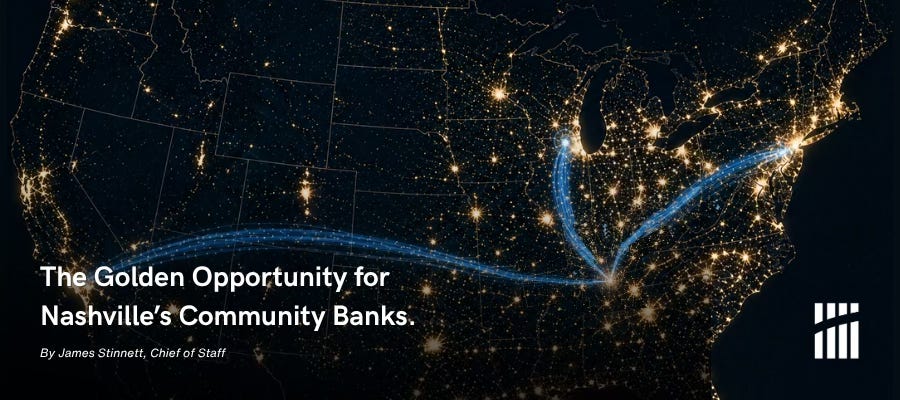
Tennessee’s wealth migration story is well-documented. What’s less discussed is what it means for banking — and why the current moment, with consolidation reshuffling the market and coastal institutions moving in, is one that local banks can’t afford to miss.
Nashville’s banking market is in the middle of a significant disruption. For the institutions paying close attention, it looks a lot like opportunity.
Bank consolidation has reshaped competitive markets across the country in recent years — and customers have noticed. McKinsey research shows that 41% of bank customers subject to a merger are likely to switch providers within 12 months. The reason isn’t fees or rates. It’s that they want a banker, not a call center.
Bain & Company found that one major merger saw the combined institution’s Net Promoter Score (the standard measure of whether customers would recommend their bank to someone else) drop 55% in a single quarter as customers ran into service disruptions and a shift away from relationship-based banking toward standardized service. That’s not an edge case; it’s the pattern — and it’s playing out in a Tennessee market that is simultaneously absorbing one of the most significant wealth migrations in the country.
From 2020 to 2024, the Nashville MSA added over 136,000 residents — 72,000 of them from high-income states like California, New York, and Illinois. They’re young families, business owners, healthcare executives, entertainment entrepreneurs, and professionals with complex financial lives who are actively evaluating where — and with whom — they want to bank.
That migration doesn't stop at the Davidson and Williamson county lines. Wilson and Sumner Counties sit among the state’s wealthiest and fastest-growing communities, and Montgomery County’s population has grown roughly 46% since 2010. The opportunity is regional, and it’s still expanding.
The institutions that recognize this are already making moves. California Bank & Trust expanded its Entertainment Finance team into Nashville in 2025, explicitly completing what it called its coast-to-coast presence across Los Angeles, New York City, and Nashville — the Big Three of the music industry. J.P. Morgan Private Bank hired a new Tennessee market head the same year, poached from UBS. PNC has committed to 35 new Nashville branches by 2030.
The question isn’t whether there’s an opportunity; it’s whether the banks that are actually rooted in this market are ready to make the most of it.
Who Wins This Market — And How
Nearly half of new movers actively switch financial service providers before or during their relocation. That decision window is short — and it's when relationships are won or lost. It doesn't matter whether that mover is a 24-year-old starting their first job or an executive relocating a business — the window opens and closes the same way for everyone. The bank that meets them there doesn't just gain a customer; it becomes the hub for that household's entire financial life. And right now, Williamson and Davidson Counties — home to one of the wealthiest corridors in the United States and the business, healthcare, and entertainment infrastructure that defines the broader Nashville economy — are full of households at every income level in that decision window.
The story isn't just about wealth. The same migration reshaping Middle Tennessee's banking market includes teachers, nurses, tradespeople, and young professionals — new residents at every stage of their financial journey. Tennessee ranked fourth in the country for Gen Z net migration in 2024, with young adults accounting for nearly one in three interstate moves nationally. These are households just getting started — opening first accounts and building relationships with institutions they may keep for decades. Their financial lives revolve around mobile apps and digital wallets, and they respond to clear, tangible value — a sign-up bonus tied to direct deposit setup or a frictionless mobile experience with fee transparency. Nearly 75% of new checking accounts nationally are being opened by Gen Z consumers. The bank that shows up for a 24-year-old relocating to Nashville for a healthcare job is planting a flag at the start of a long financial relationship.
Move up the income ladder and the fundamentals are the same — the channels just change. For high-net-worth clients (entrepreneurs, executives, professionals with $1M–$10M in net worth) acquisition requires meeting people where they already are: in the premium publications they read, at the professional events they attend, and at the moment they are actively researching their options online. A strong digital presence validates credibility during that research phase and gets you in the consideration set, but it rarely closes a meaningful relationship on its own. The other half of the conversion engine is the CPA, the estate attorney, the commercial real estate broker, the wealth advisor — the trusted professional who says: ‘You should talk to my banker.’ The banks that win this segment build those center-of-influence relationships with the same intentionality they bring to digital advertising. They show up at the right community events, sit on the right nonprofit boards, and are visible in the professional networks where high-earning new residents are building their local professional infrastructure. Digital and relationship-building are not competing strategies. The sequence matters — credibility online gets you considered, relationships in the community get you picked.
Further up the wealth spectrum in the ultra-high-net-worth segment — relocating C-suite executives, founders, families with multi-generational wealth, country music artists, professional athletes — the dynamic shifts even more. Access is exclusively gatekeeper-driven. Family offices, artist managers, entertainment attorneys, and agents control the door, and they don’t open it for banks they don’t already know. The institutions that will serve Nashville’s most significant wealth relationships five years from now are building those gatekeeper relationships today. The door doesn't open for strangers.
The Gap the Big Players Can’t Fill
Davidson and Williamson Counties’ affluent corridor is already well-served by large institutions. But the very things that make large banking institutions formidable (scale and infrastructure) are also what make them feel impersonal to people who left California or New York. These new residents chose Tennessee in part because it feels more community-oriented and more like a place where decisions are made locally. They want a banker, not a bank. That’s a gap no amount of branch expansion can fill when what clients actually want is someone who shows up in the community, knows the right people, and understands their financial life before they ever pick up the phone.
Counterintuitively, both the consolidation reshaping this market and the national expansion into it create space for community banks with genuine local roots. The opportunity isn’t just to out-compete large institutions on product — it’s to be the alternative for clients who thought they were leaving impersonal banking behind when they left the coasts.
But local roots and relationship-driven service only win if the right clients know you exist. The banks that pair genuine community presence with smart digital marketing — getting in front of relocating households across income levels at the moment they’re actively looking — are the ones that will convert this moment into lasting market position. There are more of those clients in Middle Tennessee right now than at any point in history. The window is open. The institutions that recognize it and execute with discipline — alongside partners who understand this market and how to win it — will be the ones writing the next chapter of community banking.