

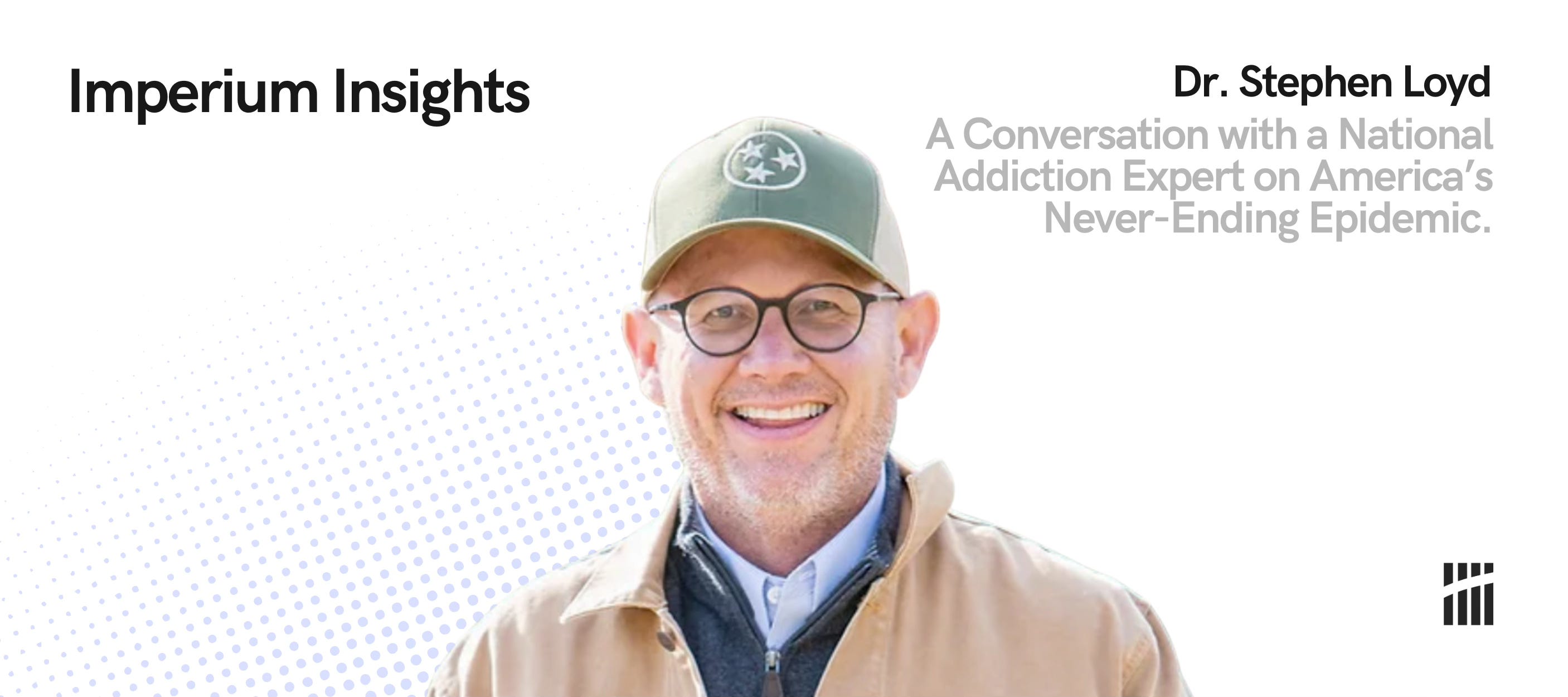
We’re launching a new Imperium conversation series built around a simple premise: the people closest to the problem usually have the clearest view of what it will take to solve it. From health and tech to defense and innovation, these are candid conversations with leaders tackling consequential challenges in real time. First up: Dr. Stephen Loyd.
Dr. Stephen Loyd, a son of Appalachia, has been at the heart of America’s struggle against opioid addiction for over 20 years. During the many iterations of our seemingly silent national crisis – heroin, oxycontin, fentanyl and now synthetic drugs – Loyd has fought the epidemic using every role available to him. He has engaged as a physician specializing in addiction recovery, a methadone clinic owner, state and federal public servant, and policy expert at large. Perhaps most importantly, he experienced this endless crisis from the most important vantage point of all, as an addict in recovery.
Blunt, animated, and apolitical, Loyd describes America’s ongoing struggle against opioid addiction in stark terms. Imagine if a 747 commercial jet crashed and killed everyone on board once a day, every day for almost 20 years. According to the statistics, that is how many American lives are lost daily to opioid addiction, Loyd says.
In the small circle of advocates and healthcare professionals in the U.S. who engage daily in fighting the epidemic, Loyd is regarded as a truthteller and a rare but heroically loud voice. He crisscrosses the country on his own dime to speak to pretty much any group that will listen about the harsh realities of opioid addiction in the U.S. In Harlem, before Congress, in front of business groups and law schools, and even at a national gathering of college students at Turning Point USA, Loyd’s message is simple. Things are getting better but not fast enough.
He currently serves as the drug czar of West Virginia, one of the most addicted states in the U.S., where he leads the Office of Drug Control Policy. He also just finished two terms chairing the Tennessee Opioid Abatement Council which oversees the spending of the state’s annual share of the opioid court settlement funding. Most importantly, he recently accepted a position with the Great American Recovery Initiative, established by President Donald Trump via executive order on January 29, 2026. It is co-chaired by Health and Human Services Secretary Robert F. Kennedy Jr. and White House Senior Advisor for Addiction Recovery Kathryn Burgum to unify federal, state, and private-sector programs against addiction.
According to Loyd, the U.S. must now cross its greatest divide in the fight against opioid use disorder, overcoming cultural and policy inertia to classify addiction as a chronic disease alongside illnesses like diabetes and hypertension. Imperium sat down with Loyd to get his take on where we stand as a country in our struggle against one of the most difficult problems to ever face the nation.
This is a transcript of our conversation, lightly edited for length and clarity.
Clint Brewer: You’ve lived this crisis from almost every conceivable angle as a physician, a patient, a policymaker, and a clinician. Looking back over that journey, what do you think the country still fundamentally misunderstands about addiction?
Stephen Loyd: I think the first thing they fundamentally misunderstand is that it is a treatable chronic disease, and every major medical organization in the United States has recognized that for a really long time. It’s still treated as otherwise, and so I think that’s the first thing. The second thing is, is that the system of care is not designed to deliver outcomes, and I think that’s probably the thing that has killed more people than anything besides the initial stigma of addiction. The system is still not where it needs to be. People get lost in transition points and they have a hard time finding their way into the system when they need help.
CB: For nearly three decades, America’s response to the opioid epidemic has evolved from prescription control to law enforcement to harm reduction to treatment expansion. How would you grade our overall strategy? Where have we made real progress, and where have we been chasing the wrong problems?
SL: I think we’ve made progress in a lot of those. I hear a lot of folks, particularly in the treatment world, talk about the lack of effectiveness of “the war on drugs.” And I think that’s too simple. And I also don’t think it’s true. I mean, I don’t think that anybody can argue that stopping the illegal flow of potent narcotics that kill Americans is not a good thing. It’s a really good thing. And I think if you look at some of the things that have happened here in the past couple of years with regards to the potency of drugs coming into this country and how they’ve gone down, how we have done a much better job of shoring that up. I think that plays directly into the decrease in overdoses that you see nationwide today. So, I think we’ve done a good job with interdiction efforts, and they’re important.
I think we’ve done a good job with looking at our treatment modalities. We’ve got access to care that we didn’t used to have, particularly around medications for opioid use disorder, and that has been latched onto by a lot of folks in law enforcement and the criminal justice systems, and so I think that’s a really good thing. I think that we’ve done a really good job with overdose reversal drugs, right? I mean, we have saved a lot of lives with harm reduction efforts there and keeping people alive.
The thing that we continue to fall short on is realizing that this is a treatable chronic disease, you know? But the problem is, is that the system of care has too many gaps in it where people fall out, and we stop treating it as an ongoing chronic condition, like we do so many other things. The biggest drainer of healthcare dollars in the United States is actually chronic disease. It eats up about 80 percent of our healthcare expenditures in the United States, diabetes, hypertension, you know, all of those things. The biggest eater of healthcare dollars in the chronic disease area is actually addiction. And we continue to fall short on training our clinicians on how to recognize it, what the risk factors are for it, having a good understanding of it, and then accessing treatment for that person at that particular level. We’ve fallen massively short on that.
Last, but you know, certainly not the least is realizing how important spirituality is in this. You know, it’s one of the things that I absolutely love about the current administration is you can actually talk about spirituality. I’m talking about connection from a spiritual standpoint with something that you connect with. I’m not telling you what to believe or who to believe. And for the longest time, state and federal governments have not funded things that have any type of spiritual component to it.
And I think we’re really missing the mark there when you start to look at the scientific evidence-based literature that we have on the importance of that right now. And the other thing is, it’s not really expensive to do. So, it turns out that probably the most effective thing that we can do probably has the smallest price tag because of just how many organizations we have that participate in that in this country.
CB: You’ve mentioned this already, but addiction is increasingly being described by physicians as a chronic disease, like diabetes or hypertension. Yet, many Americans still view it as a failure of willpower or personal responsibility. What does it mean to treat addiction as a chronic disease, and how would our healthcare system, or our culture look different if we truly embrace that understanding?
SL: Yeah, that’s a great question. And as you know, that’s what we’re working on right now at the Great American Recovery Initiative at the federal level is that very issue. And so, what does it look like? Okay, just like if you had diabetes, your hemoglobin A1C, which is what we measure, you know, to look at how severe it is. Here’s some things that you can do that can affect that number and lower your risk of all of the things that can happen to you as a result of having diabetes. And that’s what we do.
We give you education on what caused the diabetes and some things that you can do from a diet and exercise standpoint to get better control of that, and then we treat it ongoing. It’s not like you do that one time and it’s over. And then we follow you at incremental time periods until it becomes under control. At first, it’s every three months, and then as long as you get under better control, maybe we can go to every six months, but sometimes we can’t if we’re struggling. And so that’s the model that we’re talking about. With addiction, we seem to have this idea that, okay, you have this, and we’re going to take a punitive approach. And if you don’t do anything about it, then we’re going to somehow punish you in some way, which we do a lot of times in criminal justice system. And again, when you run afoul of the law, there’s still personal responsibility there, right?
And when you finally do get treatment, okay, we’re gonna send you away for a finite amount of period of time, and then when we come back, we expect you to be better. And that’s the approach that we’ve had, instead of the approach that we would take with diabetes or hypertension, where we continue to have these positive touchpoints, monitor your progress, see the things you’re still struggling with, and start to help you with those so that you can build a life. And that’s what we’re talking about.
As you know, psychiatry is basically practiced out of something called the Diagnostics and Statistics Manual. We call it the DSM. I think we’re on version 5 right now. And so, we’re talking about moving addiction and recovery out of the DSM-5 over to the ICD-11, which is the codes that you would use for other diseases like diabetes, like hypertension, like different types of cancer.
And so that is the challenge. How do we move it from this mindset of, okay, this is mainly a failure of willpower, like you described. I can’t tell you how much I wished it was willpower. If it was willpower, I would have won. I would have been able to quit. I just couldn’t. And most people out there are like that. So how do we move it from that failure of lack of willpower over to, okay, you have this disease. Here are the risk factors for that disease. Here are the things that you have that you fit the mold on it.
CB: The public conversation tends to focus on overdose deaths, but you’ve argued that by the time somebody overdoses, we’ve already failed them multiple times. What would a true prevention strategy look like if we built it from the ground up today?
SL: Ground up today, it starts with kids. It starts in kindergarten and you build it from there and that would be the most effective and it actually lasts all the way through school. And there’s a bunch of evidence-based strategies that we can talk about. One that I really love is being practiced here at Fall Hamilton Elementary School, which is a Nashville Metro Public School, and kids coming out of areas with a high incarceration rate, a ton of trauma, and just the approach they take with these at-risk kids from a prevention standpoint, utilizing evidence-based interventions, and the one they utilize is actually Stephen Covey’s “Eight Habits of Highly Effective People.” It’s really impressive.
And so that would be the most effective thing, is when you’re looking at prevention strategies. About two or three years ago in Knoxville, we actually had some grant money that I was a part of, and we went back and looked at overdose deaths. And so, every week, we would review the overdose deaths that were in greater Knox County area that came through the forensic center there in Knox County, and we would look and see how many touch points we had with that individual, looking at hospital records, police records, and the criminal justice system.
How many touch points we had in the six months to a year leading up to that overdose. So, the overdose was that final event right at the night’s end down on Magnolia Avenue, whatever. Right. And then we, you know, once we identified that person, go back and kind of an autopsy on the process that led them to that. And it was amazing. There would be 35, 40, 50 touch points that we had with that individual before that event. An intervention that any one of those touch points was something that had a chance to be effective could have more than likely changed that outcome.
And I’m not blaming anybody. It’s not a blame game. It’s just, how do we take a look at this outcome that we want to change? And then what led to it? And what could we have done differently at any one of those touch points leading up to that?
CB: One of the most compelling aspects of your work is your emphasis on adverse childhood experiences and trauma. How much of America’s addiction problem actually begins long before someone ever encounters an opioid?
SL: Almost all of it. Opioids, or, or, you know, we can go to extremes, alcohol, uh, benzodiazepines like Valium, Xanax, methamphetamine, those, those drugs change the way people feel, that’s why they use them. Many times, they’re trying to cover up these symptoms that they have from adverse childhood experiences or trauma. And if you look at it, it’s pretty amazing. I’m not saying 100%, but it is the vast majority. And so, the picking up of the drug just happens to be whatever’s available and the cheapest, right? And the most socially acceptable. And so that’s kind of how it happens. And as you know, I teach it as addiction is genetics, trauma, and opportunity.
The genetics of predisposal - that we know that for sure. We’ve known that for some time. The trauma could be early childhood experiences or even early adulthood trauma. And really even in adulthood. I had a case this morning with a veteran who really had almost no use of any drug until after his military service, right? And had some pretty traumatic things happen in the Middle East. And so, the drug is just an attempt to treat the symptom of the underlying issue.
CB: You’ve described addiction, you just referenced it through what you call the slot machine model, genetics, trauma, and opportunity. Which of those three factors receives the least attention in public policy and why?
SL: Trauma. Genetics, it’s hard to change any of that, but the trauma receives the least. And I’m really not sure why, you know, the evidence is very strong. Adverse childhood experiences, the ACES study has been well vetted in the medical literature, you know, since the late 1980s. When your ACE score gets to four or above, your risk of just about everything you can think of goes almost straight up.
So, your risk of diabetes, your risk of hypertension, your risk of eating disorders, your risk of a mental health issue, your risk of a substance use issue is dramatically increased at that ACE score of four or above. And so that gets the least amount of attention. And I’m bewildered by it because a lot of the interventions there.
Are things that would not involve pharmaceuticals. It’s things like connectivity, things like addressing the spiritual aspect of things, things about building community, community and relationship, all the things that we talk about, right? And some of the governors that, you know, that you and I have talked about that’s what they’re trying to build in their states. One of the states I work in right now has it naturally built in West Virginia. They have that community and relationship. So how do you take advantage of that and trying to help folks struggling with this?
What we tend to want to do is throw a pharmaceutical at it. Okay, you’ve got X issue. You’ve got this symptom. Let’s throw this pharmaceutical at it. And you’re basically masking the symptoms and doing nothing to drive the underlying issue. Now, I’m not saying we don’t need pharmaceuticals. I’m just saying that receives the least amount of attention.
However, if you have a supply, you will, I mean, if you have a demand, you will have a supply. I mean, we learned that in Econ 101. And so we could build a wall from the ground to the heavens, and if there is enough demand, it’ll be dropped in from the sky or tunneled in. And so how do we start to work on both of these issues at the same time? Because I think they’re of almost equal importance.
CB: States are now receiving billions of dollars through the opioid settlements, creating perhaps the largest investment in addiction response in American history. If you were advising every governor and legislature in the country, what would be your top three priorities for spending those dollars? And what mistakes do you worry that they’re making?
SL: The first thing is that you have to stop the bleeding. And so, you have to saturate your state with overdose reversal drugs in a system that is both public health involved and law enforcement involved. And there’s some states that have done a really good job with that. And so, all the data that we have, we can almost predict when and where overdoses are going to happen based on looking at our supplier cities. Second, you have to build a system of care that no matter where you touch it, there’s no wrong entry. And I tell people this all the time, and this goes for all 50 states. This one is consistent in all 50 states because states are going to vary a little bit in some of their needs.
You have to address this in criminal justice. You have to address this in your jails and prisons. And I will go so far as to tell you that if you don’t address it in your jails and prisons, you’re not going to move the needle in your state otherwise because the denominator is too big. 75 percent of every incarcerated individual in the United States was using or under the influence of a substance at the time they committed the crime. About that same percentage has a diagnosable mental health or substance use issue. And so, until you address it behind the walls of your jails and prisons, you’re really not going to make very much headway. And then, last but not least, you have to address housing.
You and I, you know, get up in the morning, go to work, we look nice, we smell decent, and that’s because we had a safe place to stay last night. When people are coming through this, a lot of times they lose everything, and when they finally get into recovery, we have to have available housing, not as a permanent thing. I’m not talking about paying for somebody’s housing going forward, or models where you take people no matter what, because the housing first models have shown, you know, in addiction recovery, that is not a good model. You can’t have housing that has, you know, 10 people pulling towards recovery and one person actively using. That’ll mess the whole house up.
So, we have to have, you know, we have to have some funding that helps people start to get back on their feet, and then job training that starts to allow them to provide for themselves, which should be the ultimate answer. So those would be my three priorities.
CB: What mistakes do you worry the states are making?
SL: The biggest one I see right now is just acting on things that you think might work. This has been going on long enough. There are enough interventions out there and enough programs around the country that we have some things that are really working, and some best practices that are really working. So just to take a stab at it out of the wild blue or go with things that were known to not work.
That really bothers me. I can’t imagine spending my money on something that I know wasn’t effective, but I do see it happen quite often. The other thing is, and this is not a knock on law enforcement colleagues or state governments, but I see state governments starting to claw back some of this opioid money to fill budget shortfalls. That’s not what the money was for.
And then last but not least, and this is always going to be out there, but spending money on things that are punitive to keep people punished. And I had to deal with a list of these yesterday, Clint, from down in Louisiana. You know, buying things like stun guns, bodies cameras, body cams. Body cams are needed in law enforcement. We all understand that. We know the reason why, but that’s a budget item that you should have covered anyway because not every call that you respond to is opioid related. So why are you using opioid dollars to backfill a budget spot that you need for body cams? And there’s multiple examples of that. There’s plenty of things that people are spending money on that are just an absolute waste. I’ve seen in West Virginia a gun range for law enforcement. Does law enforcement need a gun range? Absolutely. I would support that 1,000%. What possible connection could that have to help building a system of addiction and recovery? It doesn’t.
And so, I’m really scared because of the lack of coordinated effort, both at the local level and the state level, and then last but not least, the national level, that we’re going to waste the opportunity to build the system of care that we need.
CB: The fentanyl era has changed the rules. Today, someone can die from taking what they believe is a legitimate prescription pill. Does this require us to completely rethink how we educate young people about drugs?
SL: I think it has to. I really do. You know, there’s this thing in AA that I’ve seen for a long time, and I’m a huge fan of 12-step programs, but, you know, in AA, when you’ve got somebody struggling with alcohol, there’ll always be some old-timer in there, you know, who takes $20 out of their pocket and walks over and says, “Here you go, go out and do a little field research.” Basically, go out and suffer some more, and then come back to us. First of all, I’ve never liked that. I think it’s an unbelievably arrogant approach, and I would never argue for that. But the problem is now, is that if you go back out for a day, you can die.
And, you know, and it’s not a car wreck and it’s not, you know, some event that you have to get in. It’s like you get a hold of the wrong fentanyl laced pill, the wrong fentanyl laced methamphetamine, and you die that afternoon. And so, yes, it has changed the conversation that has to. Because it’s no longer that. And I tell folks this all the time, and you’ve known me for a long time, and you knew me back when, you know, probably when we first met, you’re like, “Steve probably needs to stay away from alcohol.” You’d have been right, okay?
But I’m healthy, and I’m 59 years old, so it’s gonna take a while for it to kill me, unless I get in a car wreck. If I decide that I want to go back to pain pills today and I go back out on the street and I buy what I think is an OxyContin and it turns out to be fentanyl, I’ll be dead this afternoon. And then last but not least, you don’t even have to be a user anymore. I mean, we went to high school parties back in the day where, you know, pills float around that such and such got into their mom and dad’s medicine cabinet, and, you know, and I’m not saying that’s a good thing. It’s not a good thing.
And I’ve got this guy out here in, you know, where we live, in Wilson County, who runs a roofing business, very successful. His son got incarcerated for a non-drug-related offense for a short amount of time and never had a drug issue. But when he got behind bars, he got a hold of a pill that was what he thought was Xanax, and it wasn’t Xanax, it was fentanyl, and he died. He died of an opioid overdose with no history of opioid use. So, yes, I think that conversation has to change. And, you know, and what’s really in vogue right now is calling it poisoning, right? This is not an overdose, and it is poisoning. But I still think we have to stay, you know, at the basis and look at, you know, really what we’re trying to accomplish, and that is education. I do this all the time in schools. And basically, I’ve got this little slideshow where I put up two pills, and I’ll get the students to pick which one they want to take. And, you know, one of them is the real pill, and the other one is fentanyl. And, you know, the long and short of it is you pick the wrong one, you die, and you can’t tell the difference in between them.
And that’s really what we’re doing. We’re playing Russian roulette.
CB: Much of the national response has focused on treatment, recovery, and overdose reversal, essentially intervening after the addiction has already taken hold. Why do you think America has struggled to develop effective prevention solutions? And what would a truly evidence-based prevention strategy look like?
SL: This is an answer that won’t be popular, but it’s what I see. With those strategies that you talked about, in a short amount of time, if you’re looking at a graph or a chart and you implement those things, you should see a downward trend. We’re making progress.
Prevention efforts take a generation. And I think that that’s where people struggle with it. We have a lot of effective evidence-based preventions out there. I mean, a lot. We don’t have the stomach for them, because we don’t follow them long-term, and we don’t see the payoff.
And so, there’s a lot of issues to that from a political standpoint, politicians, and it’s not a knock, but they want to see a change in a two- or four-year election cycle. And that’s, most of the time, not going to be the case. And so, I think there’s a lot of barriers for it. From a return on investment standpoint, it is the best bang for our buck. I’m really a prevention guy. For every $1 invested in prevention programs for substance use, it’s about a $14 downstream savings when you look at it. Treatment is a good thing and we need it. If you look at that, that’s about a $1 investment for a $4 savings. So, so it’s the most effective thing that we can spend our money on. It’s also the hardest one to track. It’s the hardest one to show outcomes. And again, the changes aren’t seen for a generation.
The most effective programs that I see, and matter of fact, I was with one this morning in Harlem called Safe Harlem. Completely student led. They’ve got a faculty advisor, but completely student-led in some of the toughest neighborhoods in the United States, in Harlem, East Harlem, the Bronx, Queens. Incredible. And some of the outcomes that they’re seeing with, you know, they’re measuring outcomes with surveys and the national survey on substance use among kids. The outcomes that they’re seeing are really impressive. So, picking the evidence-based program that fits your system the best. And I really think that it’s best when it’s peer led and the students leading it themselves.
So, recovery is often portrayed as a destination, something someone either achieves or doesn’t.
CB: From your own experience and from treating thousands of patients, what does long-term recovery look like in the real world?
SL: If you look up recovery, I think there’s probably three or four organizations that have definitions of it. People want to say, well, their drug screen is good, so they’re in recovery. Well, I don’t necessarily believe that. I know a lot of folks who don’t use anymore or don’t drink anymore, but they’re not doing any of the things that you would think that a normal person would do. Are we meeting our responsibilities as adults? That’s how I measure it.
Do I know people who do those things that I consider to be in recovery that every now and then will pop positive for weed on a drug screen? I do. Does that mean they’re not in recovery? Not in my book. I mean, they are doing the things that they need to do, living their life in a way that’s beneficial to themselves, able to provide for themselves and able to provide a pathway for their children to better themselves. And so those are things that I look for.
Sometimes you can take a step forward or two steps forward and maybe one or two or three steps back. Our system must be built so the fact that you can come back in. I don’t want to give up on anybody. Now, with that said, there are consequences. And so too many times I’m talking about this and say, well, Dr. Lloyd, you’re “hug a thug.” Not at all. I think there are a lot of people that have found recovery when they were sitting in a jail cell.
And, you know, you and I live in Nashville, and, you know, one of the biggest stars we have in Nashville right now is Jason DeFord. Jelly Roll decided he wanted recovery sitting in a Davidson County jail. And so, I think there are benefits to things like that. I think accountability, personal accountability, I think those are all good things. The long and short of it is, what do I look for when I’m looking at somebody progress through the recovery process? I look for, are you taking accountability for your own life? And if you are, then you’re progressing in a way that I can continue to work with. If you’re not, then we have to look at the things that are preventing you from being able to do that.
Now, drug screens are useful. The truth of the matter is that they have never shown benefit in achieving long-term outcomes like I just described. They’re a tool. Do we need to do them? Yes. But recovery is about so much more than a drug screen.
CB: If you could change one thing, not a law, but a deeply held cultural belief about addiction in America, what would it be, and how would changing that belief alter the trajectory of this epidemic?
SL: It’s what I’ve spent the last 22 years doing, and that is shifting it from a moral failure to a disease. When I went to treatment, I looked at it as a moral failure. And for a long time, it prevented me from reaching out for help. So that’s still the thing that we have to change. It’s still the thing that prevents most people from stepping into this.
And so, addiction prevalence has been pretty level since about the time of the Civil War. So, it’s still about the same number of people, but the population has grown, right? And so, whenever you take away that moral failure aspect of it, and we’re going to treat it as a chronic disease more people step into it and ask for help.
There are so many parallels - and you lived through this like I did - to the AIDS crisis of the 1980s. We had AZT pretty early, I think around 1986, but for the longest time, you didn’t have people stepping out and stepping into this because of the stigma associated with the disease and being a homosexual or injection drug user. When that started to melt away a little bit through various acts, I think, you know, you can never underestimate Ryan White, Magic Johnson, you know, in the early 90s, and that stigma started to melt away, and you made access to treatment pretty much universal.
There’s talk there of eradicating HIV in the United States. I mean, that’s actually a conversation right now and certainly one that I never dreamed in my lifetime I would see. And so, I think that that is possible whenever you make the changes that I’m talking about. And am I saying that we’re going to eradicate addiction? No. Am I saying that we can help more people because they’ll become willing to step into the process? Yes, I am saying that.
CB: So, you’ve dedicated the second half of your life to helping people survive a disease that nearly killed you. When you look 20 years into the future, what gives you confidence that the next generation can inherit a fundamentally different addiction landscape than the one we’ve lived through?
SL: Because I think these things are changing. Are they changing fast enough for me? No. Are they changing fast enough for the people who lost their lives? No, but they are changing. We’ve got medical schools and residencies now. We’ve got, you know, training programs in nursing school and physician assistant school who are the prescribers and the people who take care of us and their attitudes around this are changing.
And so, I don’t think it’ll be mine or your generation. I think it will be the generation behind us. I think it’ll be the generation of students that we have right now. When you graduate medical school, you don’t get to go out and be a doctor. You have to do a residency. And I tell people that’s where you really learn how to be a doctor is residency. And the accrediting body is called the Accreditation Council for Graduate Medical Education, the ACGME.
And two years ago, they formalized this in the curriculum of every residency in the United States around addiction and recovery. They have milestones, they have training milestones, they have competencies around medical knowledge, patient care, systems-based practice that are directly tied to addiction. And so that’s what gives me hope going forward.
CB: We’ve spent over 20 years fighting this epidemic. We’ve devoted billions of dollars, mobilized medicine, public health, law enforcement, and every level of government. But opioids continue to kill thousands of Americans every year. Why has the most powerful and resource-rich nation in the world struggled to solve the crisis? And what do we still fundamentally need to understand if we’re ever going to turn the tide?
SL: We’ve never addressed the system of care. We have done bits and pieces of this and that, but we’ve never addressed the system of care. It’s why I got so excited about the current job I’m in in DC. It’s the first time, at a high level, that we’re talking about taking on the whole system. In the United States, we have never addressed the entire system of care like we did with cancer, like we did with every other disease process that we can think about. And that has cost us dearly. The other thing is that there’s this idea out here that everything needs to be grassroots and decided at the local level. And for the most part, I’m a fan of that.
I think this issue is something different. I think leadership has to come from the top down, and I’m not talking about me. I’m talking about leadership at the national level that works with communities, that works with states to put together this cohesive system that has to exist, that keeps people from falling out of it and dying. And I think that whenever we do that or we start to approach that.