On Our Radar
Bari Weiss Signals a New Era at CBS News
Bari Weiss’s early weeks at CBS News have made clear that she intends to treat the role as a renovation project. Backed by Paramount’s new owner, David Ellison, she has moved quickly to diagnose where the organization’s competitive edge has dulled: meeting directly with anchors, tapping her own network to bring in new voices, and taking a hands-on approach to booking and editorial workflow. It shows that CBS is willing to test a different model at a moment when the broader industry is struggling to define what a modern national news division should look like.
Inside the organization, Weiss’s push has sparked debate, but also a sense of possibility. Supporters see her mandate as an opening to experiment with structure and storytelling; others are still gauging how her strong point of view will translate into coverage. What’s clear so far is that she’s approaching the job with urgency and a clear thesis: that legacy news can evolve, and that CBS has an opportunity to reposition itself rather than fall back on old habits.
Rebuilding the U.S. Semiconductor Base
America’s semiconductor story is, at its heart, a tale of how technological leadership quietly evolved into strategic dependence. The authors lay out how the U.S. ceded manufacturing to Asia over decades, leaving advanced semiconductor capacity concentrated in a single, precarious chokepoint: TSMC in Taiwan. That mattered less when chips were “just” an input to phones and cars; it matters a lot more when frontier AI and modern weapons systems run on chips manufactured on an island 110 miles off China’s coast. Pandemic-era shortages, China’s industrial buildup, and the prospect of a Taiwan crisis have turned what looked like an efficient global supply chain into a national-security liability.
Against that backdrop, they frame the central question as how to build an “American TSMC.” Starting from scratch is too slow and too expensive; relying on TSMC’s Arizona factories keeps critical know-how offshore and is increasingly sensitive in Taiwanese politics. That leaves “buying” the capability by restructuring Intel (the only U.S. company still trying to run a leading-edge logic foundry). The case is made that Intel’s manufacturing arm should be treated as a strategic asset: carved out, recapitalized with government and hyperscaler support, led by engineers rather than financial managers, and pushed to leapfrog TSMC on next-generation chipmaking. It’s less a rescue-Intel argument than a test of whether the U.S. is willing to do the slow, heavy industrial work required to match its AI ambitions.
All Roads Lead to Video Content
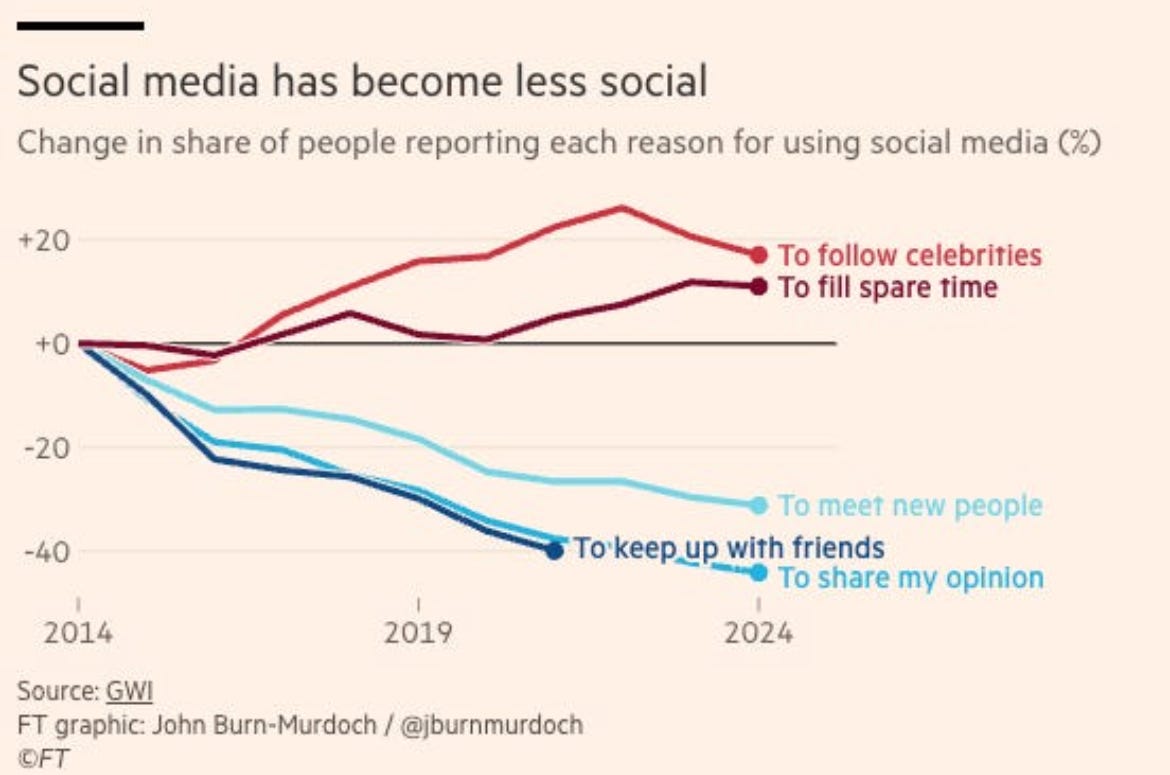
The center of gravity in media has fundamentally shifted to the endless feed of video — what Derek Thompson calls the new “television” of our era. Social platforms that once emphasized connection are now algorithm-driven pipelines of short, unconnected clips delivered from strangers. Podcasts are transforming into YouTube shows, with video versions outpacing audio-only ones, and even AI content networks prioritize a rhythm of continuous, immersive video designed for infinite scrolling. It’s the cultural arc that Raymond Williams foresaw: not discrete stories, but “continuous flow,” where platforms like TikTok and YouTube perfect the model of media as an unbroken, ever-refreshing stream.
Thompson’s point isn’t nostalgia, he argues instead that the rise of immersive video makes sustained attention harder and weakens shared experiences; solitude is filled instantaneously by screens, leaving less room for self-reflection. Political and public life increasingly mimic the pace and spectacle of short-form video, prioritizing style over substance. The result: the format of endless video flow now sets the terms for how our culture competes for (and fragments) attention.
A New Era of World Cup Underdogs
The World Cup’s expanded field has opened the door for both historic soccer nations and first-time entrants, and few stories capture that shift better than Scotland’s. After nearly three decades of heartbreak, Scotland finally ended its World Cup drought with a chaotic 4–2 win over Denmark. For a country with one of the world’s oldest soccer associations, the modern era has mostly meant heartbreaking failures and long stretches of irrelevance, made sharper by watching its top talent drift into England’s far wealthier system. And while resilience played its part, FIFA’s move to a 48-team tournament made this breakthrough possible, the same structural change that ushered in newcomers like Cape Verde and Uzbekistan.
Scotland’s journey is emblematic of a World Cup reshaped by access. With 42 nations qualified, several are set to make their debut, underscoring how the biggest transformation in global soccer right now is the widening of opportunity.
The Meaning of a Well-Worn Watch
Elliot Ackerman believes every man should understand what it means to truly own a watch — how an object gathers meaning simply by staying with you through long stretches of life. He traces that idea back to a deployment in 2006, when long days aboard a ship and conversations with a fellow Marine pushed him toward buying something built to last. The Rolex he picked up in Dubai wasn’t intended to be a status symbol; it was a tool he expected to depend on, and one that followed him from military service to war reporting to the beginnings of a family.
For Ackerman, a watch earns its value through continuity. You wear it everywhere, rely on it without fuss, and let it absorb the dents and dings of life instead of shielding it from use. Over time, routine turns a possession into an heirloom. His point is simple: over years of wear, an object can turn into proof of where you’ve been and who you’ve become.
Tennessee Newsrooms Earn National Recognition
Young America’s Foundation’s National Journalism Center announced this year’s Dao Prize winners in Washington, highlighting a growing ecosystem of conservative investigative outlets — including two based in Nashville. The Daily Wire earned recognition in the inaugural “DOGE” reporting category for Luke Rosiak’s work uncovering waste inside a little-known federal agency, while The Tennessee Star was honored in the local journalism category for a series on a traffic stop that led to human-smuggling charges.
The night’s top honor went to The Federalist for its reporting on the Russia-collusion saga, with additional runner-up citations for Pirate Wires and the Daily Caller News Foundation. Across categories, the Dao Prize aims to reward deeply sourced, adversarial reporting — the sort of long-form digging that conservative outlets argue is too often absent in mainstream newsrooms. This year’s winners reflect a range of platforms and styles, but also a broader point: investigative journalism on the right is getting more distributed and more rooted outside of traditional coastal media centers.
Other Reading
Inside Cursor (Colossus)
Elon Musk’s Boring Co. and Nashville Tunnel (The Tennessean)
Nate Bargatze Theme Park ‘Nateland’ Planned (Nashville Business Journal)
Legal Action and Legislation to Fight Scammers (Google Blog)
Elon Musk Calls Jeff Bezos ‘Copycat’ for AI Startup (Forbes)
Dolly Parton Travel Stops To Launch In 2026 (Knox News)
Kevin Spacey Homeless, Sexual Assault Trials (Variety)
ADHD Startups Founder Guilty of Conspiracy in Adderall Case (WSJ)
The Fall Box Office Crisis: A Phase, a Fluke, or the Future? (The Town with Matthew Belloni)