


Power and influence continue to shift across politics and markets faster than most institutions are adapting. From foreign policy and AI regulation to local utilities and campaigns, this week’s stories highlight how credibility now rests on clear choices, advance preparation, and the ability to operate inside systems that won’t stop moving.
Also top of mind: today’s Supreme Court ruling on the Trump administration’s tariffs, a decision that will ripple across trade, supply chains, and domestic politics. More to come in next week’s Imperium Insights.
On Our Radar
Munich’s Foreign Policy Split Screen
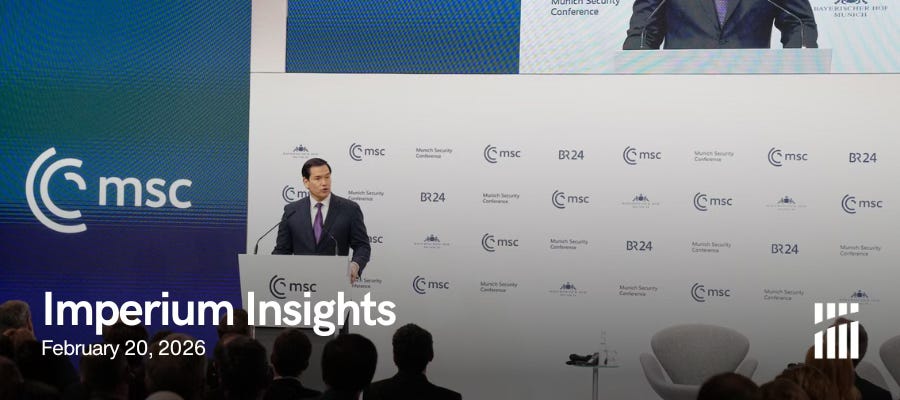
At the Munich Security Conference in Germany, two contrasting performances highlighted the split in America’s foreign-policy positioning. Alexandria Ocasio-Cortez’s uncertain reply on whether the U.S. should defend Taiwan underscored the left’s lack of a defined national-security framework. Her focus on diplomatic prevention rather than deterrence reflected progressives’ broader struggle to articulate responses to hard-power dilemmas. The moment exposed a gap between domestic policy depth and geopolitical fluency that seems likely to limit the left’s credibility ahead of 2028.
Marco Rubio, by contrast, projected coherence around U.S.–European unity and strategic purpose. His emphasis on “togetherness” recast the administration’s agenda as collective self-defense rather than isolationism, offering Europe a sense of renewed partnership. By framing transatlantic cooperation as civilizational preservation, Rubio positioned Washington as both patron and arbiter of NATO’s future — with Europe expected to play a more substantial role in funding and sustaining collective defense.
The New Industrial Lobby
AI’s leading labs are becoming major power centers in Washington even as they call for clearer rules. Anthropic and OpenAI each spent just over $3 million on federal lobbying in 2025, plus hundreds of thousands in California, largely focused on national security, export controls and data-center buildout. Anthropic is also entering campaign politics with a $20 million “pro-regulation” donation, positioning the company as a leading voice on “responsible” AI governance.
Their policy goals are closely aligned: present frontier AI as both a national security asset and economic engine, expand federal use of their models, tighten chip exports to strategic competitors and accelerate permitting and incentives for infrastructure. They also support federal frameworks that could eventually preempt a patchwork of state rules, with comprehensive legislation still emerging. For now, frontier labs are positioning themselves as both major contractors and central narrators — informing policymakers about AI’s capabilities while advocating for rapid scale-up of U.S.-based AI capacity.
War All The Time
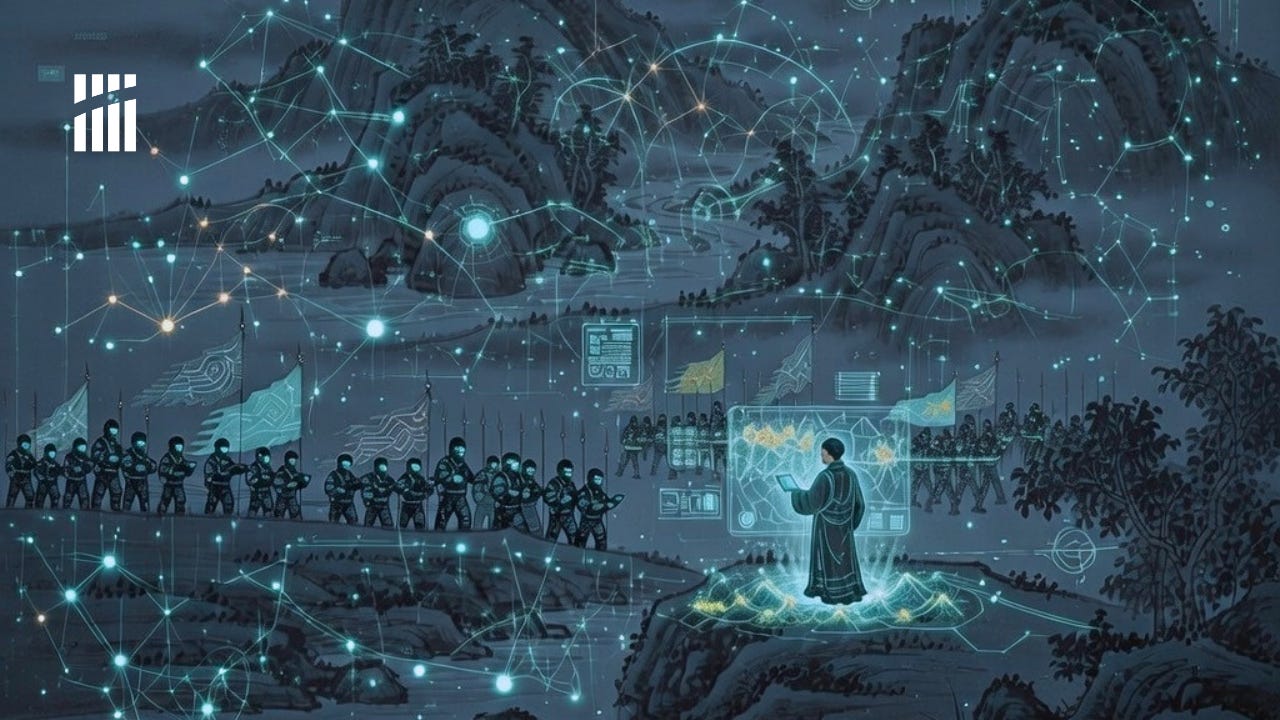
Imperium Managing Partner Clint Brewer frames modern communications as continuous competition rather than episodic crisis response. His recent thought leadership piece applies lessons from The Art of War to today’s accelerated information environment, arguing that leaders must build digital resilience in advance — from Generative Engine Optimization to narrative intelligence — while understanding when to act forcefully and when restraint preserves advantage. Success, he argues, no longer comes from reacting to headlines, but from preparation, intelligence gathering, and disciplined decision-making before a crisis ever begins.
Nashville’s Utility Reckoning
Nashville’s utility leadership remains under fire after a winter storm left more than 200,000 customers without power, intensifying scrutiny of preparedness and spending. NES CEO Teresa Broyles-Aplin receives a substantial compensation package and oversaw cuts of millions of dollars from tree and vegetation management, even after an internal audit warned that insufficient trimming increased outage risk.
A Metro Council resolution urging the NES board to fire Broyles-Aplin was introduced and then deferred, reflecting divisions over whether leadership should change before investigations conclude. Mayor Freddie O’Connell’s Winter Storm Response Commission and NES’s promised reforms (more emergency management staff, better outage maps and communication, and a re-evaluation of vegetation management and line-burying) may start to address structural issues, but they also leave an unresolved question: whether residents will view process fixes as sufficient accountability.
Robinhood’s Private Market Bet
Robinhood is testing whether retail investors will follow it into private markets, launching a $1 billion closed-end fund designed to give everyday traders exposure to late-stage companies like SpaceX, OpenAI, Stripe, and Databricks. The pitch is “democratization” — opening access to deals historically limited to venture capital and institutional investors — while also creating a new recurring revenue stream as startups stay private longer and more value accrues before IPO.
The opportunity isn’t without structural risks: closed-end funds often trade at discounts to their underlying assets, private valuations are opaque, and retail enthusiasm can drive volatility disconnected from fundamentals. But if the model works, it could signal a broader shift toward retail participation in private equity and reshape how late-stage companies raise capital.
The New Market Watchdogs
Edwin Dorsey has turned deep-dive company investigations into a standalone business, selling his research through his newsletter The Bear Cave instead of betting against the stocks himself. He first broke through by showing that Care.com approved a fake “Harvey Weinstein” babysitter profile despite promising background checks — a case that later drew national scrutiny and contributed to the company being taken private.
Today, The Bear Cave brings in seven-figure subscription revenue as Dorsey uncovers small companies that look more hype than substance and maps longer-term threats to bigger brands like Hershey. His growing focus on prediction markets points to a broader shift: markets and niche researchers, not traditional gatekeepers, are increasingly setting the early-warning signals that executives, investors and policymakers watch.
Other Reading
Palantir moves headquarters from Denver to Miami — (Axios Local Denver)
OpenAI Hires Former Instagram Executive Charles Porch — (Vanity Fair)
Mamdani’s New York City Property Tax Push Roils Budget Talks — (Politico)
Chicago Bears Weigh Stadium Move to Hammond, Indiana — (Chicago Sun-Times)
Ex-Top Tesla Engineer Raises $140 Million to Rewire the Electric Grid — (Forbes)
Trump Orders Release of UFO Government Files — (The Wall Street Journal)