
On Our Radar
Nashville Confronts Its First AI Chart-Toppers
Two AI-generated acts, Breaking Rust and Cain Walker, landed near the top of Billboard’s country digital sales chart this week — an unusual moment for a genre that has historically prized its songwriting lineage. For a city built on the labor of human songwriters, the idea that synthetic voices and machine-written lyrics can compete on the same stage cuts directly into a long-standing cultural and economic identity.
Streaming has already thinned the ranks of professional songwriters, and the arrival of AI-generated tracks adds a new layer of uncertainty over how music is made, trained, and monetized. Advocacy groups are now focused on transparency — whether these models were built on human work and whether creators will be compensated if their styles or voices are replicated. But underneath the policy framing sits a deeper question for Nashville: what happens when a system designed around craft and authorship is confronted with tools that can mimic both at scale?
Gatsby as a Guide to America
On a recent episode of Old School, Shiloh Brooks talks with Fareed Zakaria about The Great Gatsby and what it revealed to him as a new arrival in America. Zakaria first encountered the book at Yale, and its world of reinvention and restless ambition offered a framework for understanding the country he’d just entered. What stands out to him now is how sharply Fitzgerald separates appearance from substance: a man can build a fortune and a mansion yet remain fundamentally unmoored.
Zakaria ties this to a broader modern problem. Once faith and inherited meaning lose their authority, ambition fills the vacuum, and self-creation becomes the new religion. Read this way, Gatsby becomes less a tale of aspiration than a reminder that ambition, untethered from something deeper, eventually runs out of road.
Corporate Law’s Center of Gravity Is Shifting
Coinbase’s move to exit Delaware and reincorporate in Texas is less a tech-sector stunt than a signal of how quickly the country’s corporate-law map is shifting. For decades, Delaware’s dominance rested on predictable court rulings and a well-understood governance framework. But as the Chancery Court’s decisions have grown harder to forecast, companies that once treated the state as an inevitability are starting to treat it as optional.
Texas, meanwhile, has positioned itself to capitalize on that uncertainty. Recent statutory reforms and the creation of a dedicated business court have given companies a clearer sense of how their decisions will be evaluated — a competitive advantage in an era where legal predictability increasingly shapes where firms choose to plant their flag. Coinbase may be the most prominent mover so far, but its logic reflects a broader recalibration underway. Incorporation, once a fixed decision, is becoming another frontier of state-level experimentation.
Beyond Meat’s Corporate Reset
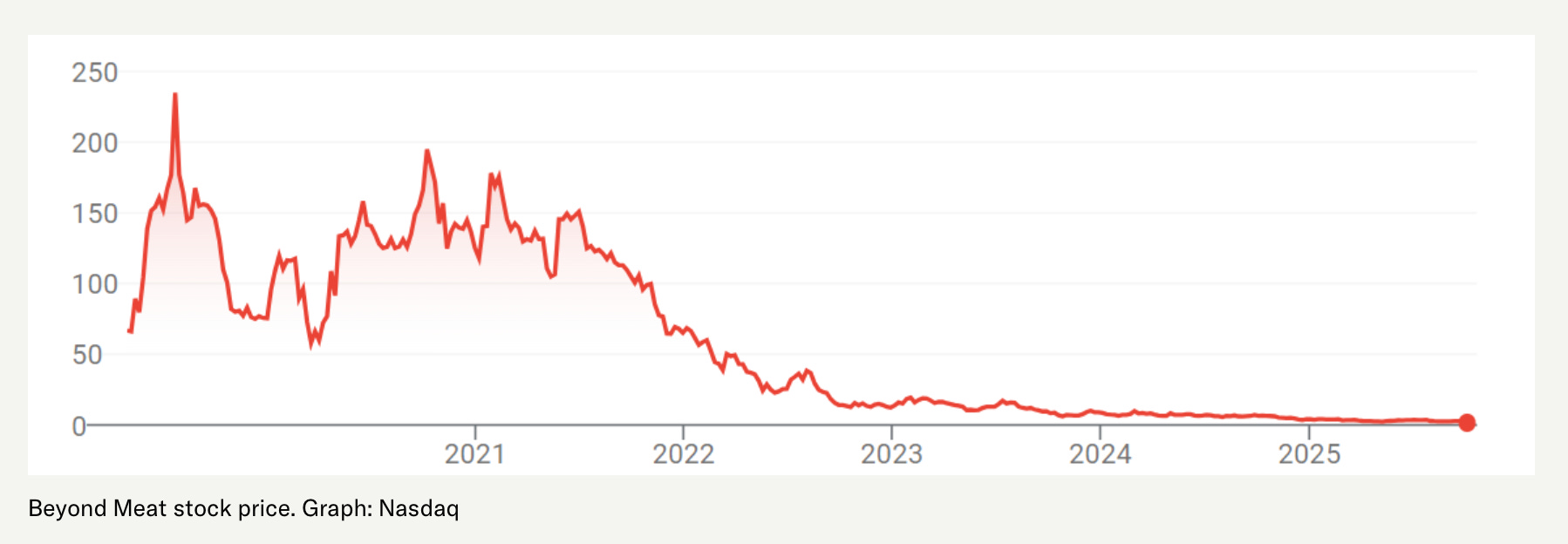
After another brutal quarter, Beyond Meat is trying to convince Wall Street (and itself) that the long-awaited turnaround is finally within reach. The company’s latest earnings showed double-digit sales declines almost everywhere, the result of a category that cooled as soon as the plant-based hype cycle ended. But CEO Ethan Brown insists the balance-sheet overhaul completed this fall gives the company a rare second chance. Shedding more than a billion dollars in looming debt in exchange for new notes and heavy dilution has left the stock battered, yet management now has the room to right-size operations and rethink the business Beyond first built its name on.
Beyond is dialing back capacity, pushing more experimentation through its Test Kitchen, and looking for retail partners willing to bet again on a tighter, more disciplined lineup. The CEO also nodded to a strategic shift toward institutional buyers — chains and campuses that care as much about ingredient profiles as they do about trends. It’s still an uphill climb; analysts doubt the promised return to healthy margins, and consumer enthusiasm remains tepid. For now, the question isn’t whether the category rebounds — it’s whether Beyond can rebuild itself in time to meet whatever comes next.
The New Architecture of Online Discovery
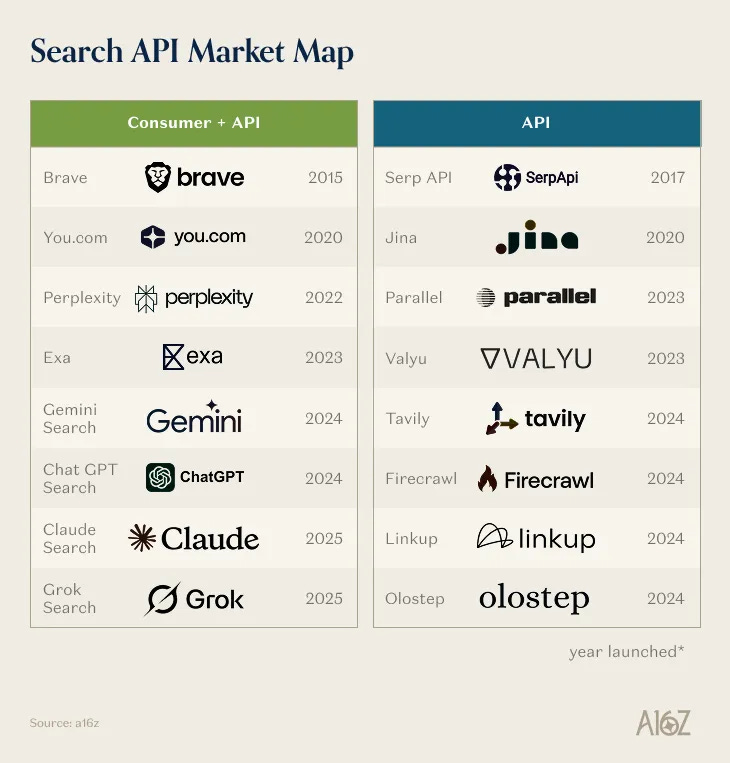
Search is being rebuilt in real time, and the shift is larger than most people using the internet every day can see. For three decades, search was designed for humans skimming blue links; the entire ecosystem bent around marketers, SEO farms, and a handful of giants who decided what information surfaced first. The new wave isn’t trying to fix that system so much as replace it with something built for agents — tools that can crawl, judge, and synthesize at a scale no human ever could. The startups competing now aren’t Yahoo-style portals but infrastructure companies, indexing the web for machines and feeding that intelligence back into consumer products.
The result is an early search landscape that looks crowded but strangely cohesive. Most API providers compete on speed, cost, and the quality of the data they surface, while new “deep research” tools show how far the frontier has already shifted from retrieval to reasoning. Developers are stitching these services into CRMs, coding agents, and market-analysis workflows — places where context and recency matter as much as accuracy. It’s still unsettled which teams will break away as the true platforms, but the direction is clear: as search becomes AI-native, the web becomes easier for agents to navigate and, eventually, easier for humans to understand again.
Thanksgiving Is Around the Corner
With the holiday fast approaching, this is the time when people start sketching out their game plan — what’s coming back from last year and what new dish might be worth taking a swing at to impress the family. If you’re still locking in your menu, here’s a straightforward roundup of dependable Thanksgiving recipes worth working into the rotation this year.
Other Reading
US Mint Presses Final Pennies as Production Ends After More Than 230 Years (AP)
Mamdani and the New Racism (The Free Press)
Puck Alumni Are Building a Food Media Startup (Feed Me)
The “AI Existential Risk” Industrial Complex (AI Panic)
He Once Hunted Terrorists in Iraq. Now He Runs a $2-Billion Identity Verification Company (Inc.)
The 20-Somethings Who Raised $121 Million to Build Military Drones (NYT)
The Credit-Card Rule That Powers Rewards Cards Just Got Broken (WSJ)
Gamma, a PowerPoint for the A.I. Era, Raises $68 Million (NYT)
Nashville SC Captain, USMNT Defender Walker Zimmerman to Leave Club in Free Agency (The Tennessean)
The Skinny Font Taking Over Tech Companies and the White House (WSJ)