


Two hundred and fifty years in, the founding-era playbook keeps resurfacing. Adams' Revolutionary privateers are inspiring a modern push to enlist private ships against Russia's shadow fleet. Saronic is reviving American shipbuilding for the drone age. Dickinson's story reminds us how Americans clash over ideas, then close ranks. And the USMNT is backing up its "why not us" swagger on home soil. Plus, the narrative gap between the America we hear about and the one we live in, and the foreign money quietly amplifying the AI backlash. Here's what we're watching:
On Our Radar
America at 250
Two hundred and fifty years ago, John Adams delivered the famous closing argument for independence. Less remembered is the man who spoke right before him. Pennsylvania delegate John Dickinson made the case for giving peace one last chance, warning that the colonies were rushing into a war they might not survive. History vindicated Adams’s position, but Dickinson’s story didn’t end with the vote. Once Congress chose independence, he accepted the decision, joined the Continental Army, and personally led Pennsylvania troops in defense of the new nation. It’s hard to imagine a clearer picture of the American experiment: fierce argument over first principles, followed by a shared commitment to defend the republic once the decision has been made.
That spirit was on display again this week as Americans gathered at Williamsburg, Jamestown, Yorktown, Monticello, Mount Vernon, and communities across the country to celebrate the nation’s 250th birthday. It’s easy to think of patriotism as something reserved for holidays or moments of crisis, but the American story has always been carried forward in quieter ways too: neighbors showing up after tornadoes, strangers running toward danger on 9/11, communities rallying around people they’ve never met, soldiers refusing to leave one another behind. Dickinson once feared the Declaration would amount to nothing more than “a skiff made of paper.” Two hundred and fifty years later, it’s still sailing—not because Americans have always agreed, but because generation after generation has chosen to keep rowing in the same direction.
The American Narrative Gap
America’s 250th year is as much about how we talk about the country as it is about fireworks and history lessons. In his latest thought leadership piece, Imperium co-founder Josh Helton argues that a growing disconnect has opened up between the America described in much of the media and the one people actually experience every day.

While the dominant mainstream media narrative increasingly asks Americans to see their country through a lens of decline and skepticism, the country’s underlying fundamentals tell a very different story: a nation that still amazes World Cup visitors, remains the world’s premier destination for entrepreneurs and builders, gives at an unmatched scale, and continues to be the place millions of people would choose if they could start over somewhere new. Love of country shouldn’t be controversial. In America’s 250th year, that’s worth remembering.
China’s Influence Campaign Against American AI
Opposition to AI infrastructure is no longer just a local zoning fight; it’s become a target for foreign influence and a useful wedge in swing‑state politics. In Michigan, climate organizer Will Lawrence is running on a moratorium for data centers and finding that message polls well with younger Democratic voters who worry about water, land use, and corporate overreach. At the same time, analysis shows that some of the most well organized anti‑data‑center campaigns are being amplified by a China‑linked funding network with the stated goal of dismantling American capitalism. In Tennessee, local reporters have traced how “dark money” from similar networks of progressive billionaires and national nonprofits flow into Nashville progressive groups who also happen to oppose data centers. That combination — authentic local anxiety and foreign‑backed organizing — has already contributed to billions of dollars in delayed or scrapped AI infrastructure.
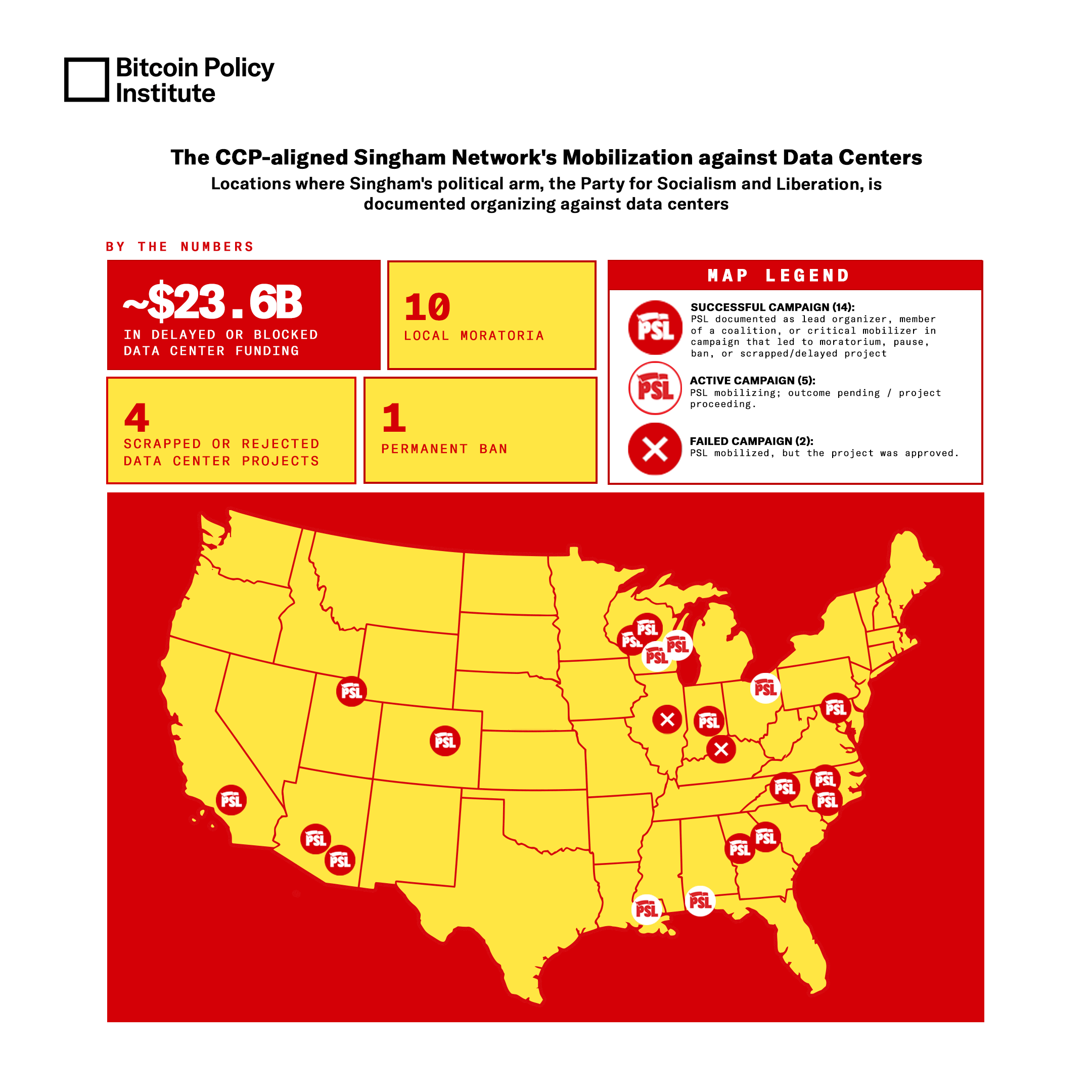
The danger is that Beijing and its proxies see those civic concerns as an opening and are quietly putting a thumb on the scale to slow American AI capacity while China races to build its own. Recent work from the Bitcoin Policy Institute traces at least 21 campaigns across 14 states where Beiing-aligned groups helped push moratoria, bans, or project cancellations, all while keeping their funding opaque and avoiding foreign‑agent registration. For policymakers, that means two things can be true at once: communities deserve a real say over how the data‑center build-out impacts their communities, and the US also needs to ensure that genuine civic debate isn’t being distorted by foreign money aimed at kneecapping American AI.
The Return of American Shipbuilding
Three years ago, Saronic was bolting cameras and sensors onto an $800 inflatable raft in a bare-bones Austin warehouse. Today it’s a $9 billion defense unicorn with major Navy contracts, a revived Louisiana shipyard, and plans for what could become the nation’s largest AI-enabled shipbuilding complex on the Gulf Coast. The idea is straightforward: build drone ships the way SpaceX builds rockets—fast, vertically integrated, and at industrial scale. The urgency is driven by a simple reality: China now dominates global shipbuilding, and the Pentagon is racing to field thousands of unmanned vessels across the Indo-Pacific.
For years, bringing manufacturing back was framed primarily as an economic objective. Increasingly, it’s becoming a national security imperative. Companies like Saronic, Anduril, and their peers aren’t just building new military hardware — they’re rebuilding the supply chains and engineering workforce needed to sustain American power over the long term. Saronic’s proposed Texas shipyard alone could create up to 10,000 jobs, while South Korean shipbuilding giants are investing billions in U.S. yards as part of the Trump administration’s broader maritime push. In the competition now taking shape, deterrence won’t belong only to the country with the biggest fleet. It will belong to the country that can scale the fastest.
America’s World Cup Run Continues
"Why not us" has become Mauricio Pochettino’s rallying cry, and so far the U.S. men’s national team is backing it up. Hired away from Europe after successful runs with Tottenham, Paris Saint-Germain, and Chelsea, the Argentine manager was brought in to give the U.S. a tougher identity ahead of a home World Cup. He arrived in 2024, took one look at a talented but loose American player pool, and set about reshaping the culture. Pochettino has fused Argentine edge with American swagger, leaning into U.S. sports mythology and insisting that representing the country means playing with relentlessness and pride.
That approach just paid off in the biggest way yet. A 10-man U.S. squad ground out a 2–0 win over Bosnia and Herzegovina in Santa Clara, snapping a knock-out victory drought and ending a long stretch of losses to European teams. Next up is Belgium in Seattle, the toughest test of the tournament so far. But with Pochettino’s group now battle-tested and finally playing with a clear sense of who they are, the “why not us” question doesn’t sound so far-fetched anymore.
The Next Maritime Revolution
John Adams was already thinking like a systems builder in 1775. With no real navy, he proposed “an American Fleet” that combined public warships with privateers—privately owned vessels operating under government commissions and paid from captured enemy prizes. The model worked. Hundreds of privateers helped seize or destroy thousands of British ships, imposed enormous costs on the British Empire, and ultimately earned “letters of marque and reprisal” a place in the Constitution. The United States hasn’t used that authority since the War of 1812, but as America marks its 250th birthday, there is a growing case that it deserves another look.
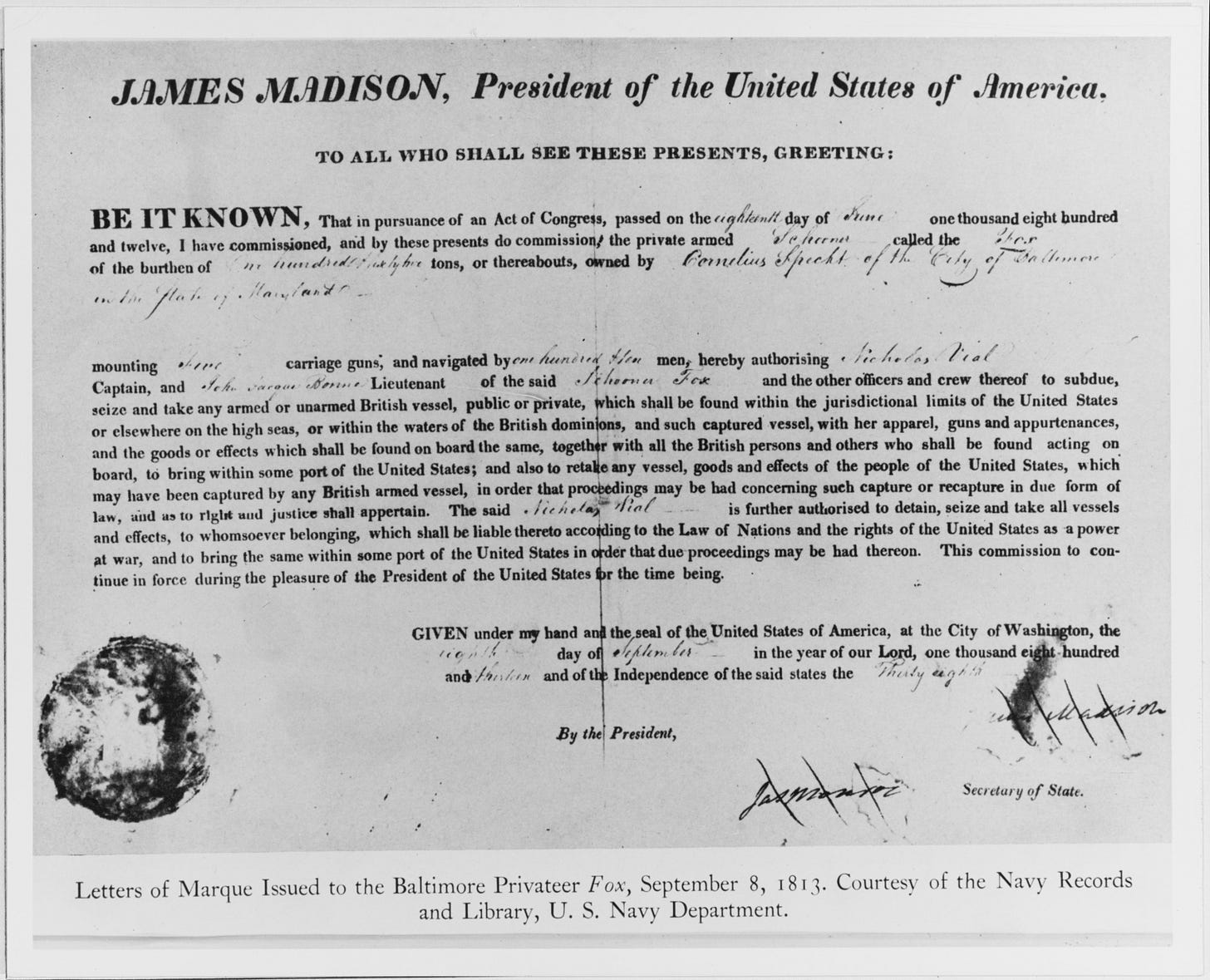
The argument is rooted in a modern strategic problem. A sprawling Russian and Iranian “shadow fleet” continues moving sanctioned oil around the world with relatively little interference, generating billions that help fund Moscow’s war in Ukraine and Tehran’s regional proxies. Meanwhile, the U.S. Navy is stretched thin, America’s commercial fleet has withered, and China dominates global shipbuilding. The proposed answer is to pair private capital with autonomous vessels, AI-enabled surveillance, and updated letters of marque that would authorize licensed firms to help enforce sanctions at sea. Two and a half centuries after private shipowners helped win independence, the question is whether America is ready to harness private enterprise once again as an extension of national power.
Other Reading
Great Americans: The Man Who Put Evil on Trial (The Free Press)
Europe Is Hot as Hell. Why Doesn’t It Want Air Conditioning? (The Wall Street Journal)
Democrats’ ‘Project 2029’ goes after tech companies with online safety plan (Semafor)