
On Our Radar
Inside the American Food System
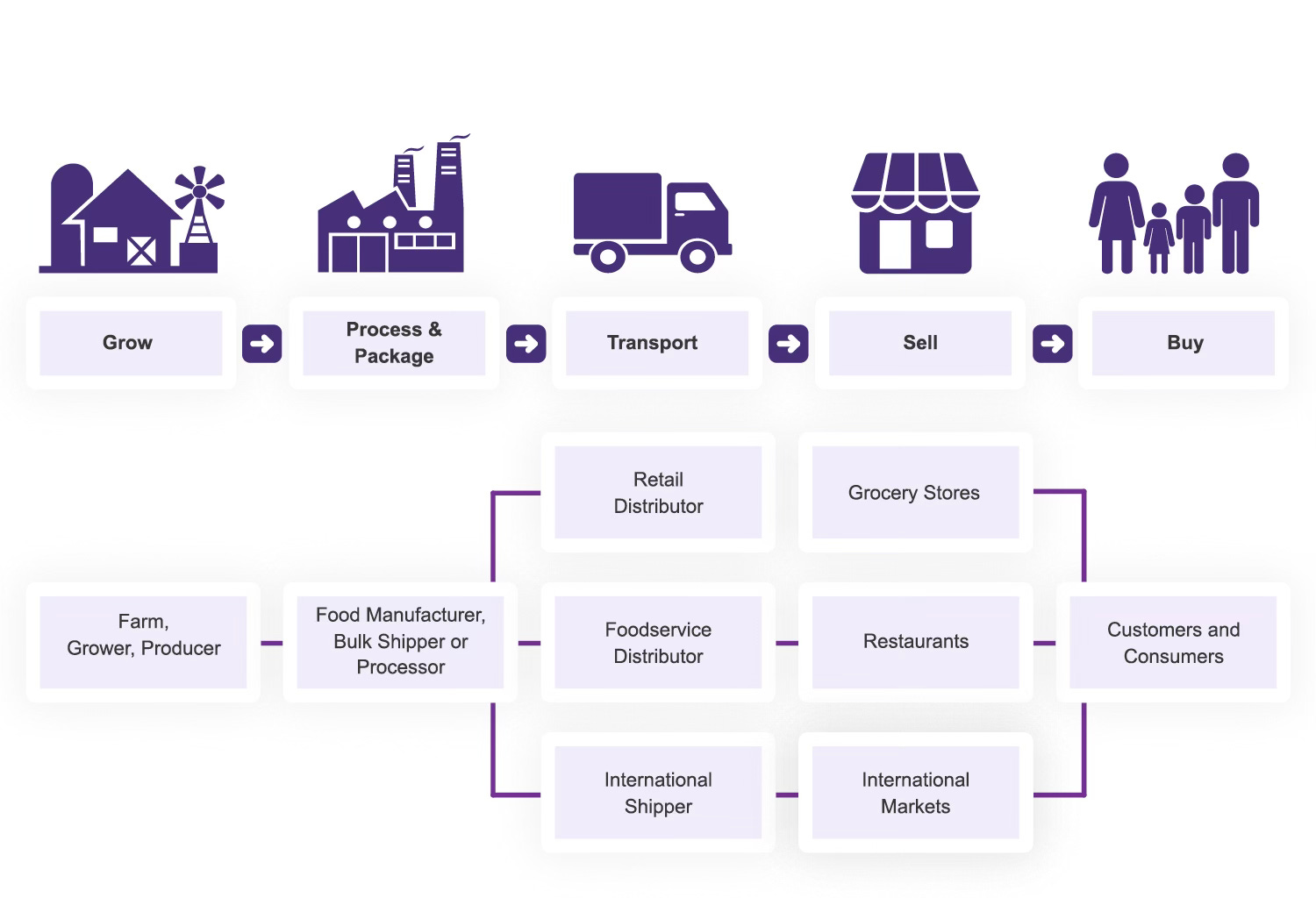
The American food system is massive, sophisticated, and mostly invisible to the people who rely on it every day. What looks like a simple path from farm to grocery shelf is actually a dense industrial web that runs through seed companies, chemical suppliers, logistics firms, processors, financiers, and national retailers. Over time, that web has become more concentrated and more centralized, with a small number of players controlling critical points across the supply chain.
The result has been unmatched efficiency and scale — but also a system that is increasingly exposed to stress. Water shortages, labor gaps, trade disruptions, and rising input costs now shape food production as much as consumer demand. Food security is no longer just an agricultural concern. It has become a question of infrastructure, resilience, and how well a highly optimized system can absorb shocks without breaking.
The New Airspace Economy
The collapse of Europe’s early electric vertical takeoff and landing (eVTOL) firms has left the U.S. as the primary proving ground for electric air mobility. German companies Volocopter and Lilium both failed to reach certification and slid into insolvency, while Archer Aviation has moved in the opposite direction — acquiring Lilium’s assets, securing the official air-taxi partnership for the 2028 Los Angeles Olympics, and purchasing a long-term ground lease at Hawthorne Municipal Airport near LAX. With testing underway in California and large-scale manufacturing coming online in Georgia, Archer is positioning itself as a leading contender to move eVTOL from concept into operational reality.
Founder and CEO Adam Goldstein frames the opportunity as systems engineering rather than just spectacle. Advances in battery performance, renewed geopolitical focus on aerospace leadership, and investor appetite for capital-intensive hardware have converged to make electric aviation viable at scale. The remaining hurdles are regulatory and infrastructural: FAA certification, vertiport networks, and autonomous airspace management. Goldstein’s longer-term vision centers on mass-produced, autonomous aircraft functioning as urban transit — with implications that extend beyond mobility into defense and logistics.
The Logistics Behind the American Revolution
The evacuation of British forces from Boston in early 1776 is often remembered as a symbolic turning point in the American Revolution. Less visible, but equally decisive, was the logistical feat that made it possible. Henry Knox, a 25-year-old bookseller with no formal military training, organized the transport of more than 120,000 pounds of captured artillery from Fort Ticonderoga to Cambridge in the middle of winter — hauling cannons hundreds of miles over frozen rivers and mountain terrain. The operation provided George Washington with the firepower needed to force the British withdrawal without a major battle.
Knox’s “noble train of artillery” turned a disorganized siege into a credible military threat, showing how logistics and infrastructure often shape geopolitical results more than battlefield tactics. Long before industrial supply chains or modern defense procurement, the Revolution was already being won by those who could move heavy things across long distances under pressure.
A Model of State-Led Reform
House Speaker Cameron Sexton joined Senator Bo Watson’s podcast, Tennessee Today, for a wide-ranging conversation covering school choice, healthcare reform, and the future direction of the state. Sexton framed the agenda less as a set of political battles than as practical questions about capacity and growth. Tennessee is expanding quickly, and the core challenge, in his view, is making sure education, infrastructure, and public services evolve fast enough to keep pace.
On school choice, Sexton argued that opportunity should not be dictated by zip code or income, with flexibility positioned as a complement to public schools rather than a replacement. Healthcare reform was framed as a longer-term structural project, centered on reducing administrative drag and shifting more control back to patients and providers. Together, the priorities point to a broader ambition: positioning Tennessee as a model for how a low-tax state can modernize key systems, manage growth, and retain policy independence without relying on federal expansion.
The Long Life of Short-Term Taxes
In California, “temporary tax” has a habit of becoming permanent. The current push for a one-time wealth tax is being sold as an emergency measure, but history suggests otherwise. Proposition 30 offers the clearest precedent: passed in 2012 as a seven-year tax hike on high earners to stabilize education funding, it was extended through 2030 via Proposition 55 and is now on track to become permanent through a new 2026 initiative. What began as a short-term fix quietly turned into a lasting expansion of state revenue.
The deeper issue is structural. Although Prop 30 revenue was legally earmarked for schools, it effectively backfilled the budget, freeing general funds for other spending while total expenditures grew. California now spends over $100 billion annually on K–12 education with only average results, weakening the case that higher taxes automatically improve outcomes. The broader lesson is simple: once Sacramento gains a new revenue stream, it rarely relinquishes it.
A Post-Immigration Labor Market
Palantir CEO Alex Karp used the World Economic Forum in Davos this week to argue that AI-driven automation will reduce the need for large-scale immigration by displacing many white-collar jobs. As artificial intelligence absorbs more analytical and administrative work, Karp suggests labor demand will shift toward skilled trades and vocational roles — jobs that are harder to automate and more rooted in physical systems.
The comments carry weight given Palantir’s role at the intersection of AI, defense, and government operations. While positioning himself as a progressive who’s skeptical of credentialism, Karp points toward a future where workforce policy and economic growth hinge less on global labor flows and more on building domestic technical capacity.
Other Reading
Josh Shapiro Writes That Harris Team Asked if He Had Ever Been an Agent of Israel (The New York Times)
NYSE to Launch 24/7 Trading Platform for Blockchain-Based Securities (The Wall Street Journal)
TikTok Reaches Deal on New U.S. Joint Venture to Avoid American Ban (Reuters)
Private-Credit Investors Are Cashing Out in Droves (The Wall Street Journal)
Humans, A.I. and the Struggle for Control (The New York Times)
The Gold-Plating of American Water (Works in Progress)