On Our Radar
Early Signs of Consolidation on the Right
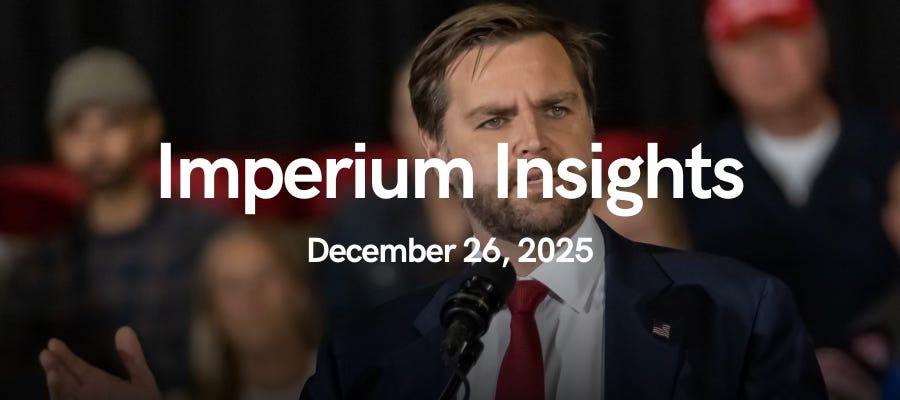
While Donald Trump remains the undisputed leader of the Republican Party, Vice President JD Vance emerged as the dominant figure in the room at Turning Point USA’s AmericaFest last week. Even though 2028 is a political lifetime away, Vance nonetheless won the conference’s straw poll with roughly 85 percent support (well ahead of other potential contenders) and received consistently favorable reactions from younger attendees who appear increasingly comfortable with him as the movement’s focal point.
Vance’s remarks emphasized continuity rather than ambition. He framed his role as stewardship of the “America First” project, grounding his message in cultural cohesion and the legacy of Charlie Kirk, while publicly deferring any discussion of future presidential plans. The broader signal from the weekend was less about an imminent campaign than about consolidation: a conservative base beginning to align early around a figure it sees as capable of translating movement energy into durable governance.

Monetizing Nostalgia
In his piece A Small Town Capitalist Christmas Story, Jarrod Thalheimer uses the unlikely rise of Chickasha, Oklahoma’s fifty-foot leg lamp to explore how nostalgia has become an economic strategy for towns hollowed out by demographic and fiscal decline. As traditional revenue sources weaken, small communities are increasingly turning to shared cultural memory as a substitute for lost industry and investment, betting that pop-culture landmarks can generate the foot traffic policy no longer does.

The leg lamp’s success illustrates an unforgiving dynamic. Nostalgia operates on market terms: sentiment can’t be manufactured, and attention can’t be forced. When the reference resonates, tourists show up and spending follows. When it doesn’t, small towns with limited capital are stuck with the bill.
The Era of Permanent Cyber Conflict
A new report from the Vanderbilt Institute of National Security argues that the United States is already living inside a state of continuous cyber conflict — and that traditional deterrence has failed to keep adversaries at bay. The analysis finds that rivals are exploiting cyberspace below the threshold of armed conflict, probing critical infrastructure and national systems in ways that rarely trigger decisive response.
The authors call for a shift toward what they describe as “digital dominance”: continuous cyber operations, tighter public-private coordination, and resilience built across infrastructure rather than isolated systems. Cybersecurity, in this framing, is no longer a technical back office function but a core element of economic competitiveness and national power. The report’s underlying claim is stark: the question is no longer whether cyber conflict will persist, but whether the United States can adapt quickly enough to compete inside it.
The Next Phase of the GLP-1 Boom

U.S. regulators have approved the first GLP-1 weight-loss pill, a tablet version of Novo Nordisk’s blockbuster Wegovy. Novo Nordisk plans to launch the pill early next year at a significantly lower list price than injectable competitors, betting that convenience and manufacturing economics will broaden uptake.
The move also intensifies competition with Eli Lilly, which is preparing its own oral GLP-1 for approval. Pills are expected to reshape insurance coverage, pricing dynamics, and patient behavior across what analysts project will become a $150 billion market. For Novo Nordisk, the approval offers a chance to regain momentum after ceding market leadership to Lilly.
When Churches Become Financial Assets
A legal fight over a valuable Nashville church has exposed a quiet vulnerability inside many American religious institutions. As congregations shrink and age, churches that once anchored their communities often retain significant real estate and financial assets, overseen by small groups with limited oversight. In this case, a businessman’s swift ascent inside a declining congregation led to allegations of “steeplejacking,” a takeover driven by institutional weakness rather than outright fraud.
Courts are hesitant to intervene on religious grounds, meaning accountability often comes only after assets are already in dispute. As church attendance in many denominations continues to decline, the question is less about individual bad actors than about how many congregations are one newcomer away from losing control of their legacy.
Other Reading
China’s Sprint for Tech Dominance Can’t Hide an Economy Full of Cracks (The Wall Street Journal)
Alphabet Buys Clean Energy Startup For AI Data Centers In $4.75 Billion Deal (Forbes)
The Huge Problem Waymo Didn’t See Coming (The Atlantic)
Trump Announces New ‘Golden Fleet’ of Trump-Class Battleships (The Daily Wire)
Kansas Lawmakers Approve Proposal to Help Chiefs Build New Stadium (ESPN)
Trump Names Greenland Special Envoy as Denmark Blasts Annexation Talk Over Critical Minerals (Foreign Policy)
Training the Idea Muscle (SF Alexandria)
Palmer Luckey on UFOs, Anduril, Invisibility Tech, & Moon Wars (Sourcery with Molly O'Shea)