On Our Radar
Nashville in the Dark
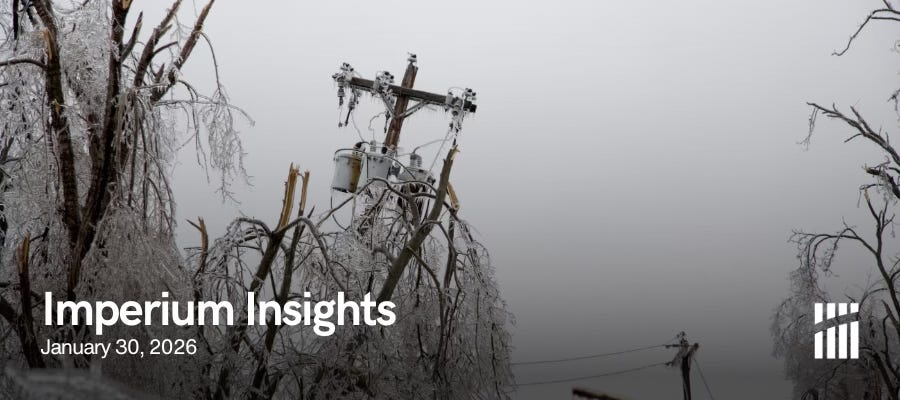
Nashville’s ice-storm blackout has become both an infrastructure crisis and a credibility test — one whose severity the rest of the country has yet to fully grasp. It’s the largest outage in Nashville Electric Service’s history, with more than 220,000 customers initially cut off and more than 84,000 still without power after almost a week. Mayor Freddie O’Connell has acknowledged the scale of the damage but has begun to distance Metro from NES, holding separate briefings as residents grow increasingly frustrated by the lack of clear, neighborhood-level updates on what crews are actually facing on the ground.
That disconnect is turning dangerous as another Arctic surge sends temperatures plunging into the teens. National Guard units are clearing debris, police are checking on elderly residents, and warming centers are filling with people unable to stay in freezing homes. NES says more than 1,000 linemen are working through hundreds of downed poles and tangled lines, but confidence is waning amid mounting questions about staffing, grid visibility, and why some neighborhoods appear untouched.
The New Canadian Fault Lines
Ontario Premier Doug Ford’s blunt warning that a separatist government in Quebec would be a “disaster” captured something many Canadian leaders are reluctant to say out loud: the country is drifting into a moment where unity can no longer be taken for granted. With Parti Québécois leader Paul St-Pierre Plamondon leading in the polls and promising a sovereignty referendum, premiers are moving quickly to project national stability.
What sharpens the moment is that Quebec is no longer alone. In Alberta, a separatist petition is gathering signatures, reflecting a wider current of Western alienation even if independence remains a minority view. Prime Minister Mark Carney has leaned hard into national unity and economic cohesion, but the reappearance of exit politics in two provinces at once points to a deeper strain throughout the country.
Anthropic CEO’s Warning for Humanity
Anthropic CEO Dario Amodei went to Davos with an unusually blunt message: artificial intelligence is about to outrun the systems meant to control it. In a new 38-page essay, he argues that within a few years we may face what he calls a “country of geniuses in a datacenter” — AI systems that outperform humans across science, engineering, and strategy. If current progress holds, machines won’t just support work, they will run it, building software, designing drugs, and potentially developing weapons on their own. The risk, Amodei warns, is that exponential technology is colliding with political and social institutions built for a slower world.
Amodei predicts massive white-collar job losses, rising biological and security risks, and the danger of AI being captured by authoritarian governments or even by the companies that build it. With trillions of dollars and geopolitical power at stake, he argues, the greatest danger is not that the world lacks solutions — it’s that no one will have the will to slow down long enough to use them.
The Hunter Remaking Trump’s K Street
Ches McDowell has become one of the most visible figures in Trump-era Washington, a big-game hunter turned lobbyist whose rise tracks closely with Donald Trump’s return to the White House. He’s built Checkmate Government Relations into a powerhouse, pulling in more than $21 million since July from clients like Eli Lilly, Novo Nordisk, Juul Labs, and Hanes.
McDowell frames his work as part of the promise to “drain the swamp,” arguing that traditional K Street firms no longer matter inside a Republican Party he sees as firmly MAGA. For him, hunting and lobbying are the same game of strategy and positioning — whether outsmarting a black bear on the North Carolina coast or threading recognition for the Lumbee Tribe into a $900 billion defense bill. From Raleigh to Washington and now Doha, he’s building Checkmate as a lasting fixture of the Republican power network rather than a four-year bet on one administration.
China’s New Taiwan Playbook
China has quietly moved a new class of amphibious “invasion barges” into the South China Sea. The ships aren’t traditional warships; they’re massive, self-propelled jack-up barges designed to roll out temporary roadways from sea to shore. Their purpose is straightforward: they allow China to move fuel, vehicles, heavy equipment, and personnel directly onto hostile beaches without needing functioning ports, a long-recognized vulnerability in any Taiwan invasion scenario.


These barges are designed to work alongside China’s amphibious assault fleet to create a continuous, mobile supply chain on occupied territory, turning an initial landing into something sustainable. Military analysts have long argued that Taiwan’s ports and airfields would be among the first targets in any conflict, making resupply the hardest problem for Beijing to solve. The Shuiqiao system is a direct answer to that constraint, signaling that China is no longer just rehearsing how to get troops ashore, but how to keep them there.
The Hall of Fame vs. Bill Belichick
Bill Belichick’s failure to make the Pro Football Hall of Fame on his first ballot had less to do with football than with unfinished grudges. Despite a résumé that includes eight Super Bowl rings, 333 wins, and a dynasty that reshaped the NFL, several Hall of Fame voters reportedly balked because of Spygate and Deflategate. According to ESPN, former Colts and Bills executive Bill Polian quietly encouraged some voters to make Belichick “wait a year” as a form of penance. One voter put it more bluntly: the “cheating stuff” still bothered people enough to override the most dominant coaching career of the modern era.
The decision ripples beyond Belichick himself. By holding back a first-ballot lock, voters have jammed up the entire coaches’ queue, pushing figures like Mike Shanahan, Tom Coughlin, and Mike Holmgren further down the line. It also reinforces what insiders privately admit Belichick understands: Hall of Fame voting is not a clean meritocracy. It is a political body that sometimes uses delay as a way to signal moral judgment, even decades after the trophies have been handed out.
Other Reading
Jonathan Bernstein: Writer, Justin Townes Earle Biography (Spotify – Banner & Company)
The Venezuela Opportunity (Not Boring)
Anduril Has Invented a Wild New Drone-Flying Contest Where Jobs Are the Prize (TechCrunch)
Elon Musk’s Neuralink Says 21-Year-Old Paralyzed Man Sends First Thoughts to Phone (Yahoo News)
Nashville Winter Storm Leaves Belle Meade Reeling (Nashville Banner)
Carney’s Quebec Speech Prompts PQ Fury (CBC News)
OpenAI Plans Fourth-Quarter IPO in Race to Beat Anthropic to Market (The Wall Street Journal)