



Imperium is tracking seven stories this week, from the changing rules of American media and the return of organized labor to the fight over truth, creative freedom and what makes a nation strong. We’re looking at the new ways Americans are moving, why Ukraine’s people have refused to fold, and what Apple’s new CEO inherits as he takes the reins of one of the world’s most powerful companies. Here’s what we’re watching:
On Our Radar
The New Media Model
Clay Travis has spent the last two decades watching America’s media landscape change — and helping change it himself. Since taking over Rush Limbaugh’s old time slot in 2021, his Clay Travis & Buck Sexton Show has grown into the top-ranked talk radio show in its time slot, reaching roughly 7 million monthly listeners across 550 stations. The formula is part of what makes it interesting: politics mixed with sports and culture, delivered with a more conversational tone than much of conservative media. Travis had already proven he could build an audience outside the traditional media world with OutKick, which he launched in 2011 and sold to Fox for $100 million in 2021. Now he’s doing it again with Sport & State, a new media venture built around the same mix of sports, politics and culture.

What Travis’ career shows is how much the rules of American media have changed. The old gatekeepers still exist, but they no longer control who gets heard — or where people go for information and entertainment. Travis built an audience by giving people something they weren’t finding elsewhere, then turned that audience into businesses of his own. Sport & State is his latest bet on that model, and it shows what’s possible for people willing to work hard outside the old rules of media.
Labor Makes a Comeback
After decades of declining influence, organized labor is finding new relevance in America. A new Gallup poll finds 71% of Americans approve of unions, matching a modern high, while 52% of Republicans now say they approve of them — only the second time in 25 years a majority of Republicans have felt that way. But the more interesting shift may be what unions are doing with that renewed support.
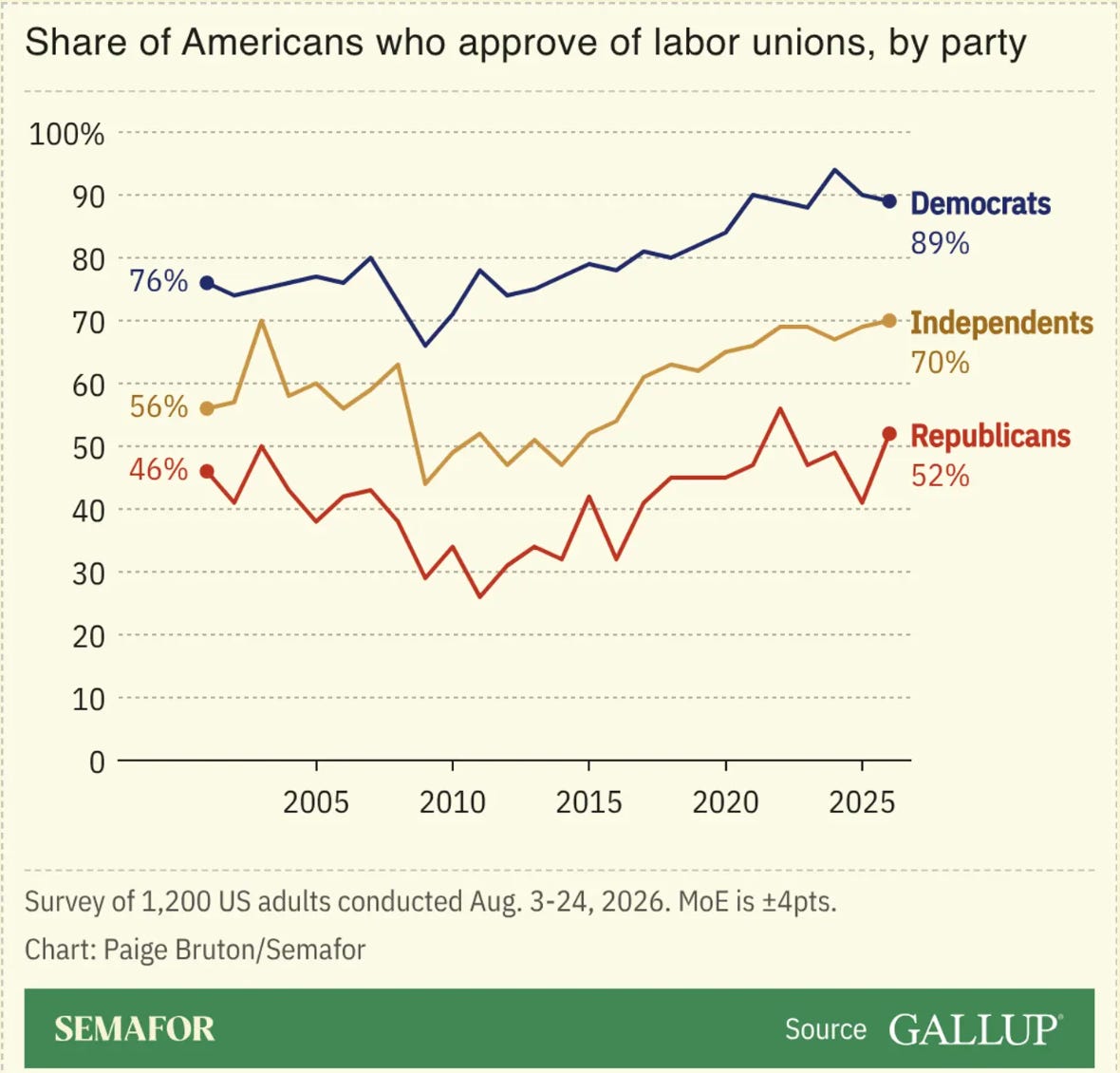
They’re increasingly making the case for building. In the fight over data centers, electricians and other union workers are showing up at city council and planning meetings to defend projects that could create thousands of well-paying construction jobs. Some unions are even threatening to withhold support from politicians who oppose them, while candidates in both parties have started reconsidering their positions as the midterms approach. The same data centers that have become a symbol of Big Tech’s growing power are creating an unlikely alliance between organized labor and the push to build more. Meanwhile, much of Big Tech has been surprisingly quiet about the backlash. For all the talk about bringing America into the future, the companies building that future still have to convince the communities doing the building that they stand to benefit, too.
Defending Reality
Next Friday marks 25 years since September 11, 2001 — a day that changed America and much of the world that followed. But as the memory of 9/11 becomes something younger Americans know only through history books, videos and stories from others, that distance creates fertile ground for a different kind of battle: one over the truth of what happened.
Conspiracy theories surrounding 9/11 have found audiences across the political spectrum, part of a broader culture increasingly willing to question even the most well-documented events. The problem goes beyond getting history wrong. A country that loses its shared understanding of the past has a harder time understanding the present — or facing the future together. The debate over 9/11 is ultimately part of a larger question about how a country preserves a shared understanding of reality as memories fade and misinformation spreads.
Who Owns the Future?
Sony Music and Warner Music are suing Anthropic, alleging the AI company unlawfully trained its models using thousands of copyrighted compositions. The scale of the lawsuit is what makes it notable: the music industry is once again confronting a technology that can copy and distribute creative work at a scale that would have been unimaginable a generation ago.
We’ve been here before. Napster and LimeWire helped usher in the digital music era by making it possible to share virtually any song with a few clicks, forcing the industry and lawmakers to wrestle with a basic question: does new technology change what people have a right to own? AI is asking that question all over again. Innovation is a defining part of American strength, but so is the freedom to create, own and profit from what you build. The challenge is making sure one kind of freedom doesn't come at the expense of another.
Movement Signals
Sometimes you can see where America is going by watching where people move. Strava offers an unusual way to do just that. Ironman participants have average household incomes roughly three times the national average, while more than 76% of core runners are college graduates, compared with about 30% of Americans overall. The neighborhoods where people run, walk and bike also tend to have better infrastructure and higher incomes. Movement, it turns out, can be a pretty good signal of what people value — and where they want to live.

That matters because America is changing faster than the data used to measure it. Census figures can take years to catch up with a neighborhood, while a running heat map shows where people are actually moving today. In Indianapolis, neighborhoods with more running activity tend to have higher household incomes — and that relationship may be one way to spot neighborhood change before the traditional numbers catch up.
A Nation Worth Fighting For
Russia had the army, the tanks and the element of surprise. Ukraine had something harder to measure: a population willing to fight for its country. When Russia invaded in 2022, it expected Ukrainians to fold. Instead, ordinary citizens joined the military, defended their cities and fought for a free Ukraine. One man with an exemption because he had more than two children still volunteered to fight. When he finally told his wife, she told him that if he hadn’t gone, she would have. That kind of determination is difficult to manufacture, and even harder to defeat.
The story also exposes a weakness in authoritarian power. Authoritarian regimes can project enormous strength while making the mistake of assuming the people they intend to control will simply submit. Putin believed Ukrainians would surrender because he underestimated what people will do when they have something they genuinely believe is worth defending. National power isn’t just measured in weapons, wealth or technology. Ukraine has shown how much harder a country is to defeat when its people are willing to sacrifice for it.
Apple’s New Boss
Apple has a new boss, and he inherits one of the strongest positions in corporate America. John Ternus takes over from Tim Cook with Apple valued at roughly $4.6 trillion, more than 2.5 billion active devices around the world and an enormous pile of cash to put to work. Unlike many of its Big Tech peers, Apple has remained relatively light on fixed assets and has avoided the massive data-center spending now consuming the rest of the industry. Ternus, a longtime hardware engineer who helped lead the development of products including the AirPods and Apple Watch, now has the financial flexibility to decide where Apple goes next — from AI and new devices to potentially making bigger bets on manufacturing and infrastructure.

His arrival is already showing a different side of the Apple CEO. On his first day in the job this week, Ternus joined X, with his first post saying “hello.” It’s a small move, but a notable one for a notoriously private company and an executive who has spent 25 years largely behind the scenes. Apple has the money, the customers and the freedom to make its next big bet. Now it needs a leader willing to make it.

Other Reading
The Political Constraint on America’s Data-Center Power Buildout (War on the Rocks)
Jury Finds Duane Davis Guilty Of First-Degree Murder For Killing Tupac Shakur (Forbes)
John Galliano Has Paid for His Crimes. Will Anna Wintour? (The Free Press)
The Woman at the Center of Japan’s Currency Fight (The New York Times)