


Across politics, markets, and technology, this week’s stories trace how institutions adapt as familiar playbooks begin to shift. From Washington’s evolving China strategy to the military’s nicotine debate and private players reshaping space, the throughline this week is experimentation at the edge of old frameworks.
On Our Radar
Trump’s China Strategy
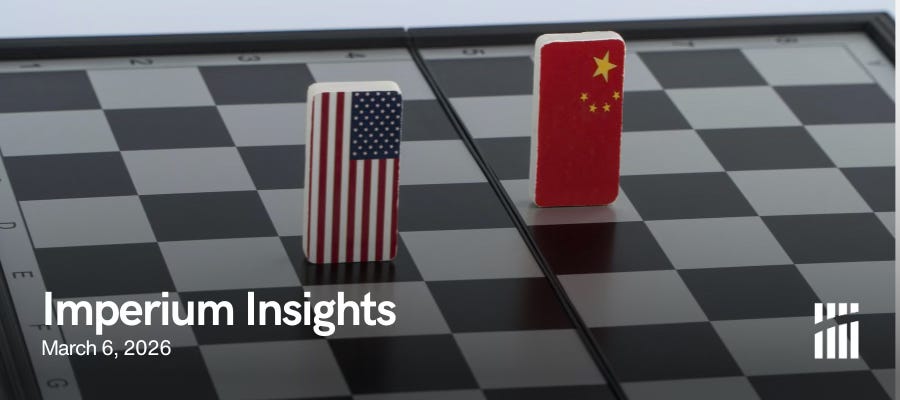
Washington’s recent moves against Iran, Venezuela, and other adversarial regimes are being framed around their immediate threats — nuclear escalation, narco-terror networks, and regional instability. For Iran, that pressure is already reshaping local dynamics, with Kurdish groups and other actors emerging as potential forces in the next phase of the campaign. But taken together, these actions also point to a broader strategic pattern: applying pressure on governments that sit at key junctions of China’s expanding geopolitical network.
Seen through this lens, the administration’s approach accomplishes two things at once. Confrontations that address acute security problems also chip away at the outer layer of China’s global partnerships. Weakening regimes aligned with Beijing — from Caracas to Tehran — limits the reach of China’s partnerships while signaling that Washington is willing to contest that network far beyond the Pacific.
Lt. Gen. (Ret.) Charlie Moore, Distinguished Visiting Professor at Vanderbilt’s Institute of National Security, joins Hannity to discuss the U.S. military campaign in Iran.
The Post-Performance Economy
The Swiss watch industry’s collapse in the 1970s offers a surprisingly clear window into a broader shift in modern markets. When Japanese competition, currency shocks, and quartz technology made precision timekeeping cheap and ubiquitous, the traditional advantage of Swiss watchmakers disappeared. The companies that survived did so by abandoning the old competition over engineering performance and pivoting toward something else entirely: brand. Mechanical watches stopped being primarily tools for telling time and became status symbols designed to signal identity and prestige.
As technology erases meaningful performance differences between products, competition increasingly shifts from function to perception. Companies differentiate through design and narrative rather than technical superiority. The Swiss watch industry’s reinvention — turning obsolete technology into luxury goods — became an early example of the “brand age,” where reputation and signaling often matter more than the underlying product itself.
The Military’s Nicotine Question
Current U.S. military tobacco policy treats all nicotine products the same, but the reality on the ground looks very different. While official guidance aims for a “tobacco-free” force, a significant share of service members still use nicotine in some form. The growing availability of smoke-free options has begun to shift that landscape, raising questions about whether policies built around cigarettes reflect on-the-ground reality for our warfighters.
The distinction matters operationally. Combustible cigarettes create visible signatures and fire risks in environments where concealment and safety matter. Smoke-free products avoid many of those drawbacks while remaining usable in confined or high-tempo settings like aircraft, submarines, and extended deployments. The pattern resurfaces a familiar dynamic in military history: frontline adaptation often moves faster than formal policy.

The Return of the American Tavern
For years, the small-town American tavern seemed like another institution fading from the landscape, squeezed between destination restaurants and the economics of modern dining. But across the country, chefs are quietly reviving the model. From historic inns in the Northeast to new restaurants in rural towns, the tavern format—simple food and a long bar — has begun to reappear as an alternative to both high-end menus and fast-casual chains.
Part of the appeal is structural. Running a tavern allows chefs to step away from the pressures of urban fine dining while still building a viable restaurant around a loyal local base. The result may be a renaissance of establishments that operate as both kitchen and gathering place, serving locals and visitors at the same bar.
Building the Post-ISS Orbital Economy
The International Space Station is approaching the end of its operational life. NASA plans to retire the ISS by 2030, leaving a major question about who will maintain a continuous human presence in low Earth orbit. A new generation of privately built stations is now emerging to fill that gap, showing a broader shift in how space infrastructure is financed and operated.
Among the most ambitious efforts is Vast, a California-based company developing a series of modular space stations intended to support research, commercial activity, and long-duration human habitation. Its first station, Haven-1, is designed as a compact proof-of-concept platform scheduled to launch later this decade, while the larger Haven-2 aims to support continuous crews and eventually replace many of the ISS’s functions. As launch costs fall and private investment rises, orbital infrastructure is shifting from government programs toward companies racing to build the first true destinations in orbit.
Mark Green Faces Lawsuit Over Guyana Energy Venture
Former Tennessee congressman Mark Green and a business partner are facing a lawsuit tied to a venture in Guyana’s growing energy sector. The complaint alleges that Green and lobbyist Marc Hebert used confidential trade information from one of Hebert’s clients to launch a competing company, Prosimos, while Green was still serving in Congress. The suit also claims the pair suggested they could leverage political connections to complicate a pending fuel agreement between the client and the Guyanese government.
The case comes as Guyana has rapidly emerged as one of the world’s newest energy frontiers. Since the discovery of major offshore oil reserves in 2015, the small South American country has attracted intense interest from international firms and governments seeking a foothold in its expanding energy infrastructure.
Other Reading
Accused Of Copying U.S. AI, Chinese Founders Mint Billions — (Forbes)
If We Don’t Build Data-Centers Here, Someone Else Will — (All-In)
Netflix Says No Thank You to Warner Bros. Discovery — (Semafor)
Starbucks Selects Tennessee for Southeast Corporate Office — (TNECD / State of Tennessee)
Joe Gebbia Is Making the Government More Like Airbnb — (The Free Press)
Time to Win — (IM–1776)