


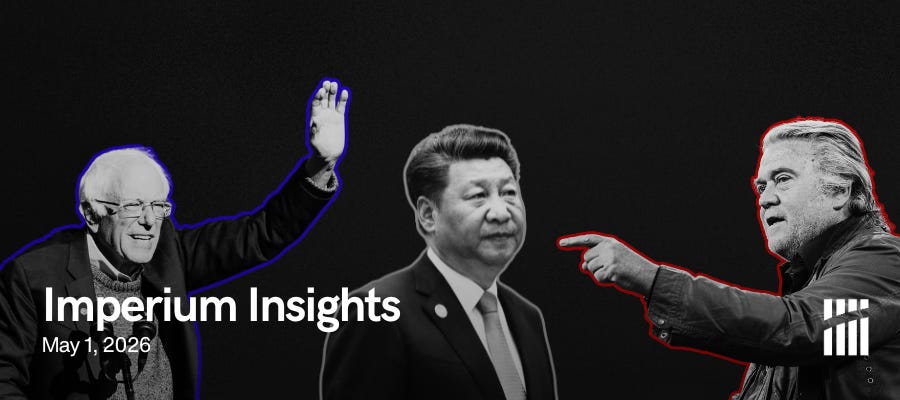
This week we’re tracking six stories, from an unlikely Bernie-to-Bannon populist coalition selling cooperation with China as a path to AI safety, to American luxury brands quietly outmaneuvering Europe. In between, a new frontier AI model is reshaping cybersecurity, Nashville's community banks are facing a once-in-a-generation customer shake-up, drones are engineering rain over Utah, and Susie Wiles is stepping out from behind the scenes.
On Our Radar
Populism Meets the AI Race
Sen. Bernie Sanders is trying to recast AI not as a race with China but as a shared global safety challenge, putting him at odds with the dominant bipartisan consensus in Washington. His call for U.S.–China cooperation on AI safety, along with an emerging “Bernie to Bannon” populist lane that stretches from Sanders’ progressive base to Steve Bannon–aligned conservatives, channels growing backlash to perceived elite‑driven technological expansion. The coalition is notable for its unlikely pairing, but its core prescription remains largely rhetorical without much clarity on what enforceable rules would actually look like.
The strategic problem is harder. China has a long history of selectively engaging with international frameworks and discarding or reshaping them when core interests are at stake, from trade and industrial policy to cyber operations and security commitments. That record makes Sanders’ cooperation‑first vision look less like a realistic safety strategy and more like a naive bet that Beijing will treat AI differently from nearly every other competitive domain. That leaves the “Bernie to Bannon” populist coalition as a vocal vessel for distrust of AI acceleration, but one still short on a workable framework for managing AI risk in a world where strategic competition remains the baseline.
The Golden Opportunity for Nashville’s Community Banks
Imperium Chief of Staff James Stinnett argues that Nashville’s banking market is undergoing a structural disruption local institutions can’t afford to treat as business as usual. Consolidation is pushing customers through mergers that weaken service and loyalty, out-of-state banks are aggressively expanding into Middle Tennessee, and one of the nation’s most significant waves of wealth and household migration to the region is funneling new residents into a narrow decision window where they are actively re-evaluating where to bank.
The thesis is straightforward: in this environment, competitive advantage is not only about competing at the product level but about which institutions are positioned to reach customers precisely when they are actively re‑evaluating their banking relationships. The community banks that will convert this reshuffled environment into durable market share are those that treat consolidation as a customer‑acquisition event, build disciplined strategies around movers already in play, and pair authentic local presence with targeted digital and relationship‑driven outreach — ensuring that when merger‑weary clients or new residents look for a Tennessee banker, they find what they actually came to Tennessee for in the first place: community, not a call center.
Cybersecurity’s AI Reckoning

Vanderbilt’s Brett Goldstein, special adviser to the chancellor on national security and strategic initiatives, points to Anthropic’s new Claude Mythos model as evidence that cybersecurity is shifting from a niche technical issue to a broader resilience problem. Mythos has already shown it can uncover software flaws at a pace that would take human experts days or weeks, and Goldstein argues that as models like this improve, the gap between large institutions and everyone else will widen. Big companies will scramble to harden their systems while smaller organizations and everyday users are left more exposed in a world where AI is speeding up both software creation and software exploitation at the same time.
Goldstein still sees basic habits like better passwords, passkeys, timely updates, and stronger authentication as the non‑negotiable front line, but he’s blunt that those steps alone won’t offset what Mythos‑class tools make possible. In his view, frontier AI firms and policymakers will have to treat cybersecurity more like critical infrastructure. Once an unreleased model can quietly find thousands of vulnerabilities across core software, “cyber” can’t sit in the IT department; it moves into the center of national security planning.
America’s Quiet Luxury Boom
American luxury brands are finding room to run at a moment when much of high-end fashion is stalling. While European groups wrestle with softer demand and years of aggressive price hikes, Ralph Lauren and Coach have done the unglamorous work of fixing distribution, stores, and positioning, and The Row has built a following at the very top of the market by keeping product scarce. The impact has been a cluster of American names that feel current to shoppers who still want status and quality but aren’t automatically reaching for a European logo.

American brands are showing they can hold both the middle and the top of the market, catching aspirational buyers trading down from European prices and serving ultra-wealthy clients who increasingly prefer less flashy, toned-down offerings. European labels are trying to claw back momentum with new creative directors and more careful pricing, but the idea that only Paris and Milan define luxury no longer fits a world where New York brands are increasingly driving the market.
Engineering Rain in the American West
California-based start-up Rainmaker claims it is the first U.S. commercial cloud-seeding operation to show physical proof that its technology generated precipitation, reporting that its drones produced about 142 million gallons of water as snow over parts of Utah and Idaho. The company uses unmanned aircraft to release silver iodide into cold clouds and says radar data show unambiguous “seeding signatures” linking its flights to added snowfall.
Scientists say the approach is promising but still modest, adding only a small fraction of the water needed to stabilize the shrinking Great Salt Lake and ease the West’s broader drought. Utah has expanded its cloud‑seeding budget and shifted from piloted aircraft to drones, treating the technology as a relatively low‑cost way to incrementally boost snowpack, even as state officials and researchers stress that it is no substitute for large‑scale conservation and changes in water use.
Trump Chief of Staff Susie Wiles Joins X
White House Chief of Staff Susie Wiles has launched an official X account to share updates about the Trump Administration’s efforts, saying she plans to use the platform to highlight the work being done to advance President Trump’s agenda and deliver for the American people. The move gives one of Trump’s closest but usually behind-the-scenes advisers a more public-facing voice to provide insight directly from the White House.
Other Reading
Stablecoins are Going Local (a16z crypto)
Sabastian Sawe Breaks Two-Hour Barrier in London Marathon World Record (The Guardian)
Quantum Computing Companies are in a Race to Go Public (The Wall Street Journal)
38 state AGs sign amicus brief supporting Mass. in Kalshi Lawsuit (State Affairs)
We’re in the ‘Call Me Maybe’ Era of M&A (Semafor)
In Major Voting Rights Act Case, Supreme Court Strikes Down Redistricting Map Challenged as Racially Discriminatory (SCOTUSblog)
LIV Golf and the PGA Tour’s Stand-Off Over Bryson DeChambeau (The Wall Street Journal)
When War Meets Instagram (The Grill Room)
Trinidad Chambliss and the Future of Culture (Vanity Fair)
Amazon Discusses ‘Apprentice’ Reboot with Don Jr. as Potential Host (The Wall Street Journal)
Big Tech Firms Beat Earnings Expectations Amid AI Spending Questions (Semafor)
Opinion | Silicon Valley Is Bracing for a Permanent Underclass (The New York Times)