
On Our Radar
The Assassination of Charlie Kirk
Conservative activist Charlie Kirk was shot and killed while speaking onstage at Utah Valley University, a shocking act of political violence that reverberated far beyond campus. Just 31, Kirk was the most successful youth organizer of his generation, building Turning Point USA into a powerhouse that mobilized thousands of students with a message he insisted was once simple common sense: America is the greatest country in history, the Constitution its greatest political document, and capitalism the surest path out of poverty.
Utah officials identified the suspected gunman as 22-year-old Tyler Robinson, arrested Friday after investigators matched him to campus surveillance footage. Gov. Spencer Cox said Robinson’s family members had raised concerns, noting he had become “more political” in recent years and mentioned Kirk’s UVU appearance before the attack.
His murder comes amid a surge of political violence that has touched both officials and citizens: shootings at congressional baseball practice, attacks on justices, arson at governors’ mansions, the killing of two young Israeli embassy employees, and multiple assassination attempts on President Donald J. Trump during the 2024 campaign. To Kirk’s allies, his killing is both a personal tragedy and a grim symbol — that speaking freely on an American campus, once a democratic ideal, now carries mortal risk.
Vols’ Quarterback Shakeup Sets Stage for Georgia Clash
This weekend’s Tennessee–Georgia matchup carries more weight than a typical SEC showdown — it’s the backdrop for one of the wildest quarterback stories in the transfer portal era. Joey Aguilar, who began at the JUCO level before stints at Appalachian State and UCLA, is now leading the Vols after Nico Iamaleava stunned Tennessee by entering the portal in April, triggering a rare quarterback “swap” that sent Nico to UCLA and Aguilar to Knoxville. While Iamaleava has struggled to settle in Los Angeles, Aguilar has quickly won over Tennessee fans with his play and presence, guiding the Vols to early wins and embracing the program’s culture. Now he faces his biggest test: a chance to topple Georgia and end the Vols’ nine-year drought against the Bulldogs — a win that could cement his place in program lore.
Dead Internet Theory Isn’t a Conspiracy Anymore
About a third of all internet traffic now comes from bots, according to Cloudflare, and even Sam Altman, the CEO of OpenAI, admits that Twitter and Reddit feel a lot “faker” than they did just a couple of years ago. The idea, sometimes called the “dead internet theory,” is that more and more of what we see online is written, shared, and amplified by bots rather than people. That problem existed before ChatGPT, but with AI tools now able to post, comment, and even browse the web like humans, the line between real and fake is blurrier than ever. Altman has even warned that AI is breaking the systems we rely on to prove we’re human, making scams easier — but he hasn’t slowed down development. Instead, the risk is that the internet itself keeps drifting toward a place where it’s harder and harder to know what’s real.
Abundance Can’t Survive the Left
Writer Mike Solana takes aim at the Democratic Party’s new “Abundance” brand, a reframe of progressivism that promises cheaper housing, better infrastructure, and futuristic projects like bullet trains and clean energy. While the vision sounds appealing, he argues it’s undermined by contradictions inside the left itself — from democratic socialists who still oppose market-rate housing to union interests that benefit from endless process rather than finished projects. Figures like New York’s Zohran Mamdani have adopted abundance rhetoric, but their policies remain rooted in socialism, while leaders like Gavin Newsom chase headlines rather than results. Solana’s conclusion: abundance may be a clever slogan, but without power, discipline, and the will to actually build, it risks becoming little more than a rebrand for a party paralyzed by its own base.
AI Use Down at Big Firms, but the Story’s More Complicated
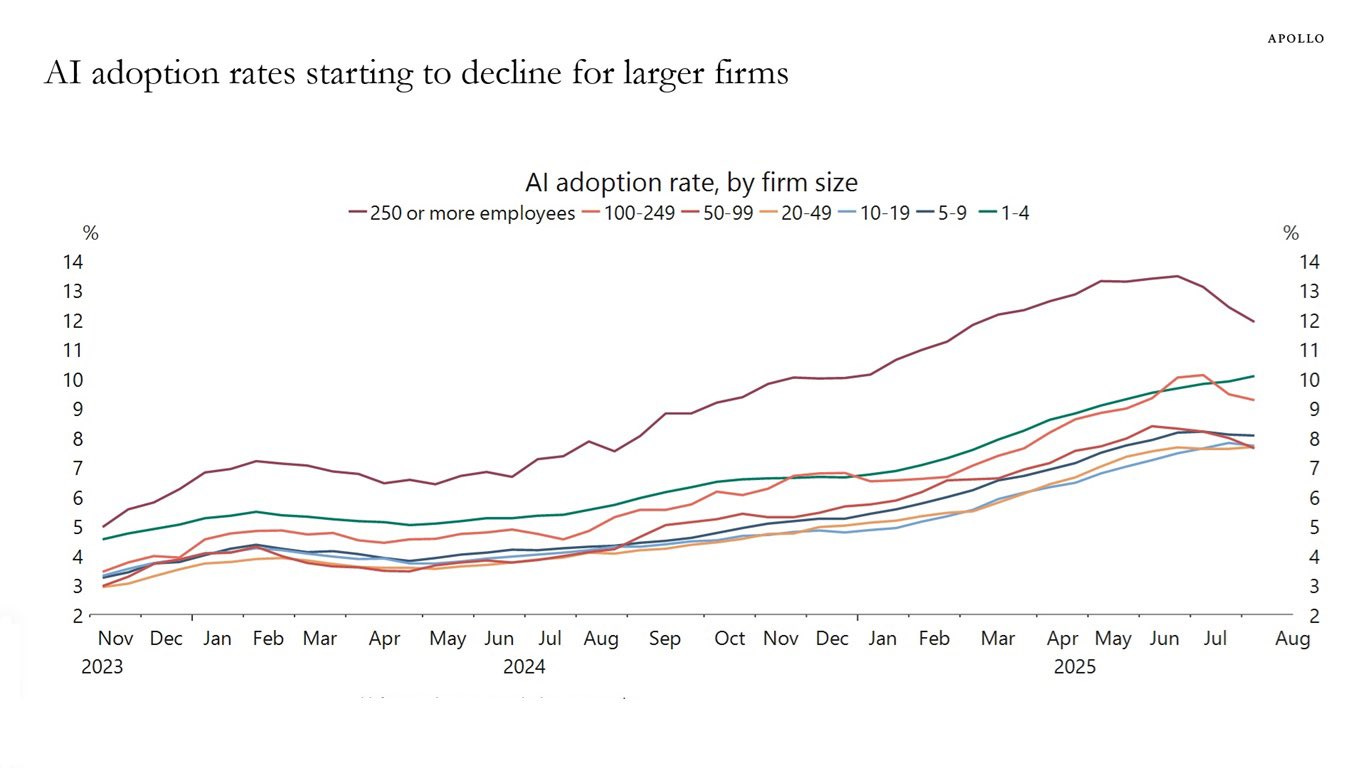
A viral Census Bureau chart showing a drop in AI adoption looks like bad news for tech, but the picture is misleading. The decline is concentrated in large firms, where “AI transformation” projects often sputter, while smaller businesses continue steady, practical use. The Census also reports fewer than 10% of firms using AI—at odds with surveys showing over half of U.S. adults rely on tools like ChatGPT—because its definition of AI includes everything from machine vision to data analytics that most owners don’t think of as “AI.” In reality, adoption is rising in ways the survey doesn’t capture: fraud detection in Stripe, receipt scans in Ramp, and LLMs inside Google Apps. The trend isn’t retreat, but AI becoming so embedded in everyday tools that businesses stop noticing it.
Other Reading
Japan Conducts First Successful Ship-Based Railgun Test (SOFX)
Albania Appoints AI Bot as Minister to Tackle Corruption (Reuters)
The United Arab Emirates Releases a Tiny but Powerful AI Model (Wired)
What is Blueskyism? (Silver Bulletin)
Where is 'College GameDay' This Week? (Knox News)
USMNT After One Year of Pochettino: Shake-ups, Process and an Unclear World Cup Outlook (The Athletic)
Poland Downs Drones in its Airspace (Reuters)
China's New AI Plan (ChinaTalk)
Hello Patient Secures $22.5M as Investors Bet on AI Voice Agent Growth (Fierce Healthcare)