



This week’s edition is tracking how institutions adapt — from Apeel Sciences becoming a case study in surviving a coordinated disinformation attack to Ukraine rewriting the playbook on modern air defense. Plus, national awards for the Imperium team, the RNC's record-setting midterm war chest, the small-town music circuit drawing summer travelers, and license plate reader networks reshaping public safety. Here's what we're watching:
On Our Radar
The Fight Over the Future of Food
Apeel Sciences founder James Rogers — whose company has been a longtime Imperium client — appeared on TBPN this week, the daily live tech talk show recently acquired by OpenAI, to discuss how the company became one of the clearest real-world examples of online disinformation distorting a market.
The Free Press detailed how a pair of misleading Facebook posts snowballed into a coordinated disinformation campaign that wiped out Apeel’s domestic revenue and pushed a category-defining ag-tech product out of the American market — turning the company’s experience into a cautionary tale for any innovator building a business in the modern information landscape. Working alongside Imperium, Apeel has recentered the conversation on building the future of food innovation.
The disinformation campaign obscured the bigger story: the post-harvest industry underpinning the U.S. food system has remained largely unchanged for decades while technology has transformed nearly every other sector of the American economy. Apeel is building toward that same transformation in ag-tech.
Imperium Honored on the National Stage
Last week, our team traveled to New York for the Public Relations Society of America's Silver Anvil Awards and returned to Music Row with national recognition: Awards of Excellence in both the Crisis Communications and Boutique Agency categories amid a crowded field that included work from Ketchum, Burson, Weber Shandwick, and FINN Partners. PRSA's national awards represent the highest standard in the profession and are reserved for work that pairs strategic rigor with measurable real-world impact. Earning a place in that cohort puts Imperium in rare company — and marks the firm as a national player operating at the leading edge of where the field is headed.

Modern public affairs requires coordinated judgment across multiple arenas at once. That’s exactly the environment Imperium was built for — a world where communications, legal, marketing, government relations, and brand building increasingly blur together. We’re energized by the recognition and excited for the year ahead!
The Midterm Split Screen
The RNC is heading into the 2026 midterms with more cash on hand than at any point in its history. The committee reported $123.8 million in reserves after April and is already investing heavily in battleground‑state infrastructure, including election‑integrity operations and turnout efforts across key states. The successful fundraising effort is being led by Vice President JD Vance in his role as RNC finance chair as Republicans prepare to defend narrow congressional majorities in what is historically a challenging midterm environment for the party in power.
On the other side of the aisle, Democrats are still bogged down in a public argument over what went wrong in 2024. The DNC’s long‑awaited 2024 “autopsy” was met with frustration across the party for avoiding some of the most contentious questions surrounding the election, including President Biden’s age, Kamala Harris’s accelerated nomination process, foreign policy missteps, and broader messaging failures. A striking split‑screen is coming into focus: Republicans projecting organizational confidence and financial momentum while Democrats remain consumed by unresolved debates about what the party stands for and how it reconnects with voters.
The Small Town Music Circuit
Smaller music towns are drawing increased attention as the summer travel season kicks off, particularly those where live events are built around working musicians and local tradition rather than entertainment‑district formats. The pattern points to a distinct segment of the summer vacation market: regional destinations where the music experience is intimate and accessible within a short drive from major metros.
Local favorite Leiper’s Fork, roughly 30 minutes from Nashville and one of the destinations on the list, is exactly what this shift looks like in practice. Fox & Locke’s listening‑room format and preservation‑minded development have positioned the village as a low‑key alternative to Lower Broadway, with consistent programming that draws serious songwriters in an informal setting. Similar hubs across the South — built around festival weekends and small‑venue calendars — show how much demand still exists for music scenes that feel tied to the communities around them.
The Future of Air Defense
Ukraine’s response to Russia’s drone and missile campaign is turning into a case study of what modern, low-cost air defense looks like. Rather than relying primarily on a small number of expensive systems, Ukraine has spent the past several years building a layered network around interceptor drones, decentralized sensors, AI-assisted targeting software, and close coordination between the military and private companies. The approach has produced a defense ecosystem built on distributed infrastructure and cheap systems that can be deployed at scale — including software like its Sky Map platform, which the U.S. has adopted to help protect military assets in the Middle East.
Ukraine is now producing thousands of interceptor drones per week at a fraction of the cost of the Iranian-designed Shahed drones Russia relies on, while private companies and civilian operators are becoming more integrated into air-defense operations. The broader lesson is that victory in future conflicts may depend on which side can adapt faster across drones, sensors, AI systems, and decentralized defense networks while operating under constant military pressure.
The Modern Public Safety Toolkit
License plate reader networks are changing the basic calculus around public safety. A growing body of evidence suggests networks like those built by Flock materially increase the odds that offenders are identified quickly. Flock's core premise is that because roughly 70% of crimes involve vehicles, relatively inexpensive automatic license plate recognition (ALPR) hardware can turn scattered cameras into a coherent investigative network. In many jurisdictions, early deployments have coincided with sharp reductions in car thefts, particularly as police departments face persistent staffing shortages and look for tools that can compress investigative timelines.
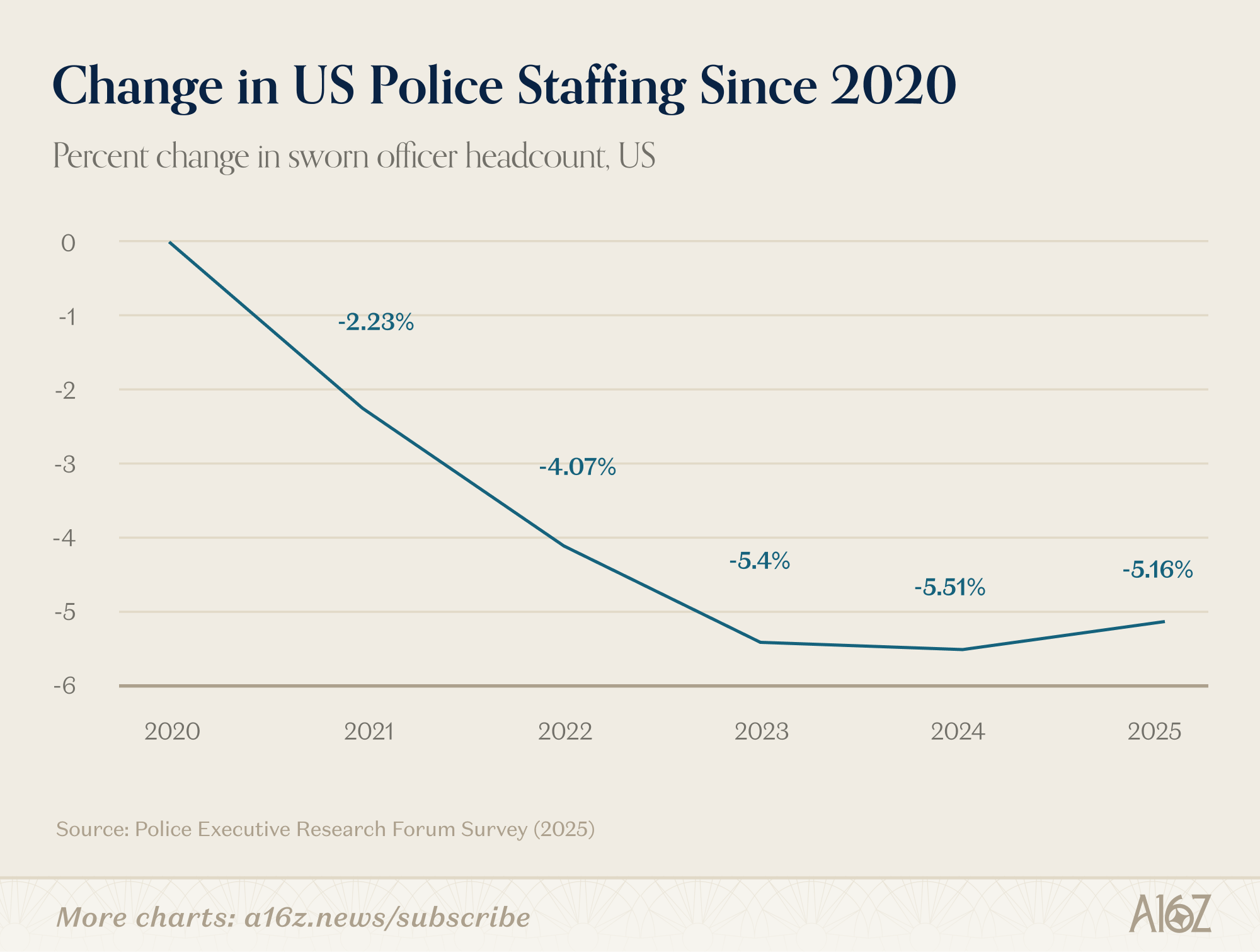
Cities like San Francisco and Las Vegas have expanded deployment and reported measurable declines across key crime categories, while others like Austin and Denver have scaled systems back under privacy and civil-liberties pressure only to see crime trend upward again. Nashville has been notably slower than surrounding Middle Tennessee communities to embrace the technology at scale, despite growing neighborhood-level adoption and support from public safety advocates. The result is a widening gap between jurisdictions that are integrating Flock-style infrastructure into everyday policing and those choosing to opt out.
Other Reading
Kyle Busch, NASCAR great and 2-time Cup Series champion, dies at 41 after illness (The New York Times)
Atlanta’s DC Blox proposes data center after scraping site of office buildings (Nashville Business Journal)
Your campaign needs more on-ramps (Milk Karten)
On Grindslop (X, @WillManidis)
Trump administration sues Minnesota over prediction market ban (The Hill)
NASA to Provide Update on Moon Base Strategy, Missions (NASA)
Stock Market News, May 20, 2026: SpaceX Filing Starts Countdown to Massive IPO (The Wall Street Journal)
Harvard Votes to Cap A’s in Effort to Curb Grade Inflation (The Wall Street Journal)
Tulsi Gabbard Resigns as Intelligence Chief (The New York Times)