



This week’s Imperium Insights breaks down the mechanics: the bottlenecks slowing AI’s physical buildout, how tax relief is filtering into household budgets, the new economics of attention reshaping how media gets made and monetized, and the next phase of U.S. national security policy coming from Nashville to Washington.
On Our Radar
AI’s Infrastructure Problem
The race to build out AI infrastructure is increasingly constrained by a non-technical problem: local resistance. Across the country, communities and state lawmakers are pushing back on new data center projects over power usage, water consumption, land use, and rising utility costs. Maine is on track to pass the first statewide moratorium on new data centers, and similar efforts have surfaced in more than a dozen states across the country. Even where statewide bills stall, local governments are stepping in with temporary bans and new approval hurdles.
On the other side of the equation, the supply chain is already stretched. Roughly half of the data center capacity expected to come online in 2026 is now projected to be delayed or canceled, with only a fraction actually under construction. Developers are running into the limits of an aging power grid, long lead times for key equipment like transformers, and global supply chains that can’t keep up with demand. Capital isn’t the issue (hyperscalers are still planning hundreds of billions in spend) but turning that capital into working capacity is proving to be much harder than sourcing funding.
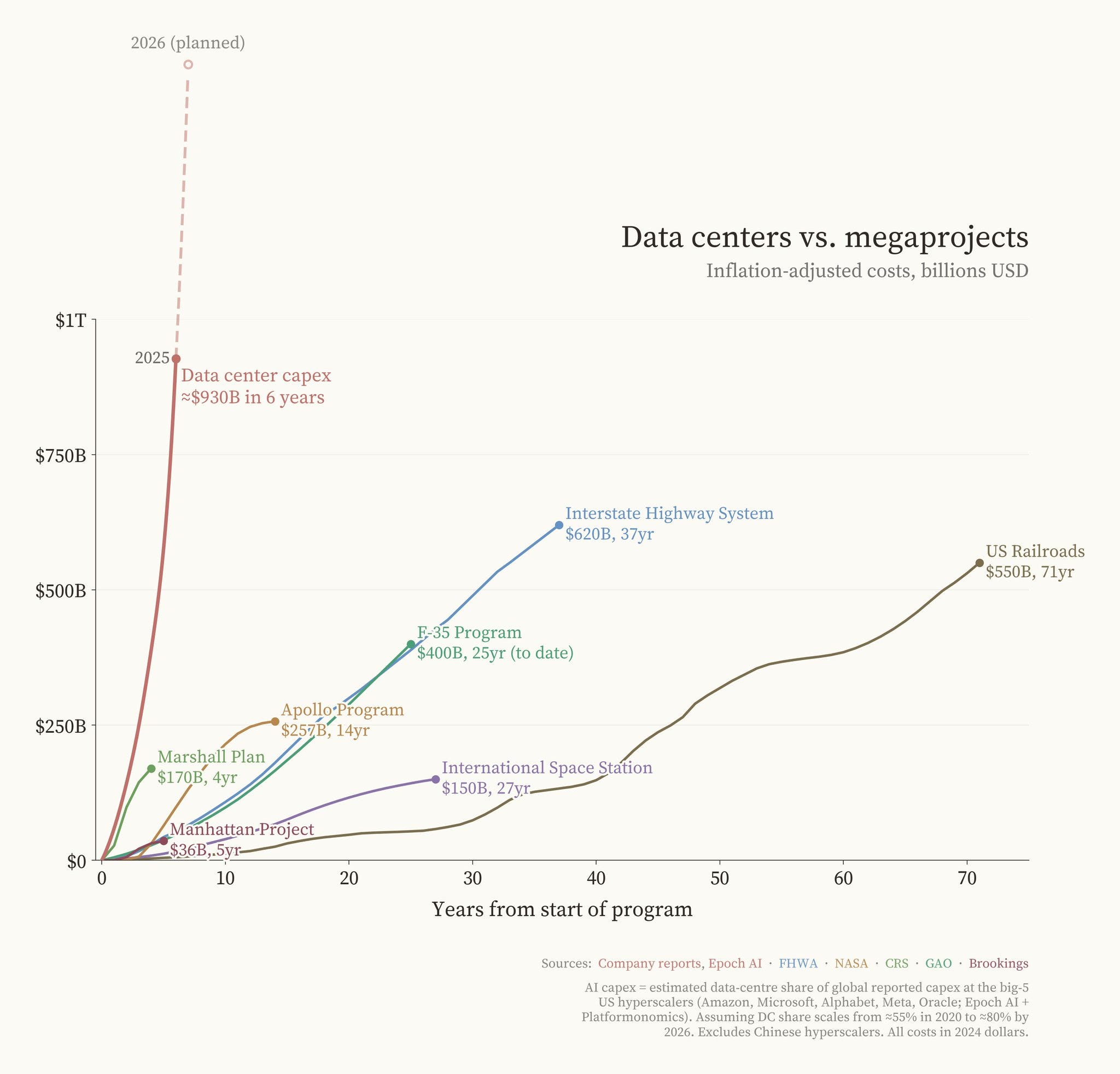
Data centers are the physical backbone of the AI economy, and constraints at the construction layer ripple into everything from enterprise adoption to national competitiveness. The U.S. is trying to scale compute fast enough to stay ahead in an intensifying race with China, but that push depends on building infrastructure at a pace the current system isn’t set up to deliver. What looks like classic NIMBY politics is transforming into something else: a growing conflict between community guardrails and a national imperative to keep building.
Tax Relief at Scale
Americans are seeing a meaningful round of tax relief this year. The new Trump-backed tax structure is on track to deliver more than $100 billion in cuts, with average refunds up more than 11% and a suite of new deductions for overtime, tips, auto-loan interest, and seniors layered on top of a higher standard deduction and expanded child tax credit. Treasury data show more than 50 million returns already claiming at least one of these breaks, with an average benefit of roughly $800 for those filers.
The mechanics of the law make the benefits show up more quietly than a one-time rebate check. Refunds are higher on average, but a large share of the relief is also appearing as smaller balances due and lower payments at filing. The impact is broad and measurable across the system, just delivered through line items and withholding rather than a single, headline‑grabbing payout.
The Dune Director Takes on Nuclear War
Dune director Denis Villeneuve is lining up his next project, and this one is rooted in real‑world stakes. Legendary has optioned Annie Jacobsen’s bestseller Nuclear War: A Scenario, a deeply reported, minute‑by‑minute account of how a modern nuclear conflict could start, spread, and spiral, built from interviews with current and former U.S. national security officials. The project keeps Villeneuve working at blockbuster scale, but trades the distant futures of Dune and Blade Runner 2049 for a story that sits uncomfortably close to real‑world strategy and command‑and‑control systems.
The expectation is that Villeneuve will adapt and direct after finishing Dune: Messiah, extending his relationship with Legendary and his run of big-budget, director‑driven projects. For the studio, it’s a bet on awards‑caliber spectacle that also plugs directly into present‑day geopolitical tension.
Client Spotlight: Vanderbilt’s Asness Summit on Modern Conflict and Emerging Threats
Next week, Vanderbilt University will host the 5th Annual Summit on Modern Conflict and Emerging Threats in Nashville, bringing together leaders from government, academia, industry, and the military to examine how conflict is evolving across domains. This year’s theme — The Shadow of War, The Illusion of Peace — reflects a moment when the boundary between conflict and stability has rarely been more blurred.
In just five years, the Summit has become one of the nation’s leading forums on modern conflict, technology, and geopolitical competition. This year it enters a new chapter as the Asness Summit on Modern Conflict and Emerging Threats, backed by a $10 million investment from the Asness family to expand its reach and amplify its impact as a Nashville-based platform for serious, cross-sector dialogue on the future of national security.
The New Economics of Attention
The “clip economy” is rapidly rewriting how media works. These clips aren’t standalone skits or memes; they’re carved out of long‑form shows and podcasts, then consumed as the main product rather than as promotional snippets. That logic helps explain why a relatively small tech talk show like TBPN, with roughly 7,000 live viewers per episode, can reportedly fetch a $200 million price from OpenAI: its clips reach hundreds of thousands of viewers, generate millions in ad revenue, and turn the “show” into a clip factory.
Once you treat clips as the core product, the rest of the ecosystem comes into focus. Creators now design formats around moments that will slice cleanly into viral minutes, while “clipping agencies” and fan accounts push those snippets far beyond the original audience. Legacy media is bleeding value as viewers abandon traditional programming for social video, even as Disney and Warner Bros. sit on vast clip‑ready libraries. One path back to relevance is to embrace the clip economy — treat shows as raw material, bake ads into clips, and accept that for a growing share of the audience, the clips aren’t marketing; the clips are the main content.
Cyber Policy Gains Traction
The White House is moving into a more active phase on cybersecurity, with National Cyber Director Sean Cairncross signaling that a new round of executive orders will roll out in the coming weeks. The emphasis is shifting from planning to implementation, with a goal of putting adversaries on the defensive rather than relying on a reactive posture.
A central priority is tighter coordination with the private sector. The administration is pushing to extend liability protections for companies that share threat data with the government, betting that stronger legal safeguards will encourage more real-time intelligence sharing. At the same time, officials are maintaining focus on state-backed actors while working to strengthen overall resilience — pointing to a more proactive approach built on deeper public–private alignment and a faster response to a rapidly evolving threat landscape.
Other Reading
The Men Who Bankrolled America — (The Free Press)
Activists’ Campaign Against Palantir Could Threaten National Security — (City Journal)
The Science of Persuasion with Josh Bandoch — (Campaign Trend Podcast)
Live Nation Illegally Monopolized Concerts and Ticketing, Jury Finds — (The Wall Street Journal)
Asking for Produce at Its Peak — (Food Fight)