On Our Radar
The Nuclear Revival Starts in Tennessee
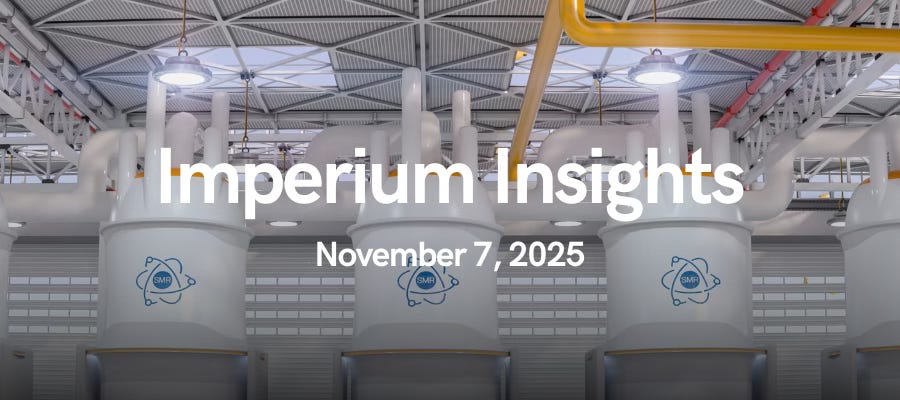
Before Los Alamos, it was Oak Ridge, Tennessee — the hidden “atom bomb city” — where America’s nuclear age began. Now, nearly 80 years later, that same site is driving the next energy revolution. Standard Nuclear, working alongside Oak Ridge National Laboratory, is scaling a new kind of fuel called TRISO — uranium particles sealed in carbon and ceramic that make meltdown-proof, modular reactors possible.
These small reactors (the size of a shipping container) could power AI data centers, remote military bases, or even cities. Backed by Trump-era policy and a renewed appetite for nuclear innovation, companies like Standard are turning Cold War science into a 21st-century export.
Nashville Joins the Michelin Map
For the first time, Nashville restaurants have earned the world’s most coveted culinary distinction. Bastion, The Catbird Seat, and Locust each received a Michelin star this week — a milestone that places the city alongside American dining powerhouses like New York and San Francisco. The Hermitage Hotel also earned two Michelin keys, recognizing its global standard of hospitality.
The nod cements Nashville’s transformation from music capital to full-fledged culinary destination. The city also scored a slate of Bib Gourmand mentions, honoring spots like Kisser, Peninsula, and Redheaded Stranger for exceptional food at approachable prices. The recognition feels less like a surprise than a long-overdue acknowledgment of how far Nashville’s food scene has come.
Bari Weiss and Paul Kingsnorth Confront the Modern Malaise
In a live Honestly event at Redeemer Church in New York, Bari Weiss sat down with writer Paul Kingsnorth to discuss his new book, Against the Machine—a sweeping diagnosis of what he calls the “mechanical worldview.” For Kingsnorth, our era’s ambient anxiety isn’t about screen time or social media — it’s about a deeper civilizational shift that began centuries ago, when reason and technology replaced the old frameworks of faith, place, and tradition. The “machine,” as he describes it, isn’t just the network of devices and algorithms that mediate our lives. It’s a way of seeing the world — one that prizes control and optimization over human scale and spiritual depth. The result, he argues, is a society that’s materially advanced but metaphysically adrift.
Kingsnorth’s critique is less a call for retreat than for re-rooting. In this conversation, he outlined four pillars that once grounded most human cultures — people, place, prayer, and the past — and suggested that modern life has systematically stripped them away. Yet his outlook isn’t entirely bleak. Renewal, he says, will come from smaller circles (families, neighborhoods, faith communities) relearning how to live with limits and meaning.
An Ongoing American Experiment
Ken Burns’ newest series revisits the American Revolution not as an origin myth, but as an ongoing civic argument. His focus, true to form, is less on battlefield drama than on the tension between principle and practice that defined the country’s founding (and still defines it now). The film frames the Revolution as something closer to an unfinished process than a concluded war, echoing Benjamin Rush’s line that “the American war is over, but the revolution is not.” The work of the founders, he suggests, was not to perfect democracy but to begin it.
Viewed through today’s lens, Burns’ narrative becomes less commemorative and more diagnostic. His treatment of the Revolution as a “civil war” within an emerging nation parallels the country’s present struggle over identity and cohesion. By grounding the project in first principles — equality and the fragile promise of self-government — the series makes a quiet argument about memory itself: that revisiting the country’s beginnings is not nostalgia, but ongoing maintenance. Burns’ America is never static; it’s a republic that must be re-argued generation after generation.
Client Spotlight
The Revolution in Opioid Prevention
The Billion Pill Pledge, founded by Goldfinch Health, represents a notable shift in how the United States approaches opioid reduction — away from crisis response and toward structural prevention. Rather than focusing on treatment or recovery, the program intervenes upstream, redesigning surgical pain management protocols to limit unnecessary prescriptions. Its 2025 report cites more than 26 million opioids prevented from circulation since launch, spanning partnerships across hospitals, insurers, and employer health plans. The effort illustrates how incremental process change — nurse education, alternative pain pathways, and standardized recovery metrics — can scale more effectively than reactive public policy.
It also reflects a broader transition in health innovation. After decades defined by litigation, regulation, and addiction treatment, prevention-based models are regaining credibility as cost-effective, evidence-driven interventions. The Billion Pill Pledge operates within the practical incentives of healthcare delivery. Yet its success underscores a larger recalibration taking place across the system — one where measurable prevention, not crisis management, is beginning to define public-health progress.
Other Reading
Replika Founder Raises $20M Pre-Seed for Wabi, the ‘YouTube of Apps’ (TechCrunch)
Thomas McGuane is the Last of His Kind (The Atlantic)
Explaining Gen-Z’s Mysterious Infatuation With Fleetwood Mac’s ‘Rumours’ (Variety)
Governor Lee Invites Disillusioned New Yorker Business Owners to Tennessee (X)
The ATP Tour’s Spotify Partnership and the Ongoing Tennis Courtship of Younger Fans (NYT)
Enjoy CarPlay While You Still Can (The Atlantic)