


This week's edition is a tour of playbooks that no longer work and the ones being written to replace them — Google's AI overhaul dismantling the blue-link web, Ferrari torching its stock price with an electric SUV, Washington racing to write the first federal rules for frontier AI and prediction markets, and Spencer Pratt showing what a modern mayoral campaign looks like. Plus, a Memorial Day reflection on why so many veterans become novelists. Here's what we're watching:
On Our Radar
The Future of American AI
Trump’s now-paused AI executive order offers an early look at how Washington is trying to govern frontier AI without slowing the pace of American innovation. The seven-page draft would have created a voluntary review process for the most advanced models, allowing companies to submit systems for evaluation of potential cyber and national-security risks up to 90 days before release while stopping short of requiring government approval for new models and using existing cybercrime laws to go after bad actors.
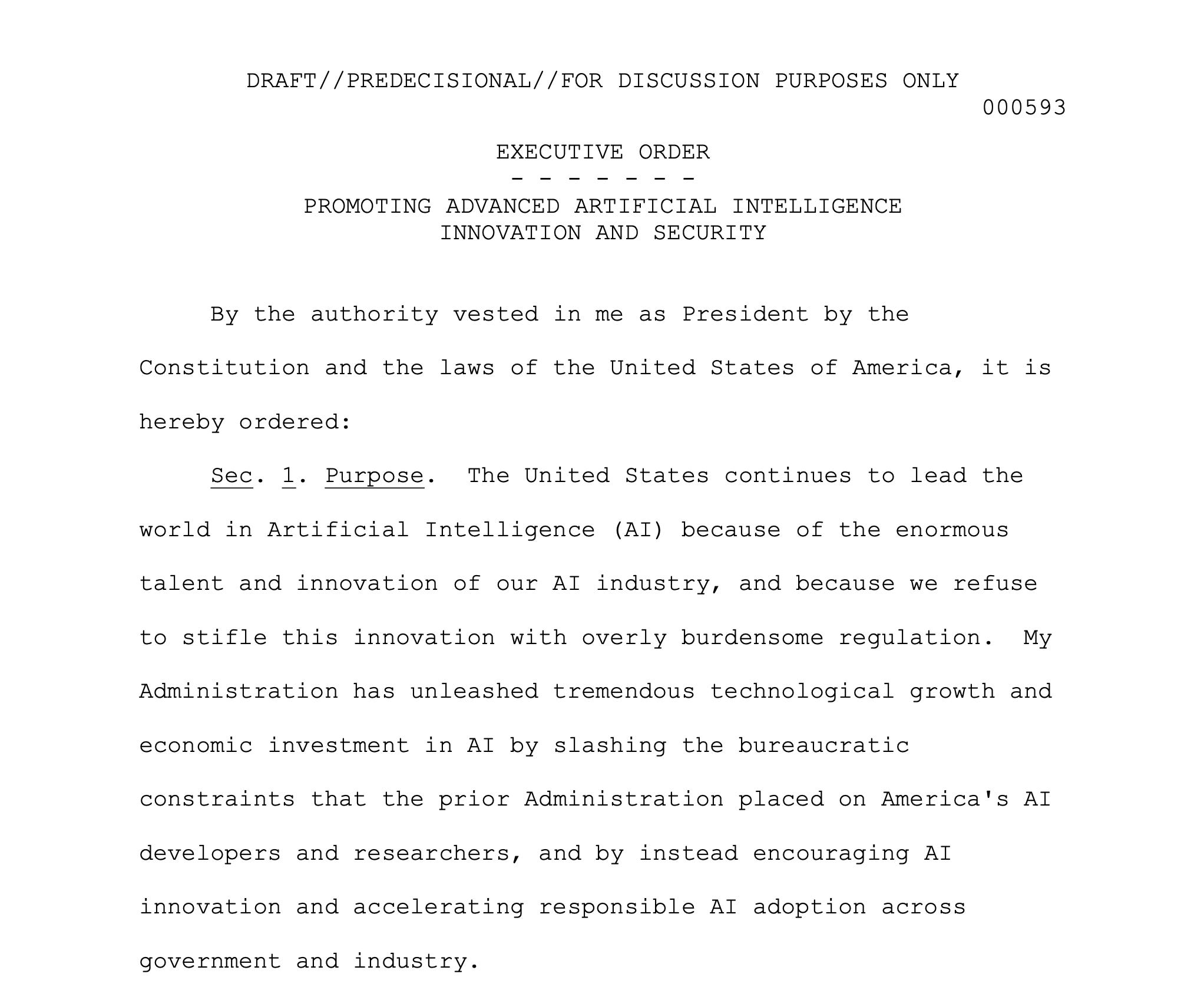
The fact that the White House briefed major developers, planned a signing ceremony, and then delayed the order shows just how carefully the Administration is trying to balance innovation and security as the AI competition heats up. President Trump has framed the issue around ensuring the U.S. maintains its edge over China, with the broader challenge now to find a framework that gives companies room to run while still addressing the growing national-security questions surrounding frontier AI systems.
Life After Blue Links
Google’s latest search overhaul is another sign that the internet’s old traffic model is disappearing fast. The company’s push toward AI-generated answers and zero-click search results moves users further away from the blue-link web that brands and marketers spent decades building around. As AI-generated responses increasingly sit between users and the open internet, visibility is becoming less about traditional SEO rankings and more about whether AI systems surface your information in the first place.
The collapse of the old model is forcing organizations to optimize for generative engines, not just search engines. Imperium’s GEO work for clients centers on making sure their most compelling arguments, data, and narratives are baked into what large language models and recommendation systems ingest and surface. When audiences get more answers from AI than from clicking into articles, the real leverage comes from shaping the inputs those systems draw on, not just the position of a link.
The New Politics of Los Angeles
Spencer Pratt is gaining momentum in the polls heading into Tuesday’s election, turning anger over the Palisades fire into a campaign built around the issues Angelenos say matter most: public safety and basic competence from City Hall. His pitch is unapologetically local: tougher enforcement around open-air drug use, mandatory treatment for severe addiction and mental-health cases, faster housing approvals, stronger wildfire preparedness, and restoring a basic sense of order and safety across the city.
Part of what’s making the campaign resonate is the way Pratt is communicating. He’s treating podcasts and viral clips as the main stage rather than an afterthought, using a constant stream of social content and AI-driven visuals to keep the campaign in voters’ feeds. In a race where the incumbent remains on the defensive over homelessness and fire recovery, Pratt is betting that speaking plainly about everyday frustrations — and doing it in the channels where people are actually spending their time — matters more to voters than partisan labels.
Ferrari’s Reality Check
Ferrari’s first all‑electric Luce is becoming a cautionary tale for legacy luxury brands trying to go electric. The $640,000 model landed with a thud among Ferrari fans who associate the brand with sharp lines and loud engines — not a rounded profile critics immediately started comparing to a very expensive Nissan Leaf. The backlash has been sharp enough to knock roughly 8% off Ferrari’s stock since launch, while memes flooded social media and former chairman Luca di Montezemolo warned the company was “risking the destruction of a legend.”
Underneath the design debate is a bigger question hanging over the luxury auto market: how many high-end buyers actually want fully electric performance cars in the first place? CEO Benedetto Vigna insists interest in the Luce remains strong, but the reaction to the launch suggests Ferrari is trying to walk a very narrow line — modernizing the brand without losing the identity that made people fall in love with it in the first place.
The New Financial Frontier
The CFTC is inching toward the first real federal rulebook for prediction markets, with a draft now sitting at the White House budget office before heading out for public comment. The agency is drawing on thousands of responses from its spring consultation covering issues like insider trading, which contracts should be off-limits, and the basic guardrails for platforms like Kalshi and Polymarket.
The push comes as states step up their own crackdowns, arguing many event contracts look more like unlicensed gambling than regulated financial products. Nevada, New Jersey, Maryland, Ohio, Montana, Illinois, and others are already pressing those cases in court, and judges remain split on whether federal derivatives law overrides state gaming rules. Trump has signaled support for keeping prediction markets under CFTC authority, tying that position to his broader support for crypto and American financial innovation — setting up a much bigger fight over who gets to shape the rules of the road for the next generation of online financial markets.
Writing After War
Author Elliot Ackerman used Memorial Day this week to ask why so many veterans end up writing novels — and what storytelling gives them once they come home. In a series of conversations with Karl Marlantes — fellow Marine and author of Matterhorn, the Vietnam War epic that took him 35 years to write — Ackerman makes the case that getting the story onto the page was one of the few ways Marlantes could make sense of combat and reconnect with a world that had kept moving forward while he was deployed.
They focus on a phrase from a friend of Marlantes: "turning ghosts into ancestors." The argument is that writing — and remembering — is how soldiers can make meaning out of the experiences they bring home, and how a country can honor the people it sent to war in the first place.
Other Reading
Serving America’s Farmers: Palantir’s Partnership Supporting USDA (Artist’s Colony)
Moon Base (NASA)
Two of America’s Thorniest Political Issues Are Dividing an Arizona Town (The New York Times)
RNC Wins North Carolina Election Integrity Case Over Non-Resident Voting (The Republican National Committee)
The App for Trump Accounts Will Launch Thursday. Here’s What to Know. (The Wall Street Journal)
French nicotine pouch ban is ‘attack on Swedish way of life’, minister says (Financial Times)
Pope Leo’s ‘Magnifica humanitas’: AI must serve humanity not concentrate power (Vatican News)
Bari Weiss: Think For Yourself, Not By Yourself (The Free Press)