


This week’s Imperium Insights is a study in leverage — who has it, who's buying it, who's quietly losing it.
Trump is busy unwinding China's bloc abroad, the U.S. is racing Beijing to the ocean floor, Fox is paying $25 billion for the TV operating system, and Cursor is getting pulled into SpaceX to feed Musk's AI machine.
Plus, Europe’s falling for America at the World Cup and a sharper way to think about your own career IP. Here’s what we’re tracking:
On Our Radar
China’s Reality Check
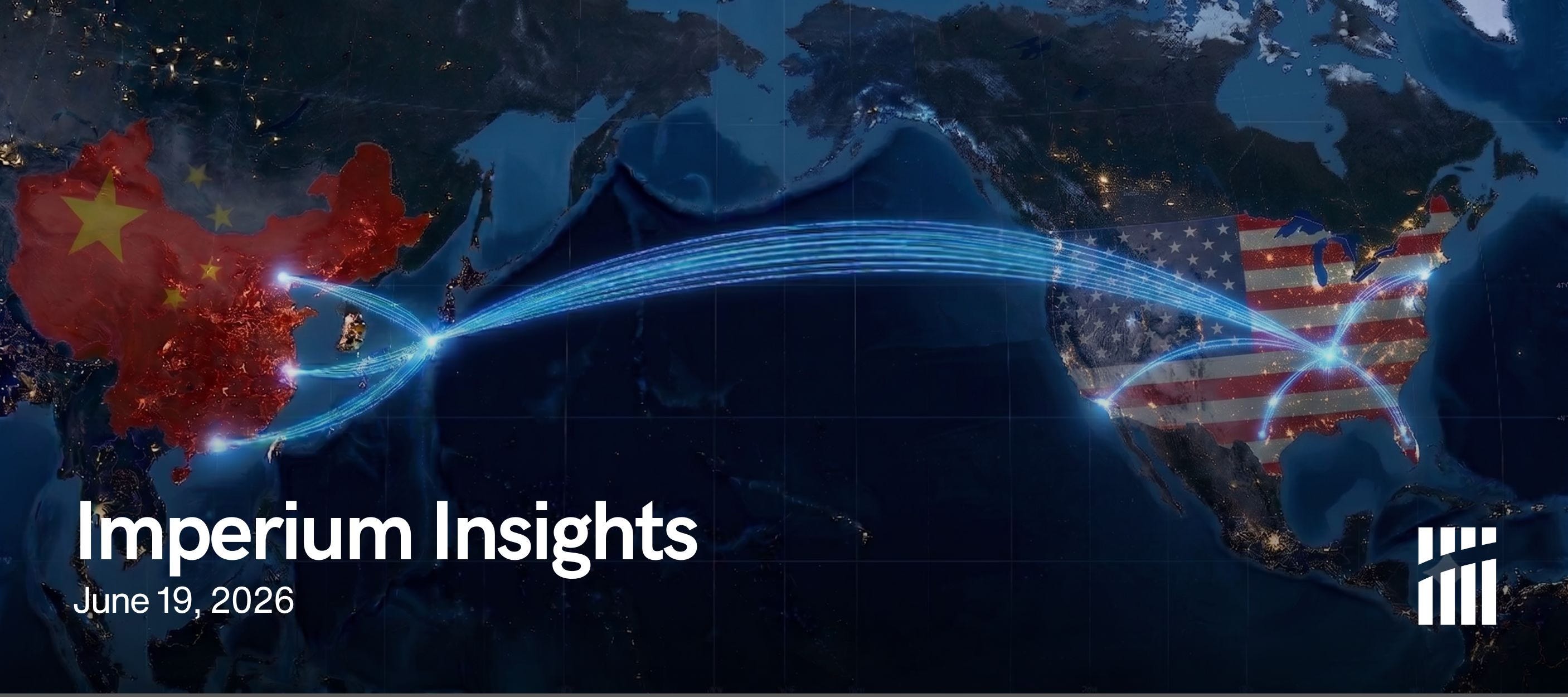
On the China front, Trump’s second term is going a lot better than Beijing would like. He’s rolled back China’s footprint in the Western Hemisphere, backing friendlier governments and taking out Venezuela’s pro-China regime in a way that also puts real pressure on Cuba. In the Middle East, Iran has gone from key Chinese partner to boxed-in under a U.S. naval blockade and crushing inflation. Put that next to a Europe finally spending more on its own defense and a Chinese economy sliding into demographic decline, and you get a President pulling apart the bloc Xi spent a decade trying to build.
Beijing is dealing with all of that while its own AI sector is in a knife fight. On paper, China still talks up its big 2030 AI plan; in reality, the market looks like a brawl — price wars that nuke margins, labs poaching each other’s top researchers, and provincial governments burning through cash to chase their own local wins instead of a single national strategy. Zoom out, and you’ve got an Administration tightening the screws on China’s power and supply lines abroad while China’s AI ecosystem undercuts itself at home just to survive.
World Cup: Europeans Rediscover America
Europeans have spent the past two weeks rediscovering America in real time. Scottish supporters have effectively taken over parts of Boston, drinking bars dry while marching to Fenway Park with bagpipes. German fans have gone viral documenting their first trips to Waffle House and Buc-ee’s with a level of enthusiasm that surprises even Americans. The US is welcoming global World Cup fans with open arms — and they’re loving it.
Even before social media, commentators have long pointed out how fast Americans build communities around almost anything — everything from sports and churches to civic groups and local traditions. That reflex hasn’t gone away, even in a moment when the national conversation loves to obsess over division. This World Cup has just put that American impulse on display: drop a few visiting fans into a U.S. crowd, and the default move is still to pull them in and make them feel like they’re part of something bigger.


Just like the rest of the internet, the Imperium office has been loving the World Cup content from Freddy.
The Ocean Floor Economy
Trillions of dollars’ worth of critical minerals are sitting on the Pacific seabed, and the U.S. is racing China to grab them first. Mineral deposits between Mexico and Hawaii hold more nickel, cobalt, manganese, and copper than all known land reserves, and demand from electric cars and big battery projects is already outrunning what regular mines can deliver. For Washington, backing companies like The Metals Company is now about one thing: catching up to China’s critical‑minerals supply chain.
There’s only one problem: all of it sits in the least‑explored ecosystem on Earth. The first wave of extraction tech is still rough — huge, clunky robots vacuuming the seafloor and kicking up sediment clouds in some of the most remote waters in the Pacific. U.S. startups are trying to design lighter‑touch methods and wrap them in environmental guardrails, while China is moving faster with fewer questions and more licenses, treating the deep ocean as another front in its industrial and military push.
The Future of Work
AI is quietly rewiring how careers actually work, and it puts a new premium on the intellectual property you actually own. In a world where career paths are more fluid, the thing that sets you apart isn’t raw output, it’s the documented, repeatable way you think — the frameworks, checklists, prompts, and playbooks that automated tools can run on top of.
Expertise that only lives in your head or on someone else’s servers doesn’t count as yours in the long run. The opportunity now is to turn more of that know‑how into assets you own. A good starting point is to pick one topic people regularly come to you for and turn your answer into a short, usable document. From there, you can gradually build a small library that gives you something durable to lean on as AI keeps pushing more people toward flexible careers that span different tracks.
Fox’s Big Bet
Fox is making its biggest move yet in streaming, agreeing to buy Roku in a roughly $25 billion deal that turns a longtime platform partner into core infrastructure. The company is paying a mix of cash and stock to fold Roku’s connected‑TV operating system and more than 100 million streaming households into a portfolio that already includes Tubi, Fox Nation, and Fox One.
The logic is simple: as viewers trade pricy subscriptions for free or cheaper, ad‑supported options, the real market power sits with whoever controls the operating system, audience data, and ad rails on the TV itself. Fox is betting that combining live news and sports rights with Roku’s platform and ad tech will make it a more serious rival to Amazon, Netflix, and Samsung’s smart‑TV ecosystem — and worth the extra leverage and debt it’s taking on to get the acquisition done.
America’s Founding Promise
America’s 250th birthday is a good moment to go back to one of the country’s most foundational lines. “We hold these truths to be self‑evident, that all men are created equal” didn’t match reality in 1776; it was the bar the country set for itself, and people have been using it to call America back to its own promise ever since — from Lincoln at Gettysburg to MLK during the Civil Rights era.
The emphasis on “we” points to a simple idea: God‑given rights hinge on citizens agreeing to a shared social contract. Heading into the 250th, it’s a reminder that the line only means anything if each generation keeps choosing to hold up their end of the deal.
The New AI Value Chain
Cursor has gone from a small MIT-founded startup to one of the most important tools in day‑to‑day software development, and now it’s getting folded into Elon Musk’s orbit at a $60 billion price tag. Michael Truell and a small team started by building an AI‑native alternative to Microsoft’s editor that actually made coding faster and more intuitive, then scaled it into a product used by millions of developers and a big slice of the Fortune 500.
The deal hands Cursor access to SpaceX’s massive Nvidia‑powered compute stack and locks in an acquisition that turns a coding assistant into a strategic asset inside Musk’s broader AI push. For SpaceX, buying Cursor is a way to bolt a best‑in‑class coding environment onto Grok, feed it richer real‑world coding data, and turn costly GPU capacity into sticky enterprise software revenue.
Other Reading
Justice Department Zeroes In On Newsom — (Semafor)
The Gen-Z Box Office Boom — (The Town with Matthew Belloni)
How Phoebe Bridgers Got the Perfect Shot for Her 2026 Tour — (Rolling Stone)
Meta’s New AI Unit Is a Total Mess — (Wired)
CNN Taps Kyla Scanlon, a Financial Content Creator, as Contributor & Economic Analyst— (Variety)
How a Tiny Island Distillery Is Making One of America’s Best Single Malts — (The Wall Street Journal)