



This week's edition tracks American dynamism in real time — how the 250th is becoming a mandate to build rather than just commemorate, why healthcare may finally be at an inflection point, and what a mega IPO and a shifting population map say about where people and markets still see room to run.
On Our Radar
Rebuilding the American Story at 250
Freedom 250 is shaping up as President Trump’s effort to put building back at the center of the national story. The White House is using Task Force 250 and the Freedom 250 partnership to emphasize that American exceptionalism still shows up in tangible projects — from rail integration and manufacturing to Artemis-era spaceflight — and to reassert a governing instinct that favors execution and visible results.
At its core, the 250th is being structured as a year-long civic project. The summer 2026 centerpiece in Washington ties together a Memorial Day observance at Arlington, a multi-week installation on the National Mall, a July 4 celebration built to host a national audience, and the Freedom 250 Grand Prix in August. Programming then extends into the fall across the country, pulling in states and private partners to make the anniversary an active demonstration of national capacity, not just a commemoration.
How Healthcare Got Stuck
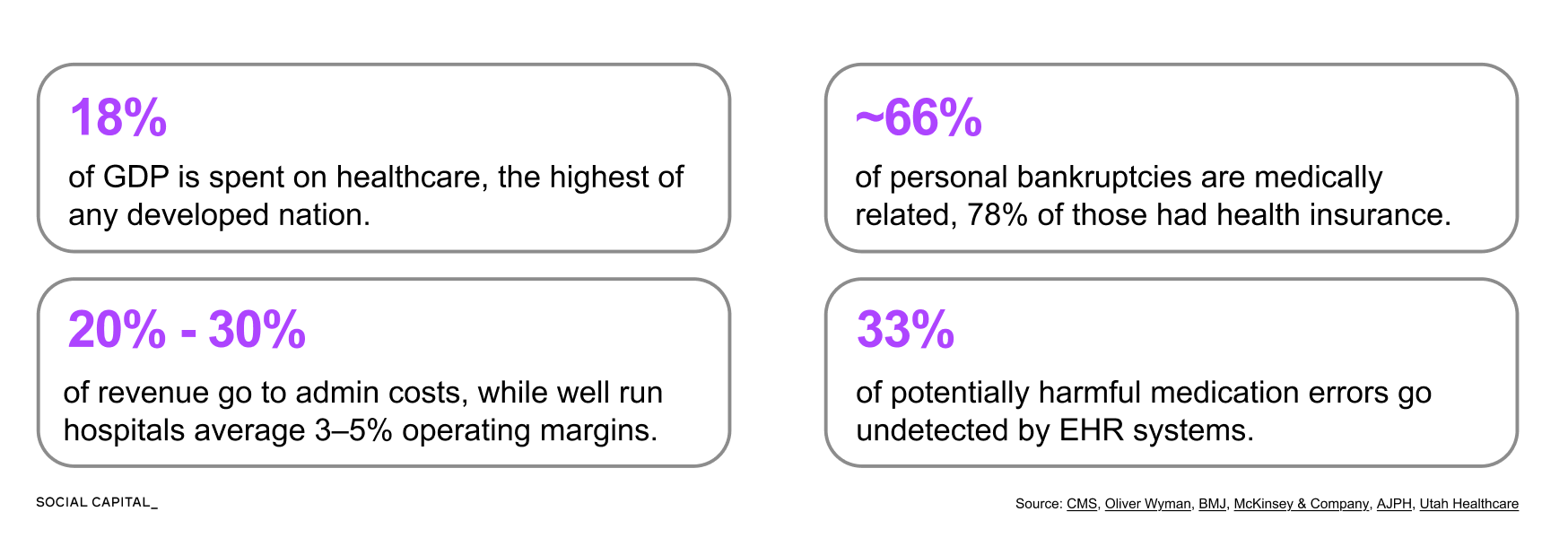
The U.S. spends $5.3 trillion a year on healthcare, but much of the system still runs on a 1960s architecture built to show a single patient’s status inside a single hospital, in real time. That design made early hospital computing reliable, but left today’s electronic health records brittle and hard to modernize, with data locked inside proprietary systems. The result is a landscape where a ransomware group can reach records for most Americans through a single weak portal, while two hospitals treating the same patient often struggle to share information — and a $1 trillion administrative layer exists just to translate between fragmented payers and providers.
Decades of interoperability pushes and consolidation haven’t changed that foundation. Epic dominates hospital EHRs and UnitedHealth now stretches across insurance, care delivery, and claims, but the underlying data remains inconsistent and hard to use at scale. The pressure point is shifting with large language models that can sit on top of this stack and structure clinical language without a full rebuild. Early deployments in documentation and medical coding hint at real progress — but the real test is whether that ends up reinforcing the current technology stack or cutting new paths through it.
America’s Population Map Is Shifting
New census data show the country’s growth pattern tilting toward the Midwest and the Carolinas. The Midwest, long associated with outmigration, is now posting net domestic gains alongside the South, with state capitals like Columbus and Lansing flipping from losses to inflows as people trade coastal costs for more affordable housing and stable economies.
In the South, North and South Carolina are among the biggest winners. Metros like Myrtle Beach, Spartanburg, Wilmington, Raleigh, and Charlotte are growing at several times the national pace, fueled by domestic movers looking for price relief and quality-of-life upgrades. That momentum stands in contrast to slower growth in the core counties of large coastal metros, where weaker immigration and aging populations are starting to show up in the numbers.
Vance’s Next Chapter
Vice President Vance capped an important week with a major book announcement. Communion: Finding My Way Back to Faith, out June 16, traces his path from the Christianity of his childhood through a period of atheism to his 2019 conversion to Catholicism, and presents that shift as a durable source of purpose that elite education and career success didn’t provide.
Vance has said he’ll wait until after the midterms to decide on a 2028 run, but the timing helps further clarify his role as the next cycle begins to take shape. A serious, faith-centered book gives him a defined lane within today’s Republican Party, while his presence in Middle Tennessee this week — headlining an RNC fundraiser hosted by Damon Hininger at The Governors Club in Brentwood — shows a steady focus on strengthening both his message and his momentum.
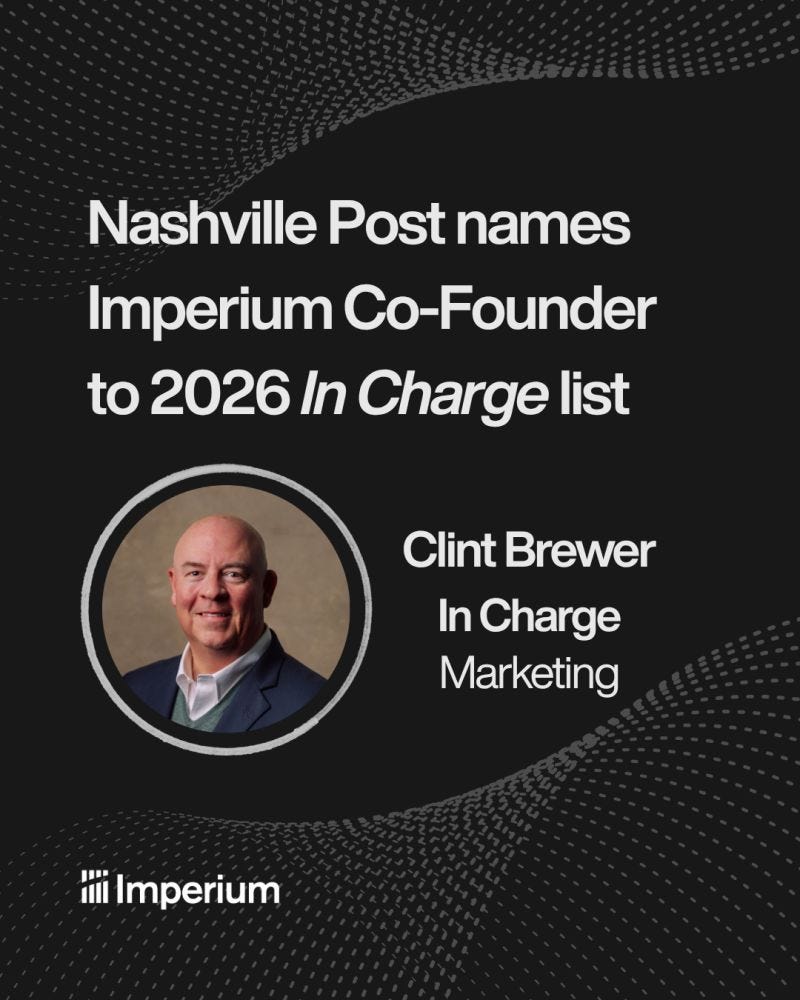
Firm Spotlight: Managing Partner Clint Brewer Named to Nashville Post’s 2026 In Charge List
Imperium Partner Clint Brewer has been named to the Nashville Post’s 2026 In Charge list, recognizing top leaders in marketing — his eighth consecutive year on the list.
At a time when brand reputation is increasingly shaped by political and social dynamics, Clint’s background across media, advocacy, and government continues to set the standard for how Imperium approaches client work. His ability to anticipate how narratives move (not just react to them) has become a core part of how we help clients operate in increasingly complex and dynamic environments.
OpenAI Moves Into Media
OpenAI is buying TBPN, the live tech and business talk show hosted by Jordi Hays and John Coogan. The show launched in 2024 and runs three hours a day on X, YouTube and LinkedIn, featuring high-caliber guests including Meta CEO Mark Zuckerberg and Microsoft CEO Satya Nadella.
OpenAI says TBPN will keep its editorial independence and continue to book its own guests, reporting into chief global affairs officer Chris Lehane. TBPN has been profitable without outside investors and is expected about $5 million in ad revenue this year, with plans to grow under former Postmates executive Dylan Abruscato. The deal follows other companies building or buying media operations (like Plaid’s acquisition of This Week in Fintech and Robinhood’s launch of Sherwood) as OpenAI shifts more toward enterprise products.
Other Reading
Can Treasury keep playing the short game and winning? (Semafor)
Chick-fil-A is Giving Away Free Ice Cream to Customers Who Can Pass This ‘Impossible’ Test (Inc.)
Trump-Aligned PAC to Use A.I. in Midterm Push (The New York Times)
Crypto company files lawsuit against Hawkins County (Kingsport Times News)