On Our Radar
Celebrating 250 Years of American Independence
The kickoff of America’s 250th anniversary began with a sweeping projection across the Washington Monument on New Year’s Eve, formally launching the Trump administration’s yearlong “America 250” initiative. The opening display set the tone for what is shaping up to be a historic observance, designed to stretch beyond a single holiday and evolve into a sustained national celebration.
With plans spanning public art, historical tributes, major sporting events, and expanded international showcases tied to the World Cup and Los Angeles Olympics, the administration is positioning America 250 as an affirmation of national continuity and confidence — framing the anniversary as both retrospective and forward-looking, an invitation to revisit the country’s founding story while projecting ambition for the next 250 years.
Capital Is Moving Again
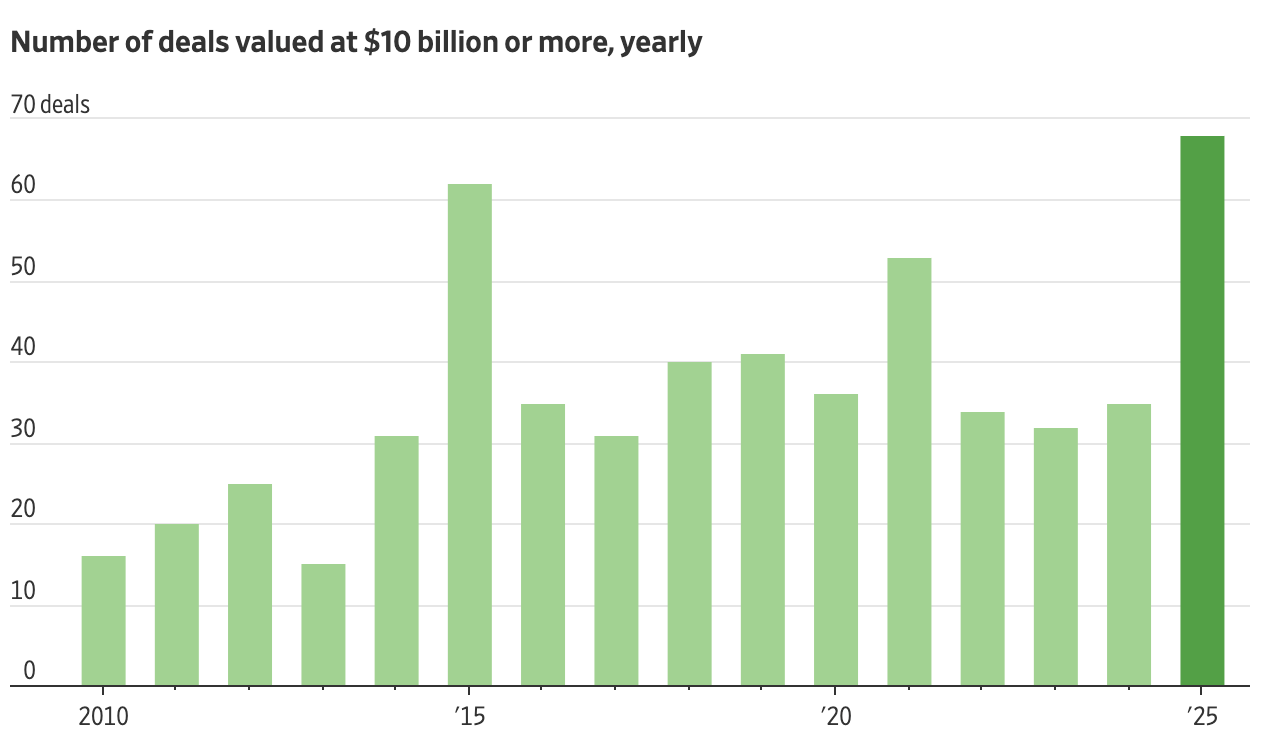
After a prolonged period of caution, dealmaking at the top end of the market is beginning to reassert itself. 2025 closed with a record number of megadeals, and bankers now expect that activity to carry into 2026. Boards appear more willing to commit capital, regulatory risk feels more navigable, and the penalty for waiting has grown clearer.
Public markets show signs of a similar recalibration. Several long-private companies are signaling readiness for initial public offerings — including SpaceX, Anthropic, and OpenAI — alongside other platforms whose scale increasingly tests the limits of staying private. If even a subset of these IPOs advances, it would suggest that the market is re-anchoring around decisive moves rather than incremental ones.
Trust in an Era of Infinite Content

Instagram chief Adam Mosseri is calling attention to a shift platforms can no longer ignore: as AI-generated images and video become indistinguishable from reality, what appears on screen is no longer sufficient to establish what’s real. His proposed response reorients toward attribution — shifting credibility from the look of a post to the identity, history, and behavior of the account behind it.
For brands that have already leaned aggressively into AI-generated content, this shift introduces a new strategic tension. AI has dramatically lowered the cost of producing content, but it has not lowered the cost of earning belief, and audiences are being trained to approach the feed with default skepticism. In that environment, the winners are less likely to be those that pump out the most content and more likely to be those whose voice and perspective are so distinctive that their posts feel impossible to fake — work that can plausibly come only from them.
A Tech Forecast for the New Year
Many of the technologies expected to define 2026 share a common trait: they’re no longer speculative. Home robots, autonomous vehicles, and digital identity systems are shifting from experiment to everyday tool. Even artificial intelligence is assuming a more structural role — shaping healthcare access, cybersecurity, and identity verification in ways that feel incremental but consequential.
The year ahead appears less about breakthrough moments than seamless integration into daily life’s infrastructure. And as these technologies fade into the background, the real challenge will be ensuring they enhance human agency after their novelty gives way to routine.
Client Spotlight: Goldfinch Health
The Arkansas Opioid Recovery Partnership announced a new partnership with Goldfinch Health, awarding nearly $1.5 million to launch a Billion Pill Pledge pilot in communities across Arkansas. The funding will support a coordinated effort to reduce opioid prescribing rates by reshaping clinical decision-making and expanding access to alternative approaches to pain management.
The pilot is anchored in the Billion Pill Pledge, a national effort focused on preventing opioid dependency before it begins. Rather than concentrating only on downstream treatment, the model targets prescribing behavior itself — challenging default practices that have historically driven overexposure to opioids. Goldfinch will lead the on-the-ground execution, positioning its prevention-first approach as a scalable test case for reducing opioid exposure at the community level.
The Shape of the New CFP

The College Football Playoff semifinals reflect how quickly the expanded format is reshaping the sport’s competitive landscape. Indiana–Oregon and Ole Miss–Miami are matchups few would have predicted a year ago, but both are the product of teams peaking late and navigating roster and coaching upheaval.
Each game carries its own set of practical questions. Indiana looks to validate its regular-season win over Oregon against a Ducks team that has since found its rhythm. Ole Miss and Miami arrive through unconventional paths, shaped by defensive momentum, quarterback play under pressure, and midseason recalibration. Together, the semifinals illustrate a postseason increasingly defined by adaptability and execution, where teams advance by managing pressure and transfer-portal chaos rather than relying on pedigree.
Other Reading
California’s Ro Khanna Takes Aim at Tech Billionaires (New York Post)
Ten Favorites From 2025 (Works in Progress)
European Banks Drive Stoxx 600 to Record Year, Outpacing U.S. Markets (GuruFocus)
Saudi Arabia Quietly Relaxes Its Alcohol Ban (The Wall Street Journal)
Minnesota Fraud Schemes: What We Know (CBS News)
Vitalik Buterin Says Decentralization Is the Only Way to Prevent Crypto Power From Concentrating (CoinMarketCap Academy)
China’s BYD Set to Overtake Tesla as World’s Top EV Seller (BBC News)
Snowflake CEO Sridhar Ramaswamy: 7 Predictions for Enterprise AI in 2026 (Fortune)