Imperium is tracking seven stories this week, bookended by U.S. Senator Bill Hagerty’s vision of powering the AI era with Tennessee nuclear, and the growing backlash against smart glasses. Along the way: Palmer Luckey’s new industrial empire, the martini renaissance, Hollywood’s dark arts, Imperium co-founder Josh Helton’s LaunchTN appointment, and China’s export machine. Here’s what we’re watching:
On Our Radar
Tennessee’s Nuclear Advantage
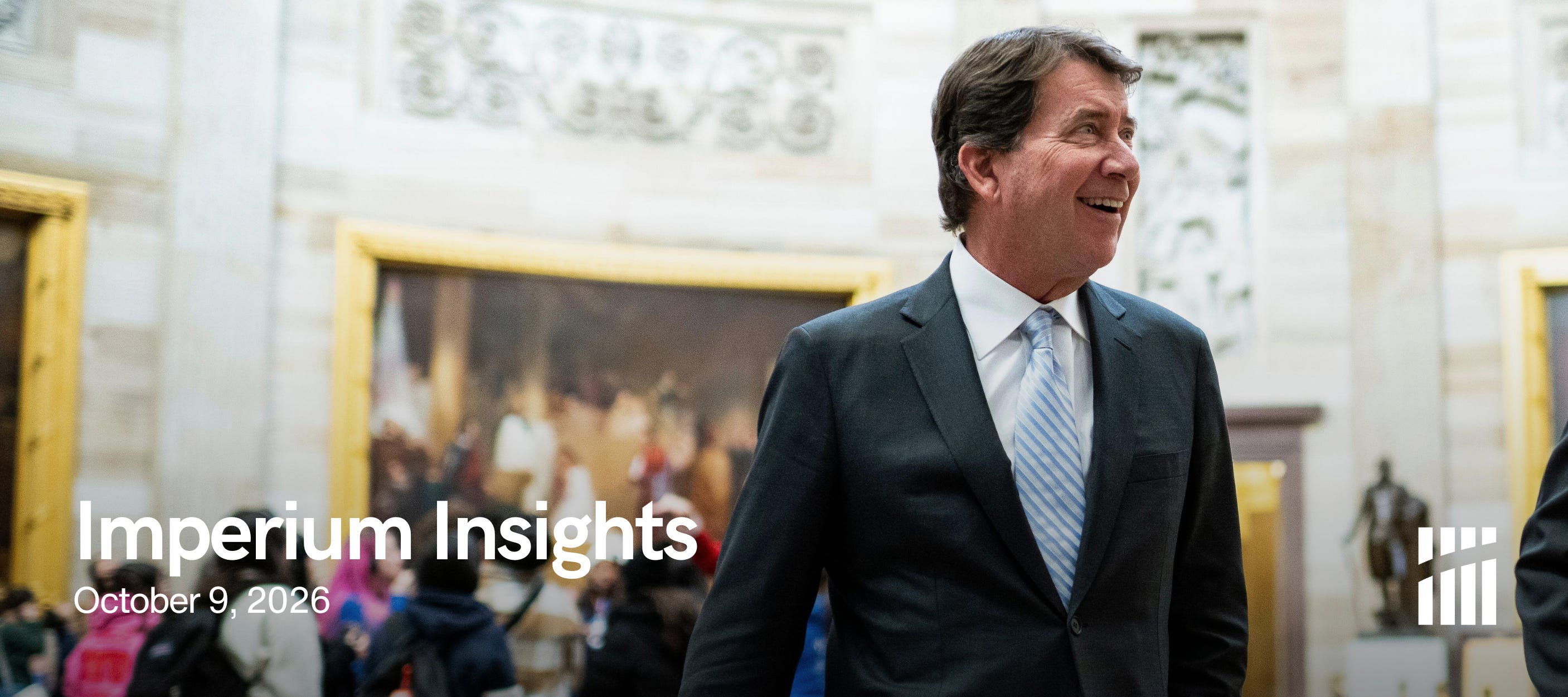
U.S. Senator Bill Hagerty is making nuclear energy a central part of his vision for Tennessee’s economic future. Speaking at Nashville’s ImagineIF conference this week, the former Economic Development Commissioner and venture capitalist pointed to the state’s unique combination of assets: Oak Ridge, the University of Tennessee, TVA, and decades of nuclear expertise. With AI driving enormous demand for dependable electricity, Hagerty sees East Tennessee as a natural hub for the next generation of nuclear power.


Silicon Valley is already moving in that direction. Google just signed a 20-year agreement with Constellation Energy supporting $4.3 billion in upgrades across 11 nuclear reactors, adding roughly the equivalent of another large reactor to the grid. Hagerty knows that America needs to keep building, but warned the audience at ImagineIF that disinformation could slow the effort. A recent Bitcoin Policy Institute report raises a related concern, spotlighting that some campaigns against American AI infrastructure have been amplified by foreign-linked organizations and Chinese state media. The opportunity for Tennesseans is enormous — if America keeps building faster than its rivals can stall it.
The New American Industrialist
Palmer Luckey is becoming a different kind of tech entrepreneur, building his empire around the machinery of American power. This week, his defense company Anduril announced a nearly $7 billion public-private push to build a submarine manufacturing hub at Sparrows Point, Maryland, backed by a $2.9 billion Navy contract. Luckey has also been tapped alongside Elon Musk and Newt Gingrich for Project Meridian, a Pentagon effort to think through how warfare could change by 2100 — and what America needs to start building now.


To cap it all off, there’s Erebor, the bank Luckey co-founded to serve startups and tech companies. It has already reportedly pulled in more than $7 billion in deposits just eight months after opening. While Silicon Valley races to build bigger AI models, Luckey is betting on the physical and financial infrastructure behind American technological power.
The Martini Renaissance
The martini is having a moment. A drink long associated with James Bond and Don Draper has found a new generation of fans, even as younger Americans are drinking less than older generations. TikTok is full of martini variations, and the classic cocktail has once again become a marker of good taste.
It may have gotten a little too mainstream. The martini has become an aesthetic unto itself, showing up on just about every kind of merch imaginable. Restaurants have gotten in on it too, pushing the drink in stranger directions with wagyu-infused versions and caviar toppings. Imperium co-founder Clint Brewer was a martini devotee long before the current craze, and he prefers to keep his simple. We’ve included his personal recipe below — why mess with a classic?

Hollywood’s Dark Arts
Hollywood has always had a dark side to reputation management, but now lawsuits from at least five women are giving us a clear look at what that can mean in the digital age. The women allege that a network of lawyers, publicists and digital strategists built anonymous websites, fake social media profiles and manipulated search results to spread damaging claims about them. The parties accused deny the allegations, but court records and messages reviewed by The New York Times show just how sophisticated these campaigns can get.
It’s an extreme version of something we’ve watched much closer to home. Imperium client Apeel Sciences saw its American business suffer after false claims that began with two Facebook posts were intentionally spread through influencers across social platforms. Imperium has since worked with Apeel to get back on the front foot, but the playbook is now being used across industries: seed a narrative, and amplify it with managed accounts until the algorithms pick it up and give it credibility. You don’t have to convince the masses if you can make the internet look like everyone already agrees.
Josh Helton Appointed to Launch Tennessee Board of Directors
Imperium co-founder Josh Helton is joining the Board of Directors of Launch Tennessee after being appointed by Lt. Governor Randy McNally. The organization sits at the heart of Tennessee’s growing startup community, helping entrepreneurs turn promising ideas into businesses built to last.

It’s a natural fit for Josh, who worked at the Tennessee Department of Economic and Community Development as the Assistant Commissioner of International Affairs under then-Commissioner Bill Hagerty. He knows what makes businesses want to build in Tennessee, and has spent much of his career helping create the relationships that make that growth possible. We’re excited to see him bring that experience to LaunchTN and help make the state an even better place to start and grow a company.
China’s Export Machine
China’s enormous manufacturing capacity is becoming a growing problem for the West. In Europe, China now ships six containers of goods for every one heading the other way, more than double the ratio from five years ago. That massive output is pushing Europe’s trade deficit with China above $1 billion a day and putting new pressure on industries that once assumed they could compete at the higher end of the market.
The pressure isn’t limited to legitimate trade. At least 50 Chinese chemical manufacturers previously tied to the fentanyl-precursor trade are now selling unapproved peptides directly to Americans to tap into the booming weight-loss market. Whether the goods are legitimate or illicit, China has built an enormous capacity to make things the West wants. Those products are finding their way into markets, regardless of whether governments are ready for them.
The Glasses Are Watching
Smart glasses are running into an obvious problem: people don’t like the idea of being recorded without knowing it. Meta helped bring the technology into the mainstream with its Ray-Bans, but governments and institutions are already pushing back. Australia is considering limits in government buildings, Norway is weighing a ban in public spaces, and courts in Britain and New York have already moved to keep them out.
The argument is straightforward: when someone films with a phone, you can usually see it. Smart glasses are different. They may be useful, but they’re also off-putting in schools, courtrooms, offices, movie theaters, and just about anywhere people expect a little privacy.
Other Reading
Joe Rogan Re-Ups Lucrative Spotify Deal (The Wall Street Journal)
Ex-CIA official found with gold bars admits to sprawling scheme, agrees to forfeit $194 million (CBS News)
Lionel Messi scores in tearful ‘last tango’ for Argentina (ESPN)
Hollywood tears into Big Tech (Politico)
The Most Accurate Presidential Simulator Of All Time (Fantasy President Career)