



Imperium Insights is tracking six stories this week: the paid digital influence campaigns quietly steering public opinion, the South's run of out-executing the coasts, the DSA's fight over AOC, fighting for innovation in an age of disinformation, New York freezing the AI buildout, and Volkswagen's 100,000-job reckoning. Here's what we're watching:
On Our Radar
Digital Dark Arts Unveiled
The age of paid influence campaigns is moving well beyond the world of politics and into almost every corner of public life. This month alone brought allegations of a foreign‑funded push to shape opinion inside the US over Middle East policy, new reporting on Chinese operatives acting as informal influence brokers, and the still-unfolding battle over who pays the legal costs tied to the coordinated media operation surrounding the Blake Lively–Justin Baldoni harassment dispute. Even Argentina’s national soccer program has faced scrutiny over claims that online narratives around players and team decisions are being quietly amplified and steered by paid networks.
What makes these campaigns effective isn’t that they’re flawlessly engineered or overly polished. Most influencer campaigns are built around creators riffing on views they already hold rather than reading off an obvious script, and the sloppier operations are still effective because they’re wired into the right attention streams while looking organic enough to pass as grassroots. In 2026, nearly every arena runs on top of the same digital ecosystems, where coordinated messages can be seeded through trusted voices and then spread in ways that feel spontaneous and authentic. If you can pay to shape those feeds, you can convince audiences of nearly anything without them realizing they’re part of someone else’s influence campaign.
The South’s 21st Century Moment
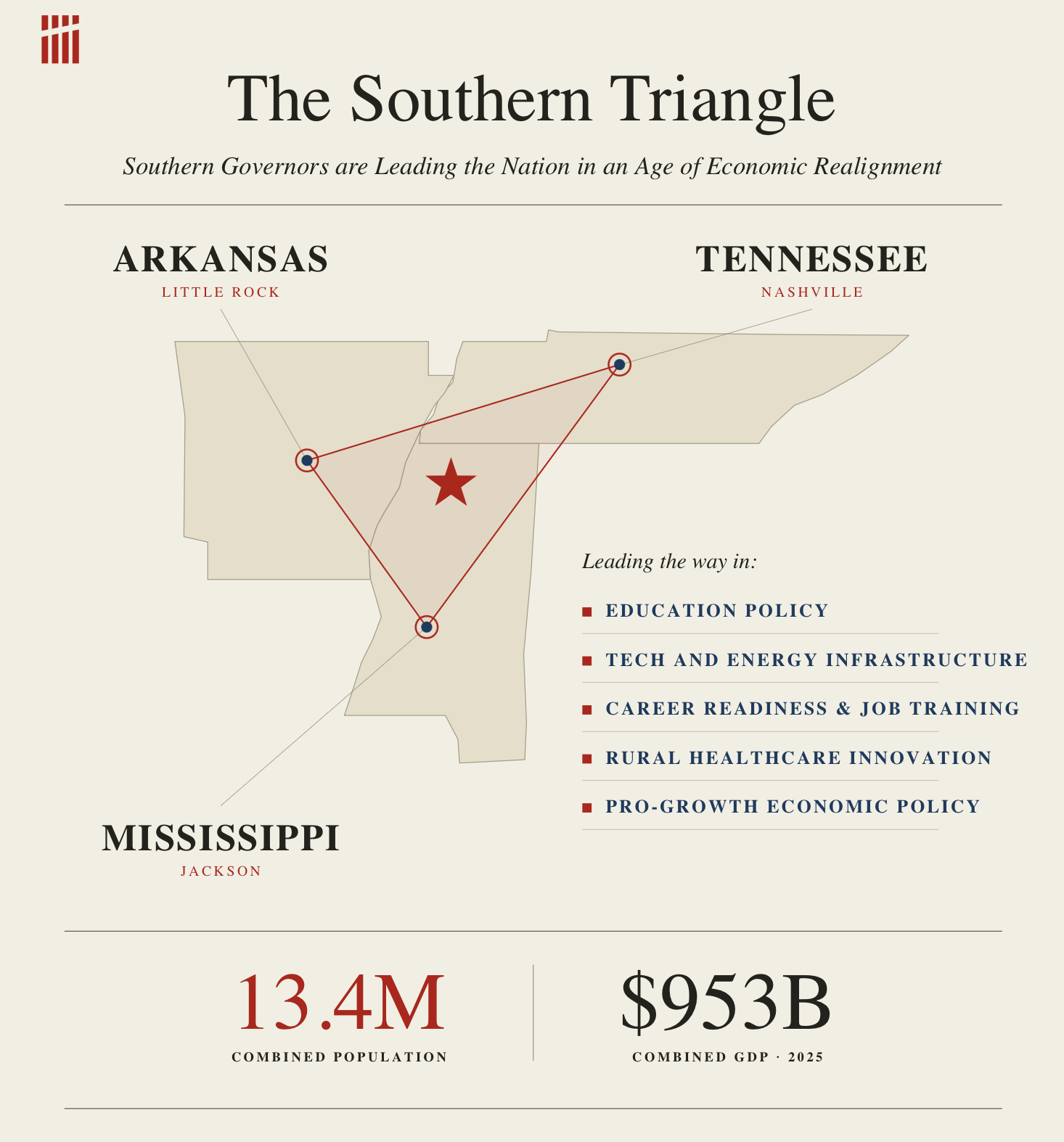
In their latest thought leadership piece, Imperium co-founders Josh Helton and Clint Brewer argue that the next American growth story isn’t being written on the coasts. Across a triangle running from Tennessee to Arkansas to Mississippi, governors and state leaders are rewriting the playbook on everything from education policy to workforce readiness and economic development, while consistently out‑executing other regions of the country. It’s a trend we’ve been tracking throughout the year — and one we suspect will only become more important in the months ahead.
DSA in AOC Disarray
The Democratic Socialists of America are suddenly confronting a problem that used to belong to the Democratic establishment: what happens when a movement gets close enough to power that its own factions start fighting over who gets to wield it. An internal battle blew up this week over whether the organization should quickly line up behind a potential Alexandria Ocasio‑Cortez presidential campaign and try to turn years of organizing into a more serious bid for national power, or whether AOC has drifted far enough into the Democratic mainstream that she no longer fully belongs to the movement that helped make her a star on the left.
Critics inside the DSA see a politician who has gotten too pragmatic and institutional over time, betraying the movement by compromising with party leadership (particularly on Israel). It’s the same problem the broader Democratic ecosystem keeps running into: the energy is with younger, anti‑establishment figures, but those figures start to look uncomfortably mainstream once they get close to governing power. The irony is hard to miss—a movement built around challenging the establishment is now having its own establishment fight over what its next chapter should be.
Innovation in the Age of Disinformation
Imperium client Apeel Sciences is entering a second act shaped as much by the modern information environment as by the food system itself. In a recent conversation on the Modern CTO podcast, CEO Luiz Beling described how a coordinated online misinformation campaign helped knock the company off a dominant position in the U.S. market, forcing Apeel to rethink not just how it told its story, but where in the system it created the most value.
That shock pushed Apeel toward a broader role as a full‑stack supply‑chain partner focused on fixing a broken food system by pairing advanced plant‑based formulations with SaaS tools. Beling’s pitch is simple: food waste is increasingly an information problem as much as an agricultural one. Apeel’s second act is built around solving both — cutting into the third of global food that never gets eaten, and showing that innovative companies now need narrative resilience alongside technical excellence if they’re going to refuse to let disinformation dictate the future of innovation.
The Politics of Compute
New York is becoming an early test case for one of the defining policy fights of the AI era: whether states treat computing power as critical infrastructure or as something to be constrained. Hochul’s one‑year moratorium on new hyperscale data centers doesn’t just pause construction; it tells investors, engineers, and companies that New York is willing to stall the backbone of the AI economy. Treating data centers as a problem to be frozen rather than infrastructure to be thoughtfully managed with input from communities is how a state turns itself from a builder of the future into a buyer of whatever others decide to make.
The larger danger is that scarcity has a way of becoming self‑reinforcing. Regions that build the infrastructure to support AI will attract more capital, talent, and companies, while those that hesitate slip further behind. As politics and local resource fights make large‑scale compute harder to build on the ground, money and engineering talent will go looking for less constrained environments — up to and including orbit. Space‑based data centers powered by solar and cooled by vacuum are already moving from thought experiment to early investment; the question for New York is whether it wants to help shape that frontier or watch other states claim the upside instead.
Volkswagen’s Reckoning
Volkswagen is turning into a cautionary tale for how legacy industrial companies navigate the new economic era. Reports that the company could cut as many as 100,000 jobs and close multiple German plants point to pressures that extend far beyond tariffs or electric vehicles — a story with implications that reach all the way to Tennessee, where Volkswagen maintains a major manufacturing presence in Chattanooga.
The deeper challenge is that Volkswagen was built for an economy where advantage came from vertical integration and manufacturing muscle. Value is shifting toward software, data, and ecosystems that move faster than traditional industrial giants are designed to operate. Volkswagen spent years perfecting the old model, and the risk now is that restructuring produces a leaner version of yesterday’s company instead of a competitor built for tomorrow’s economy.
Other Reading
House passes first bill sponsored by rookie Rep. Van Epps (Axios Nashville)
How Big Is Ella Langley Right Now? She’s About to Tie Whitney and Mariah (Rolling Stone)
US Firms Shift to Chinese AI Despite Verified Data Transfer Violations (SOFX)
Trae Stephens on Rebuilding the American Arsenal (Arena Magazine)
Startup Mass-Producing Cheap Killer Drones Wins $500 Million Army Contract (The Wall Street Journal)