



Imperium is tracking seven stories this week, bookended by America's soft-power renaissance at the World Cup and the sea-power contest reshaping the oceans. Along the way: the AI buildout financing a new industrial base, the South's manufacturing run, Maine Democrats' Platner problem, and Florida's fight over digital trust scores. Here's what we're watching:
On Our Radar
America’s Soft-Power Renaissance
The World Cup is never just about soccer, and this summer is a case study in why. Every four years, the biggest sporting event on earth becomes something larger: a collision of commerce, culture, politics, and national identity played out in front of a global audience. Fans who arrived on U.S. soil expecting a tense, divided nation have found something very different: packed stadiums, easy hospitality, giant portions, and cities that feel warmer and more welcoming than the headlines suggested. Across the board, supporters from around the world have discovered the everyday abundance of American life.
Fox placed a big bet that the tournament would become a bigger national moment than the games themselves, and that wager has paid off. CEO Eric Shanks described a wall-to-wall operation that ties together national broadcasts, local affiliates, streaming, social media, and large on-site productions so viewers can get the full World Cup experience. The ratings have followed, but the bigger story may be what the tournament says about national power in the modern era. When millions are visiting and billions more are watching from home, the host nation gets a rare opportunity to reintroduce itself to the world. This summer, America made the most of it — and revived its soft power in the process.
The New Industrial Base
The politics of data centers are quickly becoming the politics of the wider American economy. Amazon’s latest $25 billion bond sale — part of more than $100 billion in borrowing over the last year alone — is another reminder of the staggering amount of capital now flowing into AI infrastructure. Globally, AI-linked debt issuance has already topped $335 billion this year as hyperscalers sprint to finance new computing capacity, power generation, and data center construction. Investors may be showing the first signs of fatigue, but the scale of the buildout is still head-spinning: the largest companies in the world are effectively attempting to finance a new industrial base in real time.
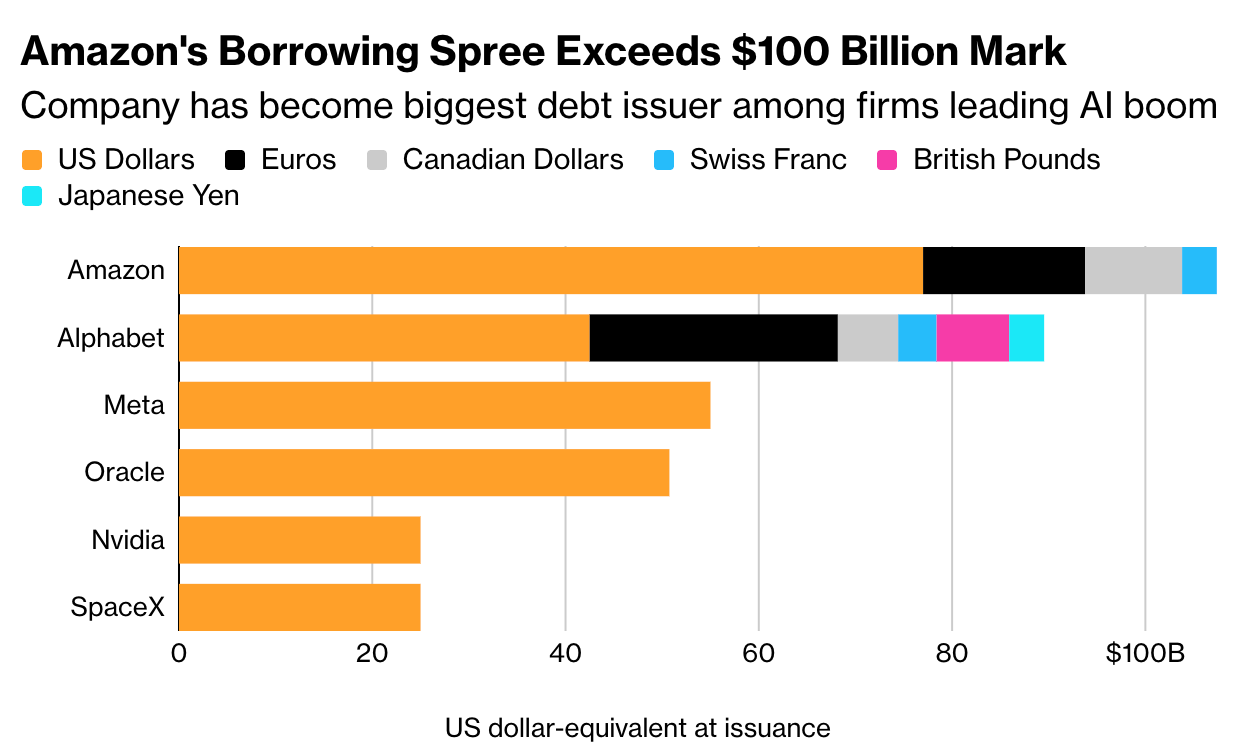
That’s why fights over data centers increasingly look more and more like debates over America’s economic future. Data centers sit upstream of everything from AI models and cloud computing to advanced manufacturing and robotics, while demand for transformers, electrical equipment, and power infrastructure is already reshaping investment decisions across the economy. The United States learned the hard way what happens when critical industries drift overseas and China captures the supply chain. The question facing policymakers now is whether AI infrastructure becomes the next version of that story — or the foundation of America’s next industrial revival.
The South’s Economic Run
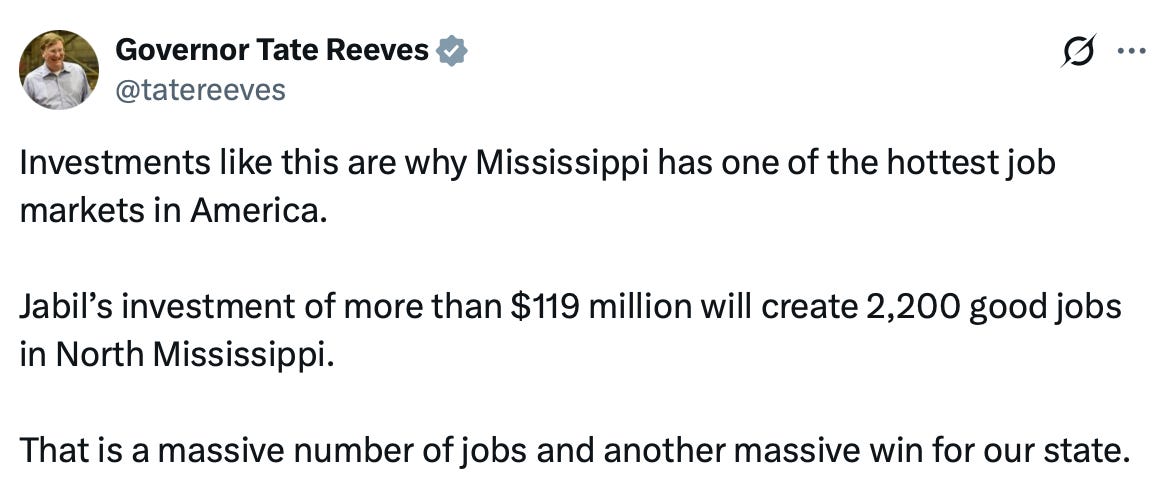
The manufacturing story in the South keeps getting bigger. Jabil just announced a $119 million expansion in Marshall County, Mississippi, adding roughly 2,200 jobs and turning a 1.5‑million‑square‑foot facility into a hub for data center infrastructure. The move comes less than a year after the company’s first Mississippi investment and plugs the state directly into one of the fastest‑growing pieces of the AI economy.
Texas is seeing the same story at an even bigger scale. Toyota plans to pour $3.6 billion into its San Antonio plant, add more than 2,000 jobs, and shift most Tacoma production from Mexico to the U.S., part of a broader $10 billion commitment to American manufacturing. Global firms are still voting with their feet — and they continue to choose southern states that can offer land, talent, infrastructure, and a political climate that still wants to build things. These projects are part of a bigger story we’ll dig into more soon: how Southern states are laying the groundwork for America’s next era of growth.
The Platner Problem
Democrats in Maine are getting a crash course in the risks of building a movement around a flawed, poorly vetted candidate. Graham Platner’s decision to suspend his campaign while insisting he was the victim of unnamed “large forces” keeps him as a live wire in the race even after stepping aside. Platner won a competitive primary, and some of those voters are likely to remain personally loyal to him, view the allegations as politically motivated, and refuse to transfer that support to whoever comes next. That leaves Democrats in a self-inflicted bind: the candidate they spent months promoting as the future of the party may still have enough influence to damage their chances after leaving the race.
Maine’s ranked-choice voting system and write-in rules give Democrats options, but the harder problem is replacing the voting bloc he assembled. For a party that has relied on anti-establishment energy to try and energize their base, the challenge is holding together a coalition that may no longer trust the party asking for its vote.
The Politics of Online Visibility
Florida is starting to turn media bias into a procurement fight, not just a talking point. The new state budget bars agencies from working with ad firms that rely on “misinformation” or “brand safety” scores from outfits like NewsGuard, Ad Fontes, or the Global Disinformation Index — systems conservative outlets argue quietly starve them of ad revenue while steering dollars toward left‑leaning brands.
The stakes are getting higher as more of the internet runs on AI and scoring systems instead of editors and ad reps. When AI search, recommendation feeds, and digital ad platforms lean on third‑party “trust” scores to decide what gets seen and what gets paid, those ratings effectively become digital infrastructure. Florida’s move (along with similar efforts in places like West Virginia and Washington) shows that lawmakers are starting to treat them that way, too.
The Return of Sea Power
Sea power is back at the center of geopolitics. The oceans are getting carved up and treated more like territory as China builds dominant shipyards, a huge merchant fleet, stakes in key ports, and claims on seabed minerals, while long‑range missiles and drones turn sea lanes and forward bases into contested zones instead of safe highways. The catch is that America still fields the strongest navy on paper but sits on top of a lean maritime economy, with thin commercial shipbuilding and shipyards that struggle just to keep its own fleet in shape.
The emerging view is that the answer isn’t just more destroyers; it’s a broader sea‑power strategy that treats shipyards, commercial fleets, ports, seabed resources, and allied capacity as one connected system. Open seas are the operating system of Western power, and what the U.S. and its partners do next — continue to rebuild those industrial and commercial foundations or let them erode — will decide whether the world’s oceans stay open on Western terms or get slowly swallowed up by rivals like China.
Other Reading
Douglas Murray: Truth Is on Trial in the Charlie Kirk Assassination Case (The Free Press)
The End of Reading Is Here (The Atlantic)
The DSA’s Communist Turn (The Free Press)
SaaSpocalypse deferred (Financial Times)
Forget Wall Street. Elite Students Are Spending Their Summers on Startup Dreams. (The Wall Street Journal)
Turkey’s Erdogan gives NATO leaders handgun conundrum after summit (NBC News)