


This week's Imperium Insights is tracking a series of reckonings — from California voters trying to break the state's progressive chokehold to leaked documents showing China testing AI that hunts down dissent before it happens. Here's what we're watching:
On Our Radar
California’s Political Reset
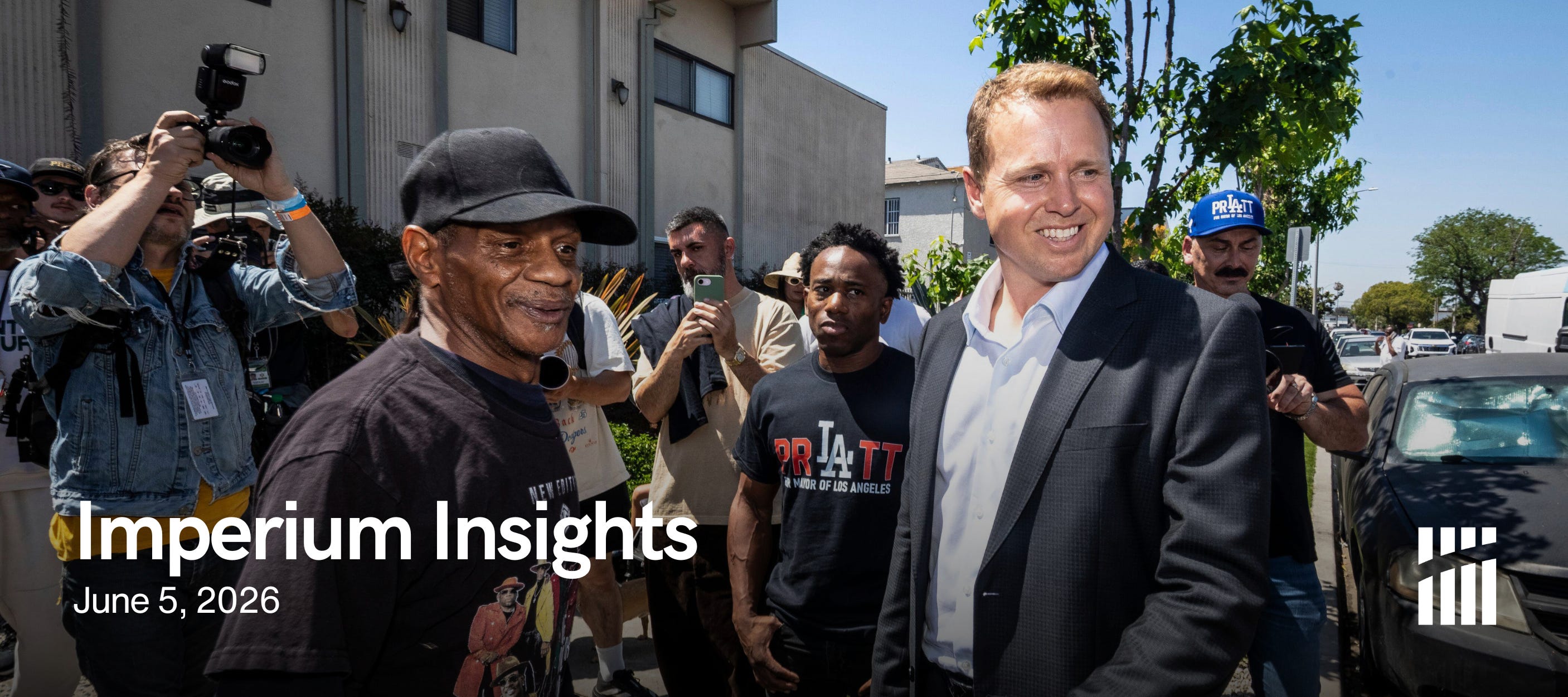
California’s primary this week showed just how fed up the electorate is with one‑party rule and the state’s long progressive experiment. Republican Steve Hilton is sitting at the top of the governor’s field, while Spencer Pratt could be headed to a runoff with Karen Bass in Los Angeles. Voters across the political spectrum are signaling they’re done with homeless encampments, petty crime, failing schools, and an LA that feels like a hollowed-out version of the place they grew up in.
Pratt in particular is showing how an online‑native campaign can cut through to voters by refusing to pull punches and talking directly about what’s not working in America’s second-largest city. Final tallies are still coming in, but early results suggest the coalition that has kept California on its progressive path is starting to crack.
America’s Split Screen
America is living through a paradox: people are wealthier, safer, and more technologically advanced than at almost any point in history, but trust in institutions and optimism about the future keep sliding. One way to understand that gap is as the snowball effect of a three‑part shock over the past two decades: social media rewiring public life, COVID severing real‑world community ties, and algorithmic media pushing people even deeper into fragmented realities where nobody agrees on what’s true anymore.
The antidote might be logging off and putting down roots in the inconvenient real world — city halls, school boards, church committees, and the local places that give people a sense of purpose and place in the midst of a whiplash-inducing technology revolution.
Marilyn Monroe at 100
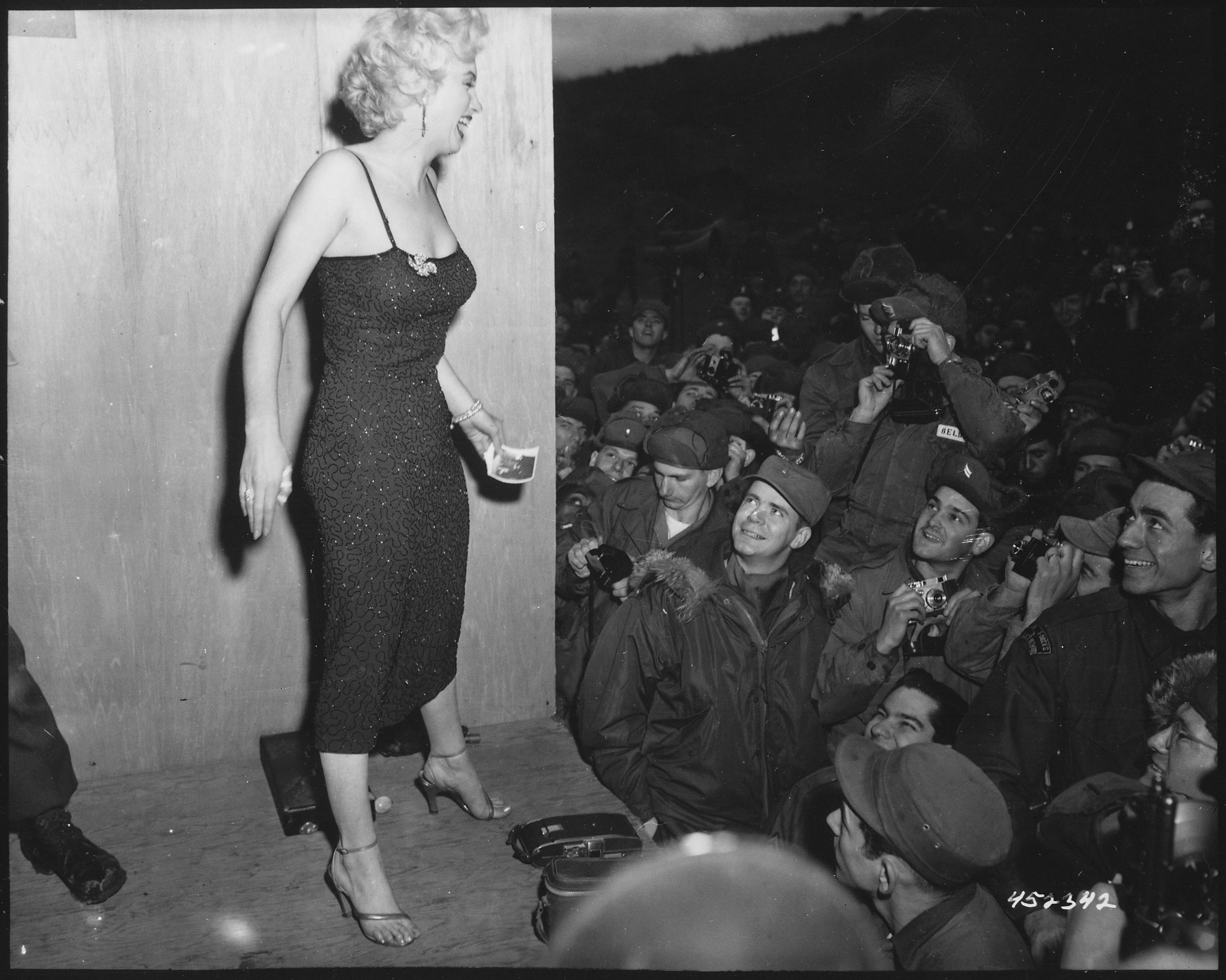
Marilyn Monroe would have turned 100 this week, and American culture has now spent nearly three times longer mythologizing her than it ever did knowing her. A new Heritage Auction sale marking the anniversary is focused on items that shed more light on her rocky final years: letters from Arthur Miller, notes from her psychiatrist, watercolor sketches, and handwritten journal entries on loneliness and depression.
The sale is also a reminder of how firmly Monroe is lodged in the American imagination decades after her death. In a media environment that’s always repackaging icons for a sequel, fame doesn’t really end so much as change form, and Monroe is a prime example of a life story now running on a permanent loop.
AI Agents Enter Wall Street
Morgan Stanley is about to let outside AI agents plug directly into one of the biggest wealth-management engines in the world, starting with its stock-plan administration business. Instead of just using AI behind the scenes, the bank will expose parts of its systems so corporate clients’ AI tools can help manage increasingly complex employee stock plans without increasing headcount.
Executives say these agents will be able to handle tasks like answering employee questions, processing routine transactions, and navigating intricate vesting and tax rules on behalf of clients’ workforces. The move puts Morgan Stanley out ahead of the pack, with firms like JPMorgan Chase and Goldman Sachs still keeping similar AI agents sealed inside internal sandboxes instead of letting outside systems plug straight into their platforms.
Illiteracy at the Ivy League
An Ivy League professor sparked a wave of debate this week by writing about how little elite college students now know about religion. Gregory Conti, a politics professor at Princeton, described students who didn’t know the Ten Commandments, couldn’t explain the difference between the Old and New Testaments, and completely missed biblical references in Shakespeare and Lincoln. His worry is that students are losing the basic reference points needed to understand core parts of Western civilization.
Top American universities are still churning out highly credentialed graduates, but they seem to be getting worse at passing down a shared cultural vocabulary and set of values, even as students pay hundreds of thousands of dollars to study the humanities. Underneath all this is an awkward question for elite education: what student outcomes, exactly, should it be trying to optimize for?
The Future of Digital Authoritarianism
A New York Times investigation this week spotlighted research from Vanderbilt's Institute of National Security, an Imperium client, looking at how a Chinese surveillance company is trying to use artificial intelligence to predict political dissent before it happens. The leaked documents show the firm testing systems that merge location data, telecom records, social media activity, and online habits into behavioral profiles to guess who might become a political risk. The idea is to use AI to flag “harmful” intent before anyone actually does or says anything.
The documents also suggest that U.S. chip controls are forcing China to fall back on older, weaker hardware, slowing its most ambitious predictive systems for now. If this kind of tech matures, it could end up bundled with China’s existing censorship and monitoring tools and sold to other authoritarian governments at odds with Washington.
Other Reading
Margot McCormack: Chef and Restaurateur (Nashville Banner)
Ivanka Trump on Building an Authentic Life (David Senra)
Anthropic Files to Go Public in Blockbuster Year for IPOs (The Wall Street Journal)
Even more crucial than winning, USMNT showcases its World Cup upside (The New York Times)
Apeel founder on MAHA, misinformation, layoffs, and a second act in post-harvest tech (AgFunder News)
First Principles Series: Don’t Ban Data Centers. Don’t Subsidize Them, Either. (Beacon Center of Tennessee)